Hair Thinning During Perimenopause: Causes to Check
A widening part, heavier shedding, and bare patches can point to different causes, even when they appear during perimenopause.
Perimenopause may be when you notice hair thinning, but timing alone can’t tell you why it’s happening. Gradual thinning over the crown can fit female pattern hair loss; increased shedding across the scalp or distinct patches call for a different assessment. Illness, medicines, nutrition, and thyroid problems are other possibilities. The pattern helps guide what to check and whether a treatment such as topical minoxidil is relevant. 145
Look at the pattern, not just the timing
If your hair seems different during perimenopause, it’s reasonable to wonder whether hormones are responsible. But hair loss has several possible causes, and starting around the same time as a menstrual change doesn’t identify yours. Notice where hair looks thinner and whether you’re seeing gradual thinning, more hairs coming out, or bare patches. Those differences can change the next step. 145
A part that gradually widens
Female pattern hair loss commonly causes thinning over the crown. You might first notice more scalp along your part, sometimes with greater thinning toward the front while the frontal hairline remains. This is a gradual change in hair density, rather than simply finding more loose hairs after washing. Genetic and hormonal factors are involved, but the pattern alone doesn’t tell you which factors apply to you. 45
Pattern thinning and diffuse shedding can overlap. A clinician may examine the scalp more closely to distinguish them. In a hospital-based study of people with various types of hair loss, trichoscopy, an examination using a magnifying device, changed an initial diagnosis of diffuse shedding to female pattern hair loss in three patients. That’s an illustration of why a closer look can matter, not a test you need to interpret yourself. 3
More hair coming out across the scalp
If the main change is increased shedding from all over, think back to changes in your health rather than assuming the cause is perimenopause. Illness, stress, some medicines, low protein intake, poor nutrition, and thyroid problems are among the possibilities. They aren’t all equally likely for every person, and the cause affects what treatment might help. 12
Patches or a changing scalp
Distinct patches point away from ordinary gradual crown thinning. Alopecia areata is one cause of patchy hair loss. A receding frontal hairline together with redness, scale, or loss of visible follicle openings can suggest a different, potentially scarring pattern. Arrange an assessment for patches or these scalp and hairline changes rather than trying to identify the cause from a cosmetic product. 56
What’s worth mentioning at an appointment
You don’t need to count every hair. A short account of what changed can help make the assessment more focused:
- Where and how: Is your part widening, is hair shedding across the scalp, or are there patches? Has your hairline changed? 35
- What happened beforehand: Note an illness, a period of major stress, or a change in eating around the time you noticed more shedding. 12
- Health and medicines: Mention known health conditions, particularly thyroid problems, and any medicines that started or changed. Ask whether a medicine could be relevant rather than stopping it on your own. 1
- Scalp and hair care: Point out redness or scale, and mention changes to styling or hair treatments. Hair-care practices and scalp findings can be useful parts of a hair-loss assessment. 36
Choose treatment for the cause
If an underlying illness or nutritional problem is contributing, addressing that problem may help the hair loss. Some types of shedding improve after recovery. Female pattern hair loss is different: topical minoxidil is an established treatment option, but it won’t identify the cause of sudden shedding or a bare patch. 124
Be cautious about buying a supplement solely because your hair started thinning in midlife. One observational study found lower zinc levels among Kurdish adults attending a dermatology clinic for hair loss than among controls. It did not test whether zinc supplements regrow hair. Whether a deficiency needs checking is a more useful question than which hair supplement to buy. 5
Hormone therapy is also not an established hair-loss treatment on this evidence. Menopause guidance discusses it for concerns such as bothersome hot flashes and prevention of bone loss, not as a way to prevent female pattern hair loss. 7
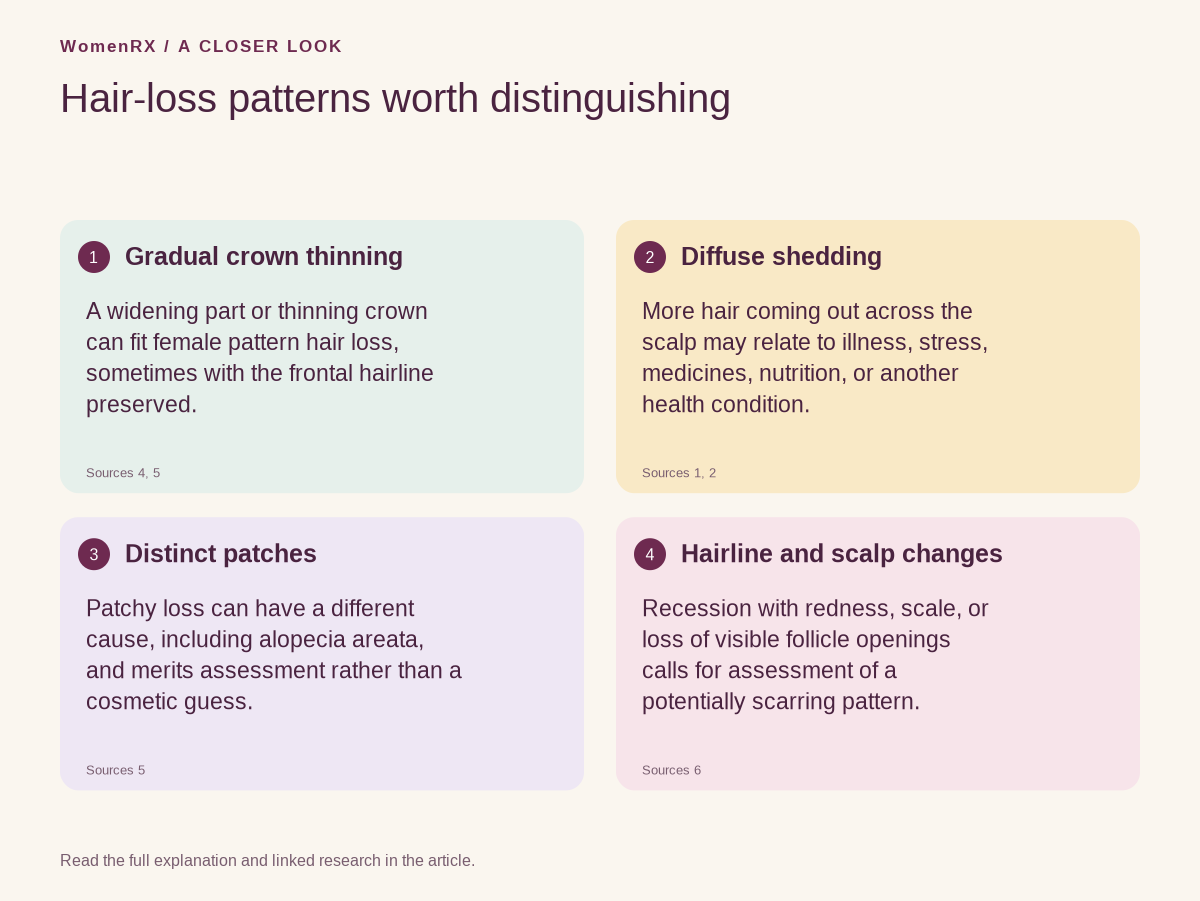
Hair-loss patterns worth distinguishing
Gradual crown thinning: A widening part or thinning crown can fit female pattern hair loss, sometimes with the frontal hairline preserved.45
Diffuse shedding: More hair coming out across the scalp may relate to illness, stress, medicines, nutrition, or another health condition.12
Distinct patches: Patchy loss can have a different cause, including alopecia areata, and merits assessment rather than a cosmetic guess.5
Hairline and scalp changes: Recession with redness, scale, or loss of visible follicle openings calls for assessment of a potentially scarring pattern.6
Read the figure as text
Where hair is changing, and whether the scalp is changing too, can help guide a more useful assessment.- Gradual crown thinning: A widening part or thinning crown can fit female pattern hair loss, sometimes with the frontal hairline preserved.45
- Diffuse shedding: More hair coming out across the scalp may relate to illness, stress, medicines, nutrition, or another health condition.12
- Distinct patches: Patchy loss can have a different cause, including alopecia areata, and merits assessment rather than a cosmetic guess.5
- Hairline and scalp changes: Recession with redness, scale, or loss of visible follicle openings calls for assessment of a potentially scarring pattern.6
More questions, answered
Does a widening part mean I have female pattern hair loss?
It fits a common pattern, especially if crown thinning has developed gradually, but it isn’t a diagnosis by itself. Increased shedding can overlap with pattern thinning, so a scalp examination may help tell them apart. 35
Sources you can check
- Hair Loss | Alopecia | Alopecia Areata | MedlinePlusAccessed 2026-09-25Return to first citation
- Hair loss - NHSAccessed 2026-09-25Return to first citation
- Diagnostic Yield and Clinical Impact of Trichoscopy in Alopecia: A Cross-Sectional Study From a Rural Tertiary Care Centre.Jagalur H, Devaraj Y, Swaroop MR, Gurudev S, Nagaraj LG, Chauwan RS, S A, Thakur A. · Cureus · 2026Return to first citation
- Androgenetic Alopecia in Women: A Narrative Review of Pathophysiology, Clinical Evaluation, and Treatments.Kearney CA, Brinks AL, Lawrence CN, Maas DE, Spindler AJ, Coric C, Gener-Pangilinan LA, Lasheras-Pérez MA, Shapiro J, Lo Sicco KI. · American journal of clinical dermatology · 2026Return to first citation
- Zinc Status in Kurdish Adults With Hair Loss.Mahmoud H, Saifdeen PM, Al-Timimi D, Saeed SA. · Cureus · 2024Return to first citation
- Recent Advances in Understanding of the Etiopathogenesis, Diagnosis, and Management of Hair Loss Diseases.Kinoshita-Ise M, Fukuyama M, Ohyama M. · Journal of clinical medicine · 2023Return to first citation
- The 2022 hormone therapy position statement of The North American Menopause Society.“The 2022 Hormone Therapy Position Statement of The North American Menopause Society” Advisory Panel. · Menopause (New York, N.Y.) · 2022Return to first citation