Hair Thinning Around Menopause: What the Pattern Can Tell You
Hormonal changes can affect hair, but a widening part, widespread shedding, and a bare patch call for different questions.
Hair may change in density or texture during perimenopause and after menopause, but the timing doesn’t identify the cause. Gradual thinning around the part can fit female pattern hair loss; diffuse shedding can fit chronic telogen effluvium, which may overlap with pattern loss. A distinct bare patch is different from both. Illness, medicines, thyroid problems, nutrition, and family history also belong in the picture. 1 3 4
What changes between perimenopause and after menopause?
During perimenopause, hormone levels fluctuate. After menopause, ovarian estrogen production has ended. Hair follicles are sensitive to these changes, and a 2025 review describes possible changes in hair density, strand thickness, and texture across this transition. It also notes that several hair disorders have been reported more often after menopause. That doesn’t mean a change you notice at either stage is necessarily caused by hormones. 4
Hair-loss patterns can offer clues, but these patterns aren’t specific to menopause; timing alone doesn’t establish the cause. A better first question is: Are you seeing a slowly widening part, more hairs shedding across your scalp, or a distinct area with little or no hair? Those descriptions point toward different possibilities, though they aren’t diagnoses you can make from a mirror. 1 3 4
A widening part is different from widespread shedding
Gradual thinning around the part or crown can fit female pattern hair loss. Hair density slowly decreases over the top of the scalp, making the part wider or the scalp more visible. Family history can be a useful clue, but the appearance needs to be considered alongside the rest of your history. 1 3
Diffuse shedding across the scalp can fit chronic telogen effluvium (CTE). It may be hard to distinguish from early female pattern hair loss, and both can happen together. Someone who already has a widening part, for example, might also notice increased shedding. The amount of hair coming out in the shower doesn’t, by itself, settle which process is happening. 3
A distinct bare patch is unlike the gradual thinning typical of female pattern hair loss or the diffuse shedding described for chronic telogen effluvium. Patchy hair loss has other possible explanations. Menopause timing alone doesn’t identify its cause; if you’re worried about the hair loss, a clinician may be able to assess it by looking at your hair and scalp. 1 2 3
What else might explain the change?
Menopause timing is one clue among several. Thyroid problems and other illnesses, certain medicines, chemotherapy, stress, low protein intake, and poor nutrition can also be associated with hair loss. Family history matters too. None of these possibilities can be confirmed simply because they happened around the time your hair changed. 1
It helps to connect the pattern to your timeline. For example, you might describe a part that has widened gradually, or shedding that began after a period of illness. Note whether you’ve seen a bare patch or changes to the scalp, and mention medicines you take or recently started, changes in eating, and hair loss in your family. These details give a clinician more to work with than “my hair got thinner at menopause.” 1 3
A clinician may be able to recognize a pattern by examining your hair and scalp. 2 Closer examination with a tool called trichoscopy can help distinguish female pattern hair loss from chronic telogen effluvium, but it supports rather than replaces a clinical assessment. 3
Why the distinction affects what you do next
Treatment depends on the cause. Addressing an underlying medical condition may help hair loss linked to that condition; minoxidil is one treatment used for female pattern hair loss. Neither point means a supplement, hormone therapy, or a single hair treatment will work for every kind of thinning. Getting the pattern right is a more useful starting point than treating all midlife hair changes as the same problem. 1 2
Hair loss can be upsetting even when it isn’t a sign of serious illness. If it’s affecting how you feel, that’s a worthwhile part of the conversation, along with what you’ve noticed on your scalp. 2
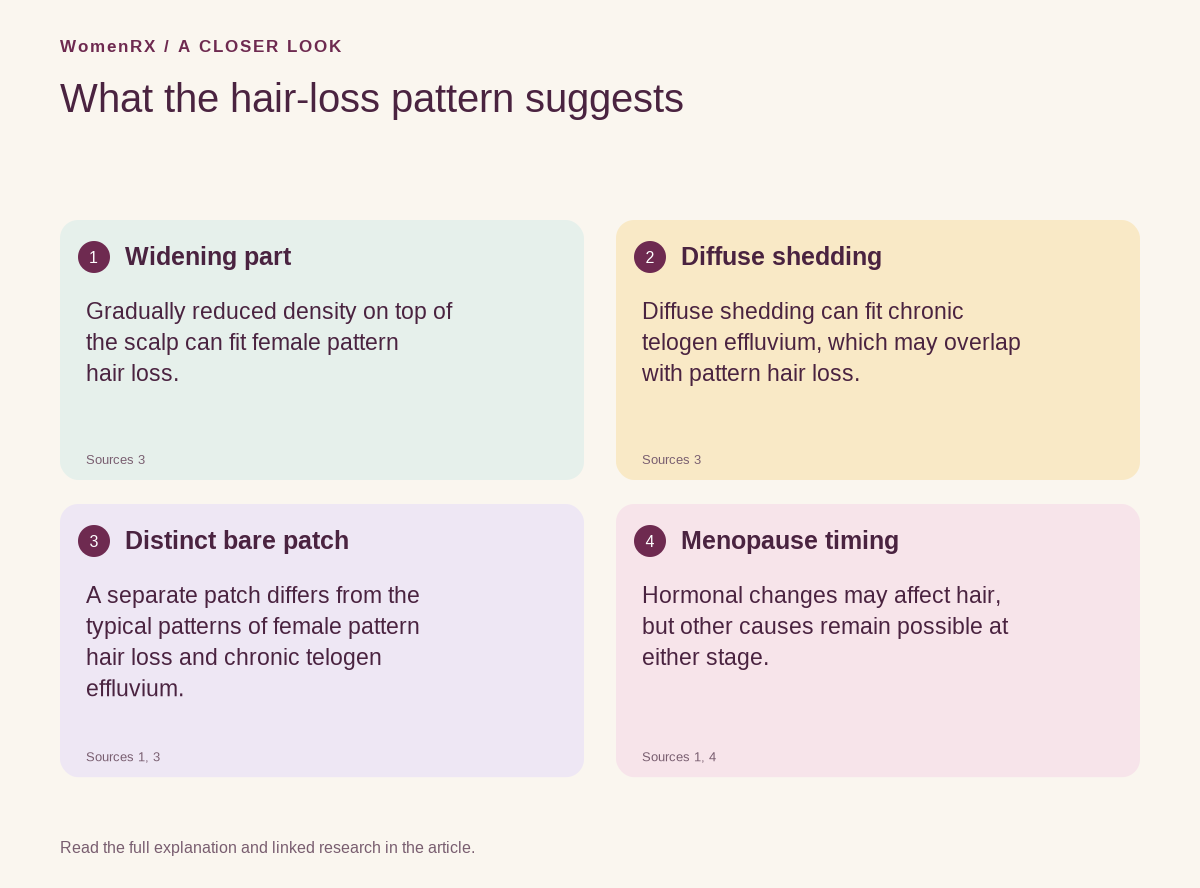
What the hair-loss pattern suggests
Widening part: Gradually reduced density on top of the scalp can fit female pattern hair loss.3
Diffuse shedding: Diffuse shedding can fit chronic telogen effluvium, which may overlap with pattern hair loss.3
Distinct bare patch: A separate patch differs from the typical patterns of female pattern hair loss and chronic telogen effluvium.13
Menopause timing: Hormonal changes may affect hair, but other causes remain possible at either stage.14
Read the figure as text
Compare what you see on your scalp; menopause timing gives context but cannot identify the cause.- Widening part: Gradually reduced density on top of the scalp can fit female pattern hair loss.3
- Diffuse shedding: Diffuse shedding can fit chronic telogen effluvium, which may overlap with pattern hair loss.3
- Distinct bare patch: A separate patch differs from the typical patterns of female pattern hair loss and chronic telogen effluvium.13
- Menopause timing: Hormonal changes may affect hair, but other causes remain possible at either stage.14
Sources you can check
- Hair Loss | Alopecia | Alopecia Areata | MedlinePlusAccessed 2026-09-25Return to first citation
- Hair loss - NHSAccessed 2026-09-25Return to first citation
- Trichoscopic Features, Clinical Correlates, and Risk Prediction in Female Pattern Hair Loss: A Retrospective Case-Control Study.Long B, Long Q, Pan W, Chen S, Ye Z, Guo H. · Clinical, cosmetic and investigational dermatology · 2026Return to first citation
- Menopause and hair loss in women: Exploring the hormonal transition.Gupta AK, Economopoulos V, Mann A, Wang T, Mirmirani P. · Maturitas · 2025Return to first citation