Perimenopause and Hair Thinning: What the Pattern Can Tell You
Hair changes can coincide with perimenopause, but where and how your hair is thinning may offer better clues than the timing alone.
Hair thinning during perimenopause may be female pattern hair loss, widespread shedding, or another hair or scalp condition. The timing alone can’t tell you which. A gradually widening part differs from hair coming out across the scalp, though the two can overlap. Notice where the change is happening, how quickly it developed, and whether your scalp has changed too. 2 3
It’s reasonable to wonder about hormones when your hair changes around the same time as your periods. But perimenopause isn’t a diagnosis for hair loss. Different conditions can look similar early on, and more than one can be happening at once. The pattern and pace give you a better place to start. 2 3
Is your part widening, or are you shedding all over?
Gradual pattern thinning often shows up as a widening part or less density over the crown. Female pattern hair loss usually develops gradually and doesn’t scar the scalp. You might also notice more shedding before a clear pattern appears, so finding hair in your brush doesn’t rule it out. 3
Diffuse shedding means hair seems to be coming out from across the scalp, rather than thinning mainly in one area. Chronic telogen effluvium is one possible explanation. It can be hard to distinguish from early female pattern hair loss, and the two may coexist. Illness can also be associated with temporary hair loss. 1 3
Loss near the temples deserves its own look. Possible explanations include pattern hair loss, shedding, repeated pulling from hairstyles, and scarring conditions. The location alone won’t identify the cause. Recognizing a scarring condition promptly matters because hair loss from it can be permanent. 4
Details worth noticing before an evaluation
You don’t need to count every hair. These details can help describe what’s changed:
- Timing and pace: When did you first notice the change? Has your part widened gradually, or did you begin noticing much more shedding?
- Location: Is the change most visible along the part, over the crown, at the temples, in patches, or across the scalp?
- Recent illness: Note whether you’ve been ill, since illness is one possible contributor to temporary hair loss. 1
- Scalp and hair practices: Mention visible changes such as scaling, as well as hairstyles that repeatedly pull at the hair. Scaling doesn’t identify a cause on its own, but scalp findings and hair practices are relevant to an examination. 2 3 4
- Medicines and supplements: Bring an up-to-date list and mention recent changes. A medication history is part of a hair-loss assessment; a change in your routine isn’t proof that a medicine caused the loss. 2
Looking at your hair and scalp may help a clinician narrow down the possibilities. Tests, when needed, can be guided by what the examination suggests. For example, one clinical study used a blood count and ferritin testing for suspected telogen effluvium, and thyroid testing when diffuse hair loss came with features suggesting an endocrine cause. That’s an example of targeted testing, not a standard panel everyone needs. 1 2
Why finding the cause changes the next step
If the change is female pattern hair loss, minoxidil is one treatment option. If hair loss is linked to an illness, it may improve after recovery. Those are different situations, and no treatment works for every type of hair loss. 1
If your loss is patchy, changing quickly, or affecting your scalp, don’t assume it’s simply part of perimenopause. An assessment is also worthwhile if the thinning is progressing or upsetting you. Describing the pattern gives that conversation a more useful starting point than the timing alone. 1 2 4
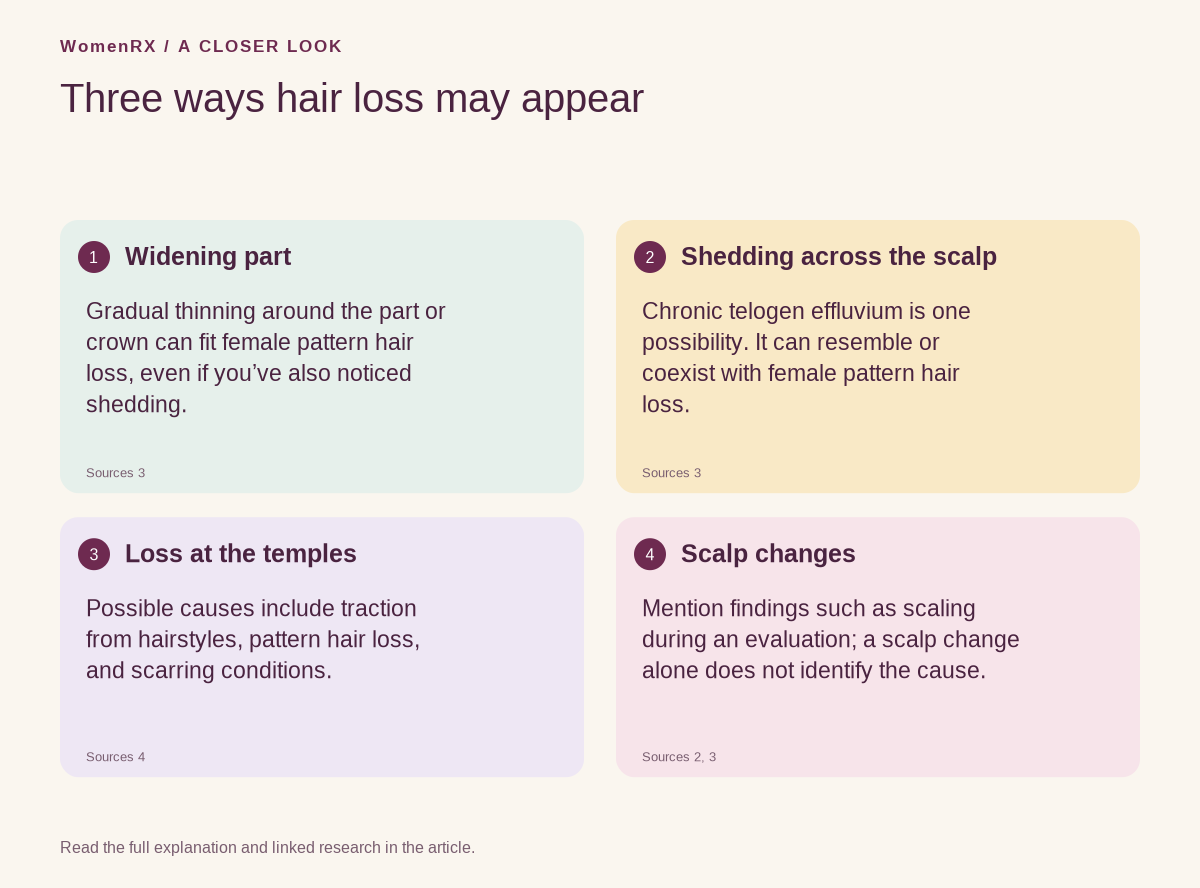
Three ways hair loss may appear
Widening part: Gradual thinning around the part or crown can fit female pattern hair loss, even if you’ve also noticed shedding.3
Shedding across the scalp: Chronic telogen effluvium is one possibility. It can resemble or coexist with female pattern hair loss.3
Loss at the temples: Possible causes include traction from hairstyles, pattern hair loss, and scarring conditions.4
Scalp changes: Mention findings such as scaling during an evaluation; a scalp change alone does not identify the cause.23
Read the figure as text
Where the change appears can help you describe it, but appearance alone cannot confirm the cause.- Widening part: Gradual thinning around the part or crown can fit female pattern hair loss, even if you’ve also noticed shedding.3
- Shedding across the scalp: Chronic telogen effluvium is one possibility. It can resemble or coexist with female pattern hair loss.3
- Loss at the temples: Possible causes include traction from hairstyles, pattern hair loss, and scarring conditions.4
- Scalp changes: Mention findings such as scaling during an evaluation; a scalp change alone does not identify the cause.23
Sources you can check
- Hair loss - NHSAccessed 2026-09-25Return to first citation
- Diagnostic Yield and Clinical Impact of Trichoscopy in Alopecia: A Cross-Sectional Study From a Rural Tertiary Care Centre.Jagalur H, Devaraj Y, Swaroop MR, Gurudev S, Nagaraj LG, Chauwan RS, S A, Thakur A. · Cureus · 2026Return to first citation
- Trichoscopic Features, Clinical Correlates, and Risk Prediction in Female Pattern Hair Loss: A Retrospective Case-Control Study.Long B, Long Q, Pan W, Chen S, Ye Z, Guo H. · Clinical, cosmetic and investigational dermatology · 2026Return to first citation
- Bitemporal Scalp Hair Loss: Differential Diagnosis of Nonscarring and Scarring Conditions.De Souza B, Tovar-Garza A, Uwakwe LN, McMichael A. · The Journal of clinical and aesthetic dermatology · 2021Return to first citation