Perimenopause Hair Thinning: How Long Can It Last?
Gradual patterned thinning and diffuse shedding can have different courses, so when hair loss starts matters less than how it appears.
How long thinning lasts depends on the type of hair loss, not just when it begins. Female pattern hair loss can progress over time, while chronic telogen effluvium, a form of diffuse shedding, is described as self-limiting. Timing alone can’t identify the cause or predict your individual course. The pattern and possible triggers offer more useful clues. 3 5
Start with the pattern, not the calendar
Hair changes can appear in midlife, but timing by itself doesn’t tell you whether they’re due to perimenopause. Female pattern hair loss is usually gradual and progressive. In women, thinning often shows most over the crown or central part, while the frontal hairline is largely preserved. Hair may become finer as follicles produce smaller strands. 5 6
How long might it last?
The course depends on what’s causing the hair loss. Female pattern hair loss tends to progress over time, whereas chronic telogen effluvium, a type of diffuse shedding, is described as self-limiting. That contrast can help frame expectations, but the date thinning began doesn’t predict its course for an individual. 5
By contrast, telogen effluvium often causes a noticeable increase in shedding across the scalp. It can follow physical stressors such as illness, surgery, childbirth, or rapid weight loss, or a medication change. The shedding may begin around three months after a trigger, so think back beyond the week you first noticed more hair in the brush. 3
The distinction isn’t always obvious. Chronic telogen effluvium and female pattern hair loss can look similar or occur together, and extra shedding can come before a clear pattern develops. Family history may be a useful clue, but it can’t diagnose the cause on its own. 5
What an assessment can sort out
A useful evaluation starts with the timeline and a look at the scalp. A clinician may ask whether loss began suddenly or gradually; whether it’s diffuse, patchy, or most visible along the part; and whether anything changed in the months beforehand. Illness, childbirth, surgery, medication changes, and rapid weight loss are relevant history for diffuse shedding. 2 3
The scalp exam helps distinguish patterned thinning from diffuse shedding, focal loss such as alopecia areata, or signs of inflammation and scarring. A dermatologist may use trichoscopy, a magnified view of the scalp and hairs, to look for features that support one pattern over another. It’s an aid to diagnosis, not a stand-alone answer. If the cause remains unclear, or scarring is suspected, further evaluation may be considered. 2 4 5
Tests should match the clues
Blood tests aren’t automatically needed for every person with thinning hair. Depending on the history and exam, testing may include a blood count, iron studies such as ferritin, or thyroid-stimulating hormone (TSH). These can help check for contributors to diffuse shedding, including iron deficiency or thyroid problems. Other tests are considered when the clinical picture points toward them, rather than as a one-size-fits-all panel. 2 3 4
If your thinning is gradual and patterned, ask whether female pattern hair loss fits what the clinician sees. If it does, minoxidil is one treatment used for this type of hair loss. Treatment choices depend on the diagnosis; a treatment intended for patterned thinning may not address a separate trigger for shedding. 1 2
When not to assume it’s menopause
Sudden or patchy loss, or signs of scalp inflammation or scarring, may call for assessment of a cause other than female pattern hair loss. Steadily worsening thinning along the part or crown is different: progression can fit female pattern hair loss. You can seek an assessment for that, too, or whenever the change worries you. Hair loss can affect well-being, and that deserves to be part of the conversation. 1 2 5
The practical takeaway: note whether you’re seeing gradual thinning, increased shedding, or both, and consider relevant changes from the preceding months. That gives an assessment a better starting point than attributing the change to perimenopause by default.
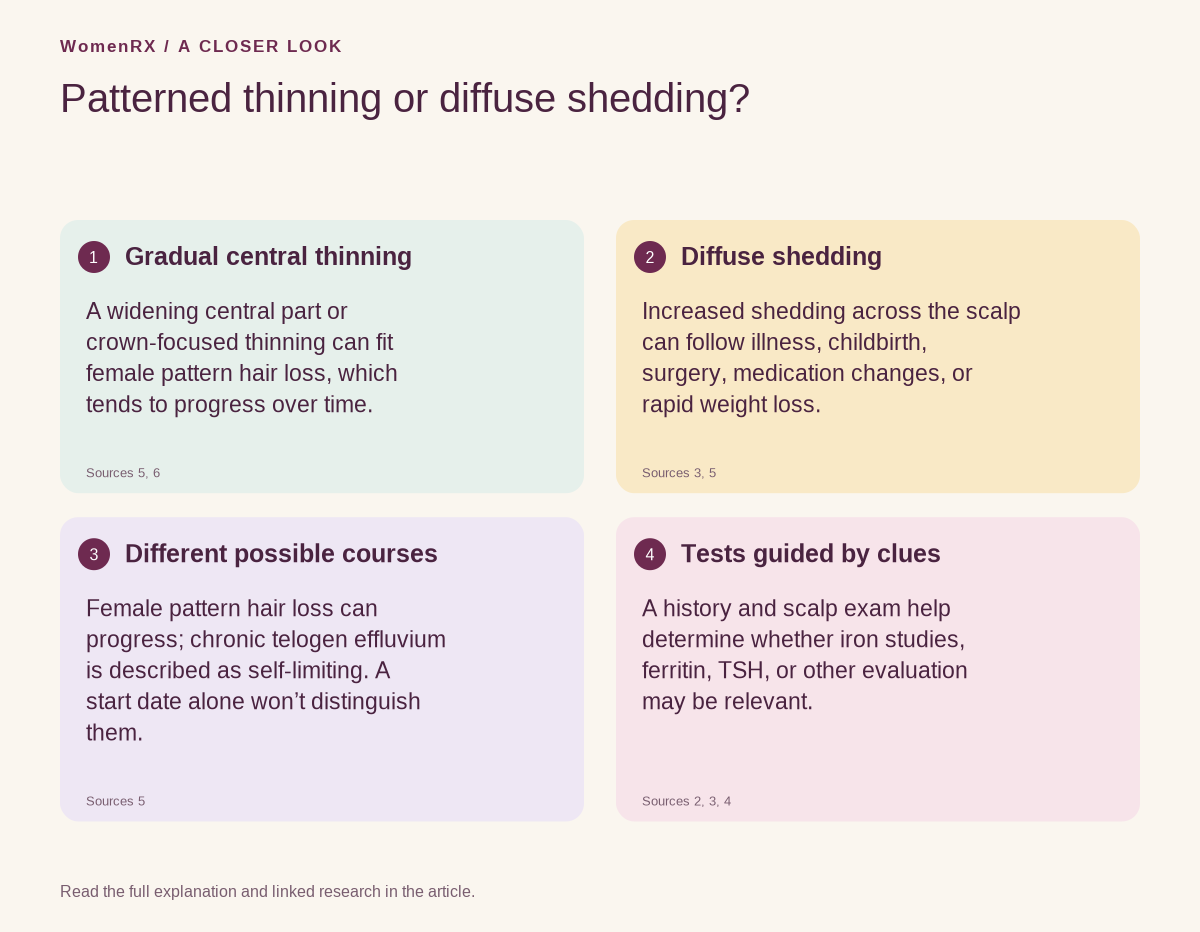
Patterned thinning or diffuse shedding?
Gradual central thinning: A widening central part or crown-focused thinning can fit female pattern hair loss, which tends to progress over time.56
Diffuse shedding: Increased shedding across the scalp can follow illness, childbirth, surgery, medication changes, or rapid weight loss.35
Different possible courses: Female pattern hair loss can progress; chronic telogen effluvium is described as self-limiting. A start date alone won’t distinguish them.5
Tests guided by clues: A history and scalp exam help determine whether iron studies, ferritin, TSH, or other evaluation may be relevant.234
Read the figure as text
The location and pace of hair loss can help frame its possible course and which causes to consider, though a pattern alone isn’t a diagnosis.- Gradual central thinning: A widening central part or crown-focused thinning can fit female pattern hair loss, which tends to progress over time.56
- Diffuse shedding: Increased shedding across the scalp can follow illness, childbirth, surgery, medication changes, or rapid weight loss.35
- Different possible courses: Female pattern hair loss can progress; chronic telogen effluvium is described as self-limiting. A start date alone won’t distinguish them.5
- Tests guided by clues: A history and scalp exam help determine whether iron studies, ferritin, TSH, or other evaluation may be relevant.234
More questions, answered
Does perimenopause cause female pattern hair loss?
A change that starts during perimenopause isn’t proof that menopause caused it. Female pattern hair loss has a gradual, often central or crown-focused pattern, while diffuse shedding can have other triggers. The pattern and history help guide an assessment. 3 5
Can the timing of hair thinning tell me how long it will last?
Not on its own. Female pattern hair loss can progress, while chronic telogen effluvium is described as self-limiting. Those different courses make identifying the type of hair loss more useful than relying on when you first noticed it. 5
Will I need ferritin and thyroid tests?
Not necessarily. Ferritin or other iron studies and TSH may be considered when the history or exam suggests diffuse shedding or a possible iron or thyroid contributor. Testing is best selected to fit the pattern and other findings. 2 3 4
Sources you can check
- Hair loss - NHSAccessed 2026-09-25Return to first citation
- Hair loss: A systematic approach to evaluation, diagnosis, and management.Walker CW, Champigny D, Hartman T, Hulsey B, Hoffart C. · JAAPA : official journal of the American Academy of Physician Assistants · 2026Return to first citation
- Revisiting Diffuse Unpatterned Alopecia: Reappraisal of a Controversial Diagnosis.Spindler A, Maas D, Zappi I, Roa GG, Rubin AI, Moshiri AS, Flamm A, Occidental MA, Washenik K, Avram M, Seykora JT, Elston DM, Shapiro J, Lo Sicco KI. · Skin appendage disorders · 2026Return to first citation
- Diagnostic Yield and Clinical Impact of Trichoscopy in Alopecia: A Cross-Sectional Study From a Rural Tertiary Care Centre.Jagalur H, Devaraj Y, Swaroop MR, Gurudev S, Nagaraj LG, Chauwan RS, S A, Thakur A. · Cureus · 2026Return to first citation
- Trichoscopic Features, Clinical Correlates, and Risk Prediction in Female Pattern Hair Loss: A Retrospective Case-Control Study.Long B, Long Q, Pan W, Chen S, Ye Z, Guo H. · Clinical, cosmetic and investigational dermatology · 2026Return to first citation
- Comparative Efficacy of Topical Minoxidil Alone Against Combination of Topical Minoxidil and Platelet Rich Plasma in Women with Female Pattern Hair Loss-A Pilot, Open Randomised Trial.Agarwal A, Mendiratta V. · Indian journal of dermatology · 2023Return to first citation