Hair Thinning in Perimenopause: What Patterns and Causes to Check
The shape and pace of hair loss can offer clues, but thinning that starts during perimenopause isn’t automatically caused by it.
Hair thinning can happen in midlife, but its timing alone can’t show that perimenopause caused it. Gradual thinning in a recognizable pattern differs from hair shedding across the scalp or distinct bare patches. Recent illness, family history, medicines, and scalp changes are useful context to share. Sudden or patchy loss, or a red or scaly scalp, deserves assessment. 1 3 4 5

Look at the pattern, not just the amount
Hair loss can look similar at first but have different causes. A clinician may be able to narrow things down by examining your hair and scalp; a dermatologist can also use magnification to look closely at individual hairs and follicles. 1 2
Gradual, concentrated thinning may fit female pattern hair loss, in which hair follicles become progressively smaller. The pattern and personal history matter; a change that becomes more noticeable during perimenopause isn’t proof that the transition caused it. 3
Shedding across much of the scalp is a different clue from thinning concentrated in one area. Illness can be associated with temporary hair loss, but diffuse loss can also have other explanations. Alopecia areata, for example, usually causes round patches but can sometimes appear as sudden, diffuse loss. 1 4 6
Distinct bare patches warrant assessment rather than an assumption that this is ordinary midlife thinning. Alopecia areata is one possible cause; a clinician can distinguish it from other conditions. 4 6
Scalp redness or scaling, or areas where follicle openings seem to be disappearing, are also worth having examined. In a small retrospective study of 24 women with a scarring condition that can cause patterned hair loss, redness or scaling around follicles and loss of follicle openings were common findings. That study doesn’t mean these signs identify one condition on their own, but they’re a reason not to rely on appearance alone. 5
What to include in the history
Note when you first noticed the change and whether it has been gradual, sudden, or occurring in episodes. If you can, describe whether you see overall shedding, thinning in a particular area, or separate patches. These observations help explain the pattern; they don’t diagnose its cause.
Mention recent illnesses and any family history of hair loss. Illness can be linked to temporary hair loss, and female pattern hair loss often runs in families. 1 Bring a list of medicines and any recent changes so the clinician can consider them alongside the rest of your history; don’t stop a medicine on your own based only on hair changes.
When to have it checked
Arrange an assessment if the loss is sudden, patchy, continuing to progress, or accompanied by scalp redness or scaling. You can also seek help simply because the change worries you. Examination matters because diffuse loss, patterned thinning, and scalp conditions don’t all call for the same explanation or approach. 1 2 4 5
If the pattern does turn out to be female pattern hair loss, treatments exist, but the right discussion depends on the diagnosis. Topical minoxidil is identified in a recent review as an FDA-approved treatment for this condition; it won’t address every cause of hair loss. 3
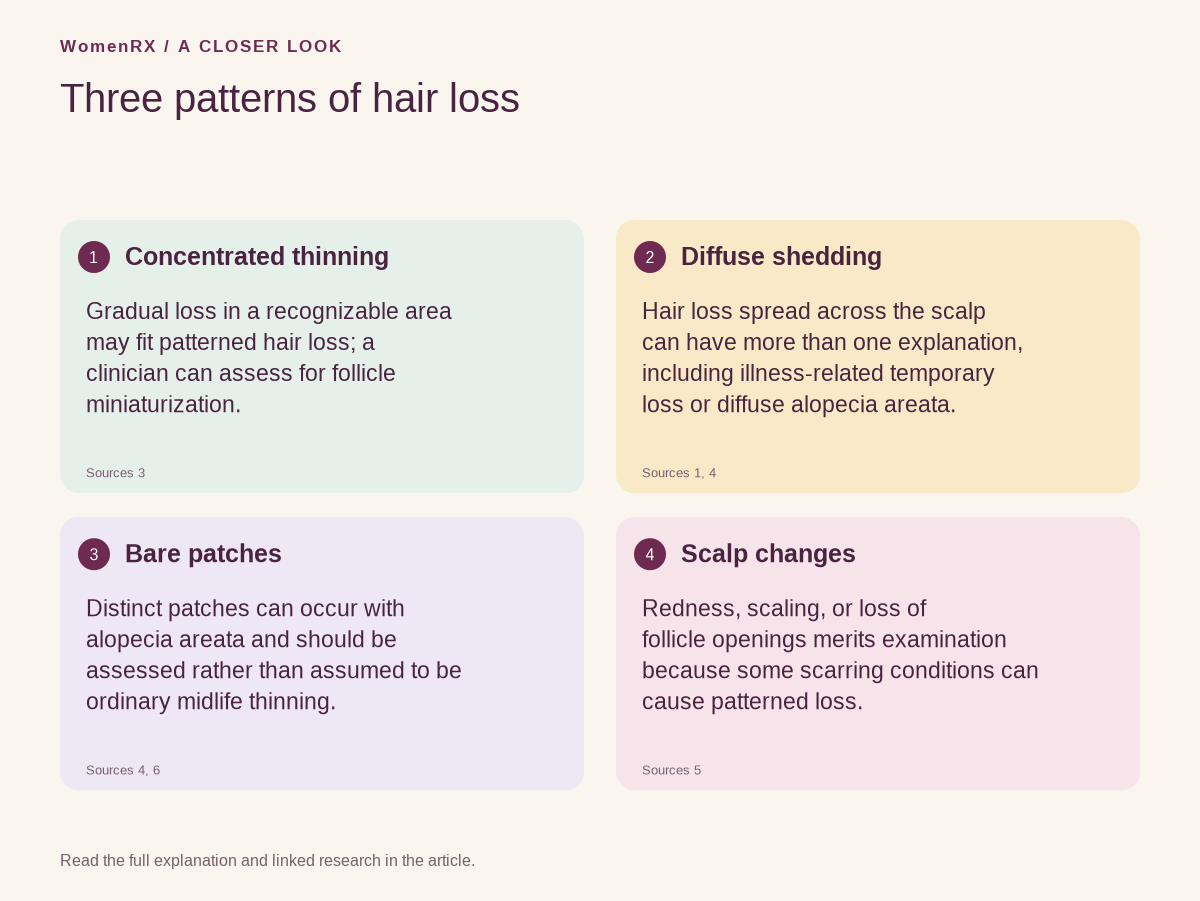
Three patterns of hair loss
Concentrated thinning: Gradual loss in a recognizable area may fit patterned hair loss; a clinician can assess for follicle miniaturization.3
Diffuse shedding: Hair loss spread across the scalp can have more than one explanation, including illness-related temporary loss or diffuse alopecia areata.14
Bare patches: Distinct patches can occur with alopecia areata and should be assessed rather than assumed to be ordinary midlife thinning.46
Scalp changes: Redness, scaling, or loss of follicle openings merits examination because some scarring conditions can cause patterned loss.5
Read the figure as text
The pattern can help guide an assessment, but it cannot confirm the cause by itself.- Concentrated thinning: Gradual loss in a recognizable area may fit patterned hair loss; a clinician can assess for follicle miniaturization.3
- Diffuse shedding: Hair loss spread across the scalp can have more than one explanation, including illness-related temporary loss or diffuse alopecia areata.14
- Bare patches: Distinct patches can occur with alopecia areata and should be assessed rather than assumed to be ordinary midlife thinning.46
- Scalp changes: Redness, scaling, or loss of follicle openings merits examination because some scarring conditions can cause patterned loss.5
More questions, answered
Does hair thinning during perimenopause mean I have female pattern hair loss?
No. Timing alone doesn’t establish the cause. Patterned thinning is one possibility, but diffuse shedding and patchy loss can have different explanations, so the hair pattern and scalp examination matter. 3 4
Sources you can check
- Hair loss - NHSAccessed 2026-09-25Return to first citation
- Trichoscopic Diagnosis of Structural Hair Defects in a Clinical Setting: A Cross-Sectional Analytical Study.Abdel Hay R, Sayed KS, Mostafa WZ, Afifi HA, Gad LZ, El-Samanoudy SI. · Skin pharmacology and physiology · 2023Return to first citation
- Androgenetic Alopecia in Women: A Narrative Review of Pathophysiology, Clinical Evaluation, and Treatments.Kearney CA, Brinks AL, Lawrence CN, Maas DE, Spindler AJ, Coric C, Gener-Pangilinan LA, Lasheras-Pérez MA, Shapiro J, Lo Sicco KI. · American journal of clinical dermatology · 2026Return to first citation
- Alopecia Areata Incognita and Diffuse Alopecia Areata: Clinical, Trichoscopic, Histopathological, and Therapeutic Features of a 5-Year Study.Alessandrini A, Starace M, Bruni F, Brandi N, Baraldi C, Misciali C, Fanti PA, Piraccini BM. · Dermatology practical & conceptual · 2019Return to first citation
- Clinicopathological characteristics and treatment outcomes of fibrosing alopecia in a pattern distribution: A retrospective cohort study.Jerjen R, Pinczewski J, Sinclair R, Bhoyrul B. · Journal of the European Academy of Dermatology and Venereology : JEADV · 2021Return to first citation
- The comparison of therapeutic effect of Clobetasol propionate lotion and squill extract in alopecia areata: a randomized, double-blind clinical trial.Moosavi ZB, Aliabdi M, Golfakhrabadi F, Namjoyan F. · Archives of dermatological research · 2020Return to first citation