What Can Help With Hair Thinning Linked to PCOS?
Hair thinning with PCOS may respond to treatment, but finding the cause comes before choosing a hair-growth medicine.
If you have PCOS and notice thinning scalp hair, don’t assume androgens are the only cause. Female pattern hair loss often runs in families, while thyroid problems, illness, medicines, stress, and poor nutrition can also contribute.32 Topical minoxidil is an option for female pattern hair loss; antiandrogens may be discussed for PCOS-related thinning.31 Discuss pregnancy plans before starting either treatment, since the questions differ.
First, work out what kind of hair loss you have
PCOS can involve higher androgen levels, and antiandrogen medicines may help reduce hair loss on the head. But having PCOS doesn’t mean every change in your hair is androgen-related.1 Describe what you’re seeing and when it began. Those details help guide the next step, but they don’t diagnose the cause on their own.
A family history may make female pattern hair loss worth considering; this type of loss often runs in families.3 Also think about what else was happening when you noticed the change. For example, have you been ill, started a medicine, or had trouble getting enough to eat? Illness, certain medicines, stress, and poor nutrition can contribute to hair loss, as can thyroid problems.23 These clues can overlap, so they’re a starting point for evaluation, not a way to identify the cause by yourself.
Treatment depends on the cause, and addressing an underlying problem can sometimes correct it.2 A clinician may be able to tell what’s causing hair loss by looking at your hair.3 Share your family history and any relevant changes in health or medicines so you can discuss whether another cause, such as a thyroid problem, needs evaluation.23 That matters more than buying a treatment for “PCOS hair loss” before you know what you’re treating.
Match the treatment to its aim
Topical minoxidil aims to improve hair growth. It can be used for female pattern hair loss.3 A review of trials in androgenetic alopecia describes visible improvement with topical minoxidil over roughly four to six months, though that is not a promise about your own result or a PCOS-specific estimate.6 If you and your clinician choose it, agree on what change you’re looking for and when to reassess rather than judging it after a few weeks. Scalp dryness or itching was reported in some of the trials included in that review.6
Antiandrogens aim at the androgen pathway. MedlinePlus describes them as an option that may reduce scalp hair loss associated with PCOS.1 Spironolactone is one medicine you may hear about in this discussion, but evidence for antiandrogens in PCOS should not be mistaken for proof that spironolactone will regrow scalp hair. A systematic review of randomized PCOS trials primarily assessed outcomes such as excess facial or body hair, not a reliable scalp-hair response to spironolactone.5 That distinction is worth asking about if you’re weighing a medicine against its risks and the time involved.
Neither approach is a guaranteed way to restore hair. If evaluation points instead to a thyroid problem or another cause, treating that cause may be more useful than choosing a medicine aimed at pattern hair loss.23
Bring pregnancy plans into the decision early
You can still become pregnant if you have PCOS, even if your periods are irregular.1 If you’re trying to conceive, might become pregnant, or are already pregnant, raise this before starting either topical minoxidil or an antiandrogen. Ask specifically whether topical minoxidil fits your plans; the pregnancy warning for antiandrogens does not answer that question. Antiandrogens can cause problems during pregnancy, so pregnancy prevention may be part of that treatment discussion.1 Spironolactone specifically is not usually recommended during pregnancy because it could affect a baby’s development.4 Pregnancy plans can change which options make sense now; they’re not a detail to leave until follow-up.
Spironolactone has other considerations, too. It can raise potassium levels, and medicines such as ibuprofen and other nonsteroidal anti-inflammatory drugs may not mix well with it.4 Before starting, go over the medicines and supplements you actually use, including potassium-containing salt substitutes, and ask whether your kidney health or potassium level affects the decision.4
What a useful follow-up looks like
Once the likely cause and treatment aim are clear, choose a way to notice change that means something to you. For example, you could compare how your part looks in photos taken under similar lighting, rather than relying on a single day’s shedding. If you’re trying topical minoxidil for pattern hair loss, the four-to-six-month window reported in an androgenetic alopecia review is a more useful point for discussing response than the first few weeks.6 If thinning continues or the pattern changes, revisit the diagnosis as well as the treatment. Hair loss has more than one possible cause, and treatment works best when it addresses the right one.2
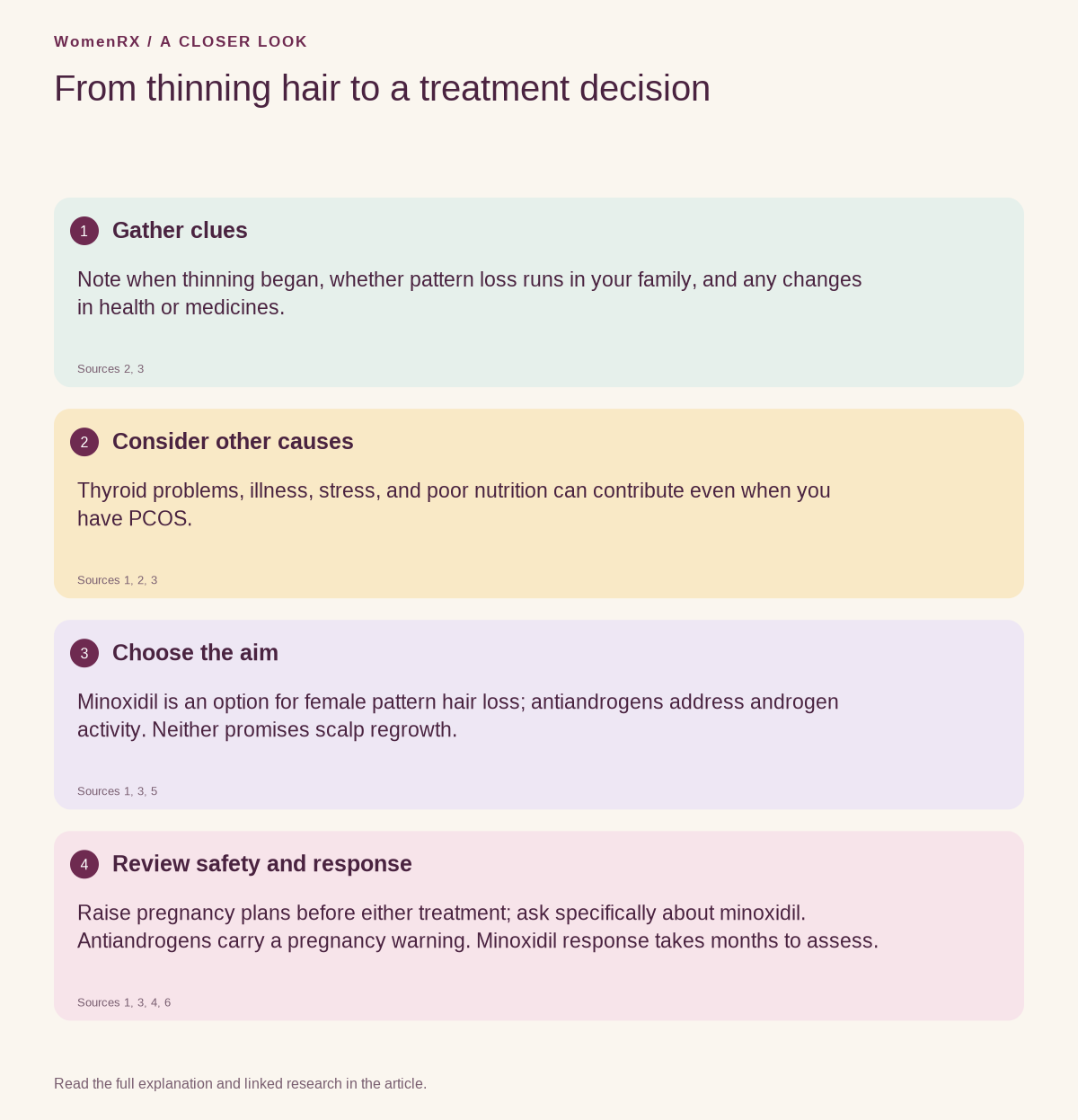
From thinning hair to a treatment decision
Gather clues: Note when thinning began, whether pattern loss runs in your family, and any changes in health or medicines.23
Consider other causes: Thyroid problems, illness, stress, and poor nutrition can contribute even when you have PCOS.123
Choose the aim: Minoxidil is an option for female pattern hair loss; antiandrogens address androgen activity. Neither promises scalp regrowth.135
Review safety and response: Raise pregnancy plans before either treatment; ask specifically about minoxidil. Antiandrogens carry a pregnancy warning. Minoxidil response takes months to assess.1346
Read the figure as text
The first choice is not which product to buy. It’s what the hair change may mean and which treatment aim fits.- Gather clues: Note when thinning began, whether pattern loss runs in your family, and any changes in health or medicines.23
- Consider other causes: Thyroid problems, illness, stress, and poor nutrition can contribute even when you have PCOS.123
- Choose the aim: Minoxidil is an option for female pattern hair loss; antiandrogens address androgen activity. Neither promises scalp regrowth.135
- Review safety and response: Raise pregnancy plans before either treatment; ask specifically about minoxidil. Antiandrogens carry a pregnancy warning. Minoxidil response takes months to assess.1346
More questions, answered
Would treating PCOS automatically stop my hair loss?
Not necessarily. PCOS may contribute, but hair loss can also have causes such as thyroid problems, medicines, stress, or poor nutrition. The useful treatment depends on what’s causing your thinning.12
Sources you can check
- PCOS | Polycystic Ovary Syndrome | MedlinePlusAccessed 2026-09-25Return to first citation
- Hair Loss | Alopecia | Alopecia Areata | MedlinePlusAccessed 2026-09-25Return to first citation
- Hair loss - NHSAccessed 2026-09-25Return to first citation
- Spironolactone - NHSAccessed 2026-09-25Return to first citation
- Efficacy and safety of anti-androgens in the management of polycystic ovary syndrome: a systematic review and meta-analysis of randomised controlled trials.Alesi S, Forslund M, Melin J, Romualdi D, Peña A, Tay CT, Witchel SF, Teede H, Mousa A. · EClinicalMedicine · 2023Return to first citation
- Comparison of the efficacy of platelet-rich plasma with topical minoxidil in treating patients with androgenetic alopecia: a systematic review of clinical trials.Abid A, Fazal F, Mumtaz H, Raja HAA, Malik BH. · Skin health and disease · 2025Return to first citation