PCOS Hair Growth and Scalp Thinning Need Different Treatments
Unwanted facial hair and a widening part can happen together, but the best treatment depends on which hair change you’re addressing and what’s causing it.
For unwanted facial or body hair, options include hormonal treatment and hair-removal methods. For female-pattern scalp thinning, minoxidil and sometimes spironolactone may be considered. First, check that the hair changes fit those diagnoses: scalp shedding has many causes, and rapidly increasing facial hair deserves evaluation for causes beyond PCOS. Pregnancy plans also change which medicines make sense. 1467
First, separate the two hair concerns
Hirsutism means growth of coarse hair in areas such as the face or body where androgen-sensitive hair commonly grows. Scalp thinning is a different problem. With female-pattern hair loss, a widening part or more diffuse thinning may be the first noticeable change. PCOS can be associated with both, but having PCOS doesn’t establish the cause of every hair change. 179
That distinction matters before choosing treatment. For example, a gradually widening part points toward a different assessment than sudden heavy shedding after childbirth or an illness. Patchy hair loss can point toward yet another cause. Thyroid problems, some medicines and poor nutrition can also contribute to hair loss. A clinician can examine the scalp and, when the findings suggest it, use blood tests or a scalp biopsy to clarify the cause. 267
The pattern of new hair growth matters, too. Rapidly worsening hirsutism shouldn’t simply be attributed to PCOS. Other causes of androgen excess can resemble it, including nonclassic congenital adrenal hyperplasia and, rarely, an androgen-secreting tumor. The history, examination and hormone testing help determine what needs to be ruled out. 4
For facial or body hair: reduce new growth, remove visible hair
Hormonal treatment and hair-removal methods do different jobs. Combined oral contraceptives are a treatment option for androgen-related symptoms in PCOS, including hirsutism, when pregnancy isn’t being pursued. Anti-androgens such as spironolactone may also be used, but pregnancy plans need to be part of that decision because anti-androgen medicines can cause problems during pregnancy. These approaches aim to reduce androgen-related hair growth; they don’t instantly remove hair that’s already visible. 15
Spironolactone is an option, not a guaranteed step up. A systematic review of five open-label randomized trials in people with PCOS found no statistically significant difference in hirsutism scores between spironolactone, alone or with metformin, and metformin alone. That comparison doesn’t prove spironolactone never helps an individual, but it does temper claims that it’s reliably more effective. 5
If the immediate task is dealing with visible hair, removal is a separate choice. Light-based treatments such as intense pulsed light (IPL) target hair on the treated area, although regrowth can occur. Topical eflornithine has been studied as an addition for facial hirsutism: in a small split-face trial, women used it on one side after IPL, and investigators measured less regrowth on that side at six months. The trial didn’t establish how well this approach works specifically for PCOS-related hair growth. It’s a facial-hair option to ask about, not a scalp-hair treatment or a promise of permanent removal. 8
For scalp thinning: identify the pattern before treating it
When the diagnosis is female-pattern hair loss, minoxidil is a scalp treatment option. It works on the thinning-hair concern, not on unwanted facial hair. Results take patience: the American Academy of Dermatology says people who see regrowth with minoxidil usually need about six to 12 months to see it. Its treatment guidance doesn’t give a PCOS-specific response rate, so that timeframe is a guide for assessing the scalp treatment, not a prediction of your result. 6
Spironolactone may also be considered for women with female-pattern hair loss, and anti-androgens may help PCOS-related scalp hair loss. But treatment depends on the diagnosis. Minoxidil or an anti-androgen aimed at pattern thinning won’t address every reason hair might be shedding or disappearing in patches. If thinning began after childbirth, followed an illness, or looks patchy rather than like a widening part, finding the cause comes before assuming it needs a PCOS treatment. 167
Let pregnancy plans shape the choice early
If you’re trying to get pregnant, that changes the hormonal-treatment conversation now, not after you’ve chosen a medicine. Hormonal birth control for PCOS symptoms isn’t an option while trying to conceive, and anti-androgens can cause problems during pregnancy. If scalp treatment is also on your mind, raise the pregnancy plan when discussing all medication choices rather than assuming a treatment for the scalp has the same considerations as one for facial hair. 1
The useful starting point is therefore specific: is the concern coarse facial or body hair, female-pattern scalp thinning, another kind of shedding, or more than one of these? Each answer leads to a different treatment target and a different way to judge whether treatment is helping. 267
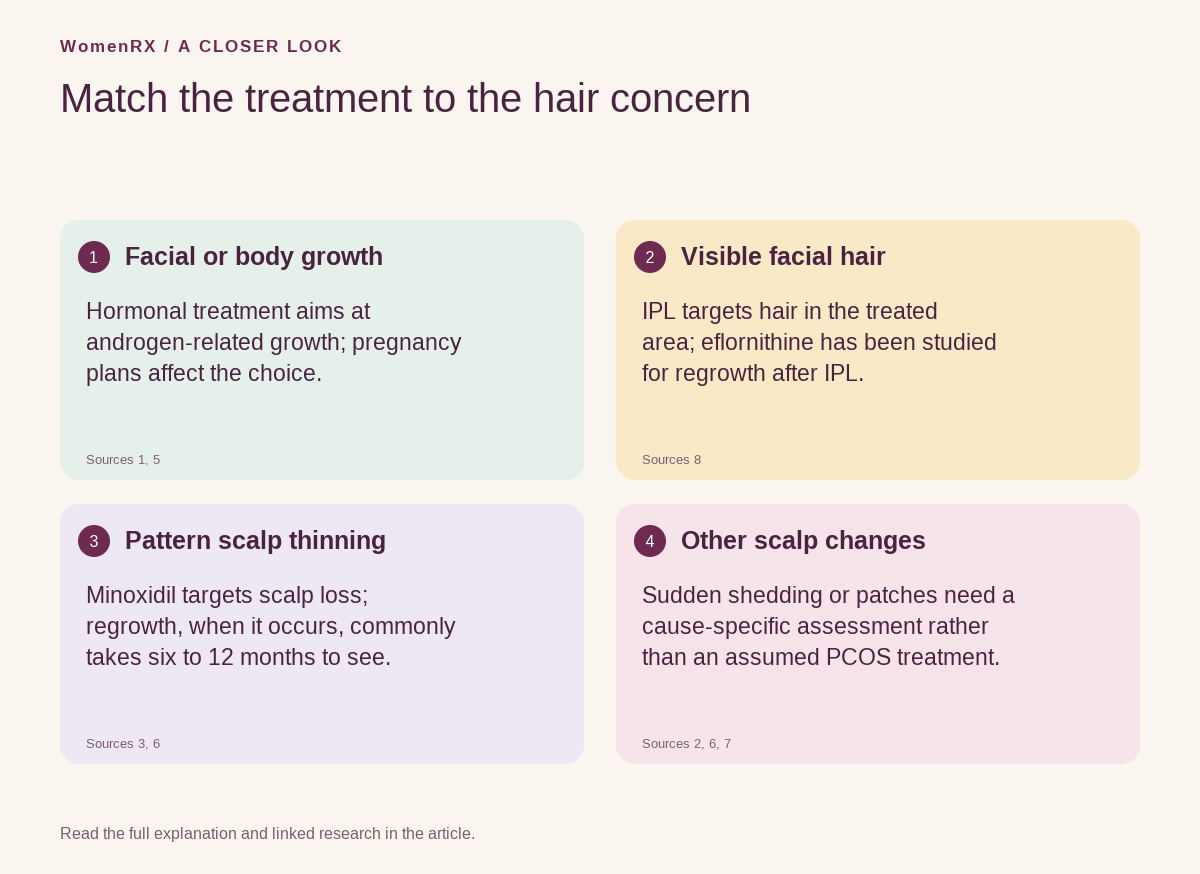
Match the treatment to the hair concern
Facial or body growth: Hormonal treatment aims at androgen-related growth; pregnancy plans affect the choice.15
Visible facial hair: IPL targets hair in the treated area; eflornithine has been studied for regrowth after IPL.8
Pattern scalp thinning: Minoxidil targets scalp loss; regrowth, when it occurs, commonly takes six to 12 months to see.36
Other scalp changes: Sudden shedding or patches need a cause-specific assessment rather than an assumed PCOS treatment.267
Read the figure as text
These options have different targets. The hair pattern and pregnancy plans help determine which belong in the conversation.- Facial or body growth: Hormonal treatment aims at androgen-related growth; pregnancy plans affect the choice.15
- Visible facial hair: IPL targets hair in the treated area; eflornithine has been studied for regrowth after IPL.8
- Pattern scalp thinning: Minoxidil targets scalp loss; regrowth, when it occurs, commonly takes six to 12 months to see.36
- Other scalp changes: Sudden shedding or patches need a cause-specific assessment rather than an assumed PCOS treatment.267
More questions, answered
Can facial-hair treatment also improve scalp thinning?
An anti-androgen may be considered for both androgen-related concerns, but that doesn’t mean both will respond or that the scalp loss has the same cause. Minoxidil targets scalp hair loss; facial hair removal targets hair already growing in the treated area. The scalp pattern should be assessed separately. 167
Sources you can check
- PCOS | Polycystic Ovary Syndrome | MedlinePlusAccessed 2026-09-25Return to first citation
- Hair Loss | Alopecia | Alopecia Areata | MedlinePlusAccessed 2026-09-25Return to first citation
- Hair loss - NHSAccessed 2026-09-25Return to first citation
- Differentiating Polycystic Ovary Syndrome from Adrenal Disorders.Yesiladali M, Yazici MGK, Attar E, Kelestimur F. · Diagnostics (Basel, Switzerland) · 2022Return to first citation
- Short-Term, Low-Dose Spironolactone for Treatment of Hyperandrogenic Symptoms of Polycystic Ovary Syndrome-A Systematic Review.Viveiros TM, Deshpande N, Karderinis I, Ma Y, Clarke S, Talaulikar V, Wattar B. · Clinical endocrinology · 2026Return to first citation
- Hair loss: Diagnosis and treatmentAccessed 2026-09-25Return to first citation
- Hair loss: Who gets and causesAccessed 2026-09-25Return to first citation
- Adjuvant eflornithine to maintain IPL-induced hair reduction in women with facial hirsutism: a randomized controlled trial.Vissing AC, Taudorf EH, Haak CS, Philipsen PA, Haedersdal M. · Journal of the European Academy of Dermatology and Venereology : JEADV · 2016Return to first citation
- Combination of Intense Pulsed Light and Topical Eflornithine Therapy Versus Intense Pulsed Light Alone in the Treatment of Idiopathic Facial Hirsutism: A Randomized Controlled Trial.Nawaz MU, Baig MB, Shahid SM, Nawaz MH, Inayat S, Dawood M. · Cureus · 2025Return to first citation