Spironolactone for PCOS Acne and Hair Growth
It may be considered for androgen-related skin symptoms, but the goals, pregnancy plan, and potassium-related risks deserve a clear conversation first.
Spironolactone is sometimes prescribed off-label for PCOS-related acne or unwanted hair growth because it blocks some androgen effects. The evidence for its benefit in PCOS is limited, and the two symptoms should be discussed as separate treatment goals. Before starting, review pregnancy plans, kidney and potassium risks, other medicines and supplements, and what follow-up makes sense. 4 5 2
Start with the symptom you want to treat
Spironolactone is an anti-androgen medicine. In PCOS, it may be considered for androgen-related symptoms such as acne or hirsutism, the growth of coarse hair in a male-pattern distribution. Its use for these PCOS symptoms is off-label. 4 5 6
Be specific about the goal. Acne and unwanted hair are different outcomes: agreeing on which matters most helps you and your prescriber judge whether treatment is helping. For acne, discuss the areas affected, how persistent it is, and whether scarring is a concern. For hair growth, discuss the areas involved and what change would be meaningful to you. Acne is influenced by hormones that can increase skin oil and block follicles; this offers context for why an anti-androgen might be considered, but it does not guarantee a response. 3
The evidence does not establish a reliable degree of benefit for spironolactone in PCOS. A 2026 systematic review found five open-label randomized trials; in the studies included in its meta-analysis, spironolactone, alone or with metformin, did not show a statistically significant difference from metformin alone in hirsutism scores, testosterone, or BMI. Those results do not prove spironolactone never helps, and they do not answer every acne-specific question. 4
Make pregnancy plans part of the decision
If you could become pregnant, bring that up before treatment, even if you do not currently plan a pregnancy. Spironolactone is generally avoided during pregnancy because its anti-androgen effects could affect development of a male fetus. Animal studies raise this concern; limited human case reports and case series have not shown an association with major birth defects or other adverse outcomes, but that evidence is too limited to establish safety. 2
Ask what pregnancy prevention, if any, fits your circumstances while taking it, and what to do if pregnancy becomes possible or you are planning to conceive. Hormonal contraception is not automatically required for every person with PCOS; the key is to make an individual plan that addresses pregnancy possibility and your preferences. 2 4
Review medicines and potassium risks
Spironolactone can raise blood potassium. Risk is higher with impaired kidney function and with potassium supplements, potassium-containing salt substitutes, or certain medicines, including ACE inhibitors and ARBs. NSAIDs such as ibuprofen are also listed among medicines to discuss. Make a complete list of prescriptions, over-the-counter medicines, vitamins, and supplements rather than focusing only on hormonal treatments. 2 1
Ask whether your health history or current medicines mean you need potassium and kidney-function checks, and when follow-up testing should happen. US prescribing information for spironolactone advises checking potassium within a week of starting or changing treatment and regularly afterward, with more frequent checks in some higher-risk situations. Your prescriber can say what monitoring applies to your situation. 2
Agree on what follow-up will measure
Before starting, decide how you will assess each target: for example, whether acne becomes less troublesome or whether unwanted hair growth improves enough to matter to you. Also ask what side effects to report and when to revisit the plan. Menstrual irregularities, increased urination, and gastrointestinal symptoms were reported in the PCOS studies summarized by the systematic review. 4
A useful discussion can be short and concrete: “I’m hoping to improve ___. How will we judge whether it’s working? What should I know about pregnancy, my other medicines, and potassium monitoring?” That keeps the decision centered on your priorities without assuming that one option fits everyone with PCOS.
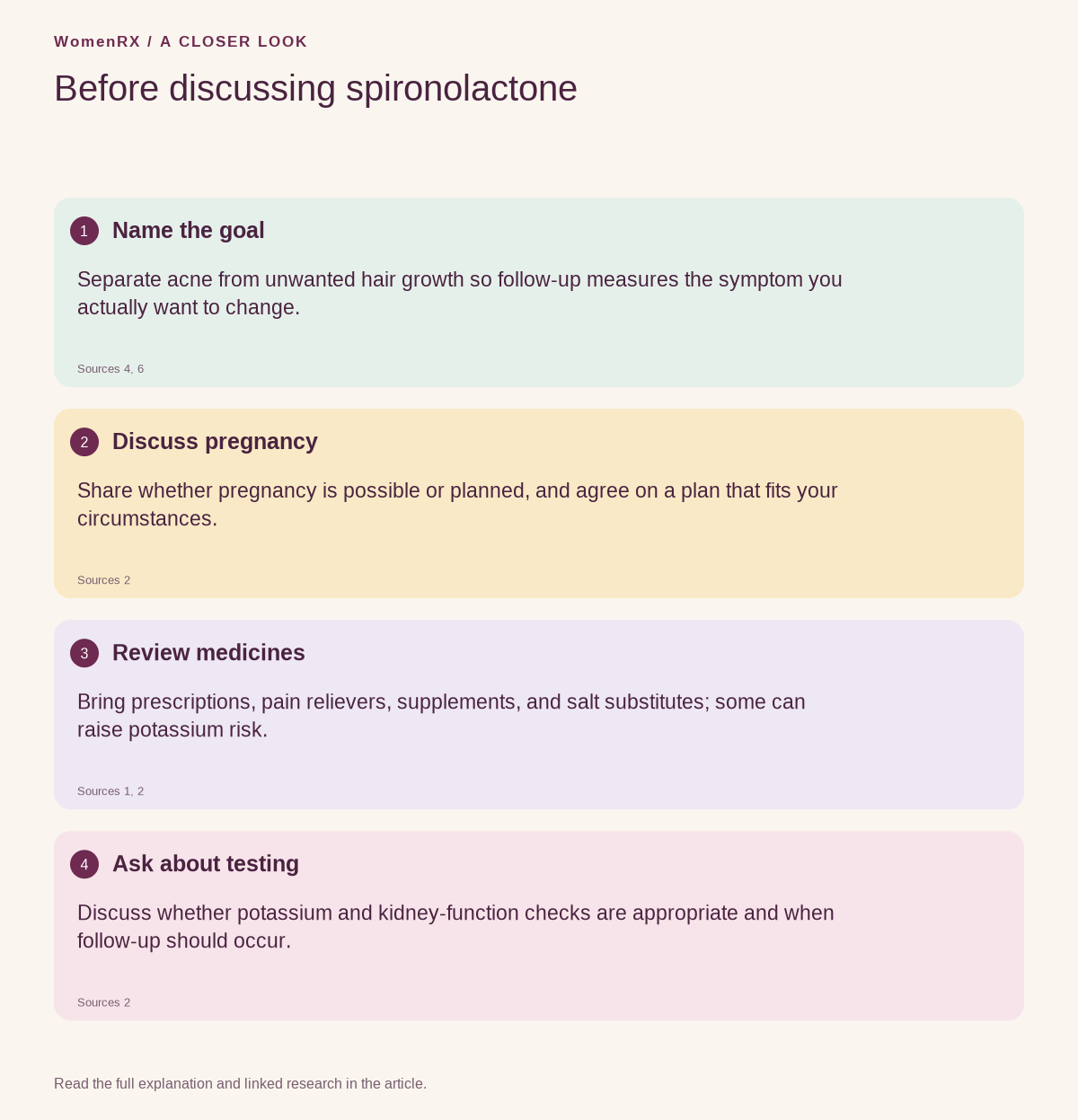
Before discussing spironolactone
Name the goal: Separate acne from unwanted hair growth so follow-up measures the symptom you actually want to change.46
Discuss pregnancy: Share whether pregnancy is possible or planned, and agree on a plan that fits your circumstances.2
Review medicines: Bring prescriptions, pain relievers, supplements, and salt substitutes; some can raise potassium risk.12
Ask about testing: Discuss whether potassium and kidney-function checks are appropriate and when follow-up should occur.2
Read the figure as text
Use these four prompts to keep the conversation focused on the symptom you want to treat and the practical safety questions that affect your decision.- Name the goal: Separate acne from unwanted hair growth so follow-up measures the symptom you actually want to change.46
- Discuss pregnancy: Share whether pregnancy is possible or planned, and agree on a plan that fits your circumstances.2
- Review medicines: Bring prescriptions, pain relievers, supplements, and salt substitutes; some can raise potassium risk.12
- Ask about testing: Discuss whether potassium and kidney-function checks are appropriate and when follow-up should occur.2
More questions, answered
Do I have to use hormonal birth control with spironolactone?
The PCOS review describes spironolactone as an off-label option, including for people unable to take hormonal contraceptives; it doesn't set a universal contraception requirement. Because the medicine is generally avoided during pregnancy, discuss whether pregnancy is possible and agree on a prevention plan that fits your preferences and circumstances. 2 4
Does evidence for unwanted hair also prove it works for acne?
No. Hirsutism scores and acne are different outcomes. The PCOS systematic review reported results for hirsutism scores, testosterone, and BMI, but those findings do not establish an acne benefit. Ask about acne as its own treatment goal. 4
Sources you can check
- Spironolactone - NHSAccessed 2026-09-25Return to first citation
- SPIRONOLACTONE TABLET, FILM COATED [REMEDYREPACK INC.] | US prescribing information and patient instructionsAccessed 2026-09-25Return to first citation
- Acne - NHSAccessed 2026-09-25Return to first citation
- Short-Term, Low-Dose Spironolactone for Treatment of Hyperandrogenic Symptoms of Polycystic Ovary Syndrome-A Systematic Review.Viveiros TM, Deshpande N, Karderinis I, Ma Y, Clarke S, Talaulikar V, Wattar B. · Clinical endocrinology · 2026Return to first citation
- AMERICAN ASSOCIATION OF CLINICAL ENDOCRINOLOGISTS, AMERICAN COLLEGE OF ENDOCRINOLOGY, AND ANDROGEN EXCESS AND PCOS SOCIETY DISEASE STATE CLINICAL REVIEW: GUIDE TO THE BEST PRACTICES IN THE EVALUATION AND TREATMENT OF POLYCYSTIC OVARY SYNDROME--PART 1.Goodman NF, Cobin RH, Futterweit W, Glueck JS, Legro RS, Carmina E, American Association of Clinical Endocrinologists (AACE), American College of Endocrinology (ACE), Androgen Exce... · Endocrine practice : official journal of the American College of Endocrinology and the American Association of Clinical Endocrinologists · 2015Return to first citation
- [Hyperandrogenism, adrenal dysfunction, and hirsutism].Makrantonaki E, Zouboulis CC. · Der Hautarzt; Zeitschrift fur Dermatologie, Venerologie, und verwandte Gebiete · 2020Return to first citation