Perimenopause and Hair Loss: What the Pattern Can Tell You
Gradual thinning along the top of your scalp points to a different question than sudden shedding or distinct bald patches.
Hair thinning in midlife isn’t automatically caused by perimenopause. Gradual widening of the part or thinning across the top can fit female pattern hair loss; increased shedding or distinct bare patches may point to other causes. A clinician can assess the scalp and your health history, then decide whether targeted testing or a treatment such as minoxidil is worth discussing. 1 2 5
Start with the shape of the change
Look at where the hair seems different and how the change is unfolding. Female pattern hair loss usually develops as gradual thinning across the frontal and top areas of the scalp, sometimes most noticeable as a widening part. Hair follicles gradually produce finer hairs, so the change can be easy to miss at first. 4 5
More hair coming out across the scalp is a different clue from a slowly widening part. Shedding can have several possible contributors, including illness, stress, some medicines, thyroid problems, and poor nutrition. A distinct bare patch also deserves a different assessment from gradual patterned thinning. These patterns don’t diagnose the cause on their own, but they help guide the next questions. 1 2 5
It’s normal to lose hair each day; a number by itself isn’t a reliable way to decide whether you have a hair-loss condition. Notice changes in your part, overall density, or specific areas instead. 1 2
Perimenopause may be part of the timing, not the whole explanation
Hair changes can happen in midlife, but age or menstrual changes alone don’t establish why your hair is thinning. Research summarized in a review reports that female pattern hair loss becomes more common after menopause. That doesn’t show that perimenopause itself causes an individual woman’s hair loss, or rule out another explanation. 4
Other possibilities include a health condition, medication effects, stress, or inadequate nutrition. Family history can also be relevant to pattern hair loss. The useful next step is to connect the hair pattern with your own history, rather than assume every change is hormonal. 1 2 5
What a clinician can look for
A scalp examination and questions about when the change began, where it’s happening, family history, health conditions, medicines, and recent stressors can help distinguish pattern thinning from other forms of hair loss. For women, a close scalp examination with a magnifying tool called trichoscopy may help identify changes in hair thickness associated with pattern hair loss. 3 5
Testing doesn’t have to mean ordering every possible blood test. A clinical consensus recommends considering basic investigations when the history or examination suggests a particular disease or deficiency. That makes it reasonable to ask what a proposed test is meant to check and how its result would affect the plan. 3
If you notice distinct patches, or scalp changes such as redness around follicles or areas where the openings of hair follicles seem to be disappearing, point those out. Some scalp conditions can resemble pattern hair loss, and signs such as inflammation or lost follicle openings can matter to the assessment. 5
Questions that make the treatment conversation clearer
You might ask:
- Does this look like gradual female pattern hair loss, increased shedding, or another pattern?
- Does my history suggest a specific cause or deficiency worth testing for?
- If this is female pattern hair loss, would topical minoxidil be a reasonable option for me?
- What changes should I watch for, and how will we judge whether the plan is helping?
Minoxidil is used for female pattern hair loss, but it isn’t a universal answer to hair loss. The treatment depends on the cause, so first clarifying the pattern helps avoid choosing a treatment for the wrong problem. 1 2
Don’t treat hormone therapy as a hair-loss remedy based on timing alone. Menopause guidance describes hormone therapy for specific menopause-related indications, including bothersome hot flashes and bone-loss prevention in eligible women; it doesn’t establish it as a treatment for hair loss. 6
The main distinction to bring into the conversation is whether you’re seeing gradual thinning in a recognizable pattern, more widespread shedding, or distinct patches. That observation can make the evaluation and treatment discussion more focused.
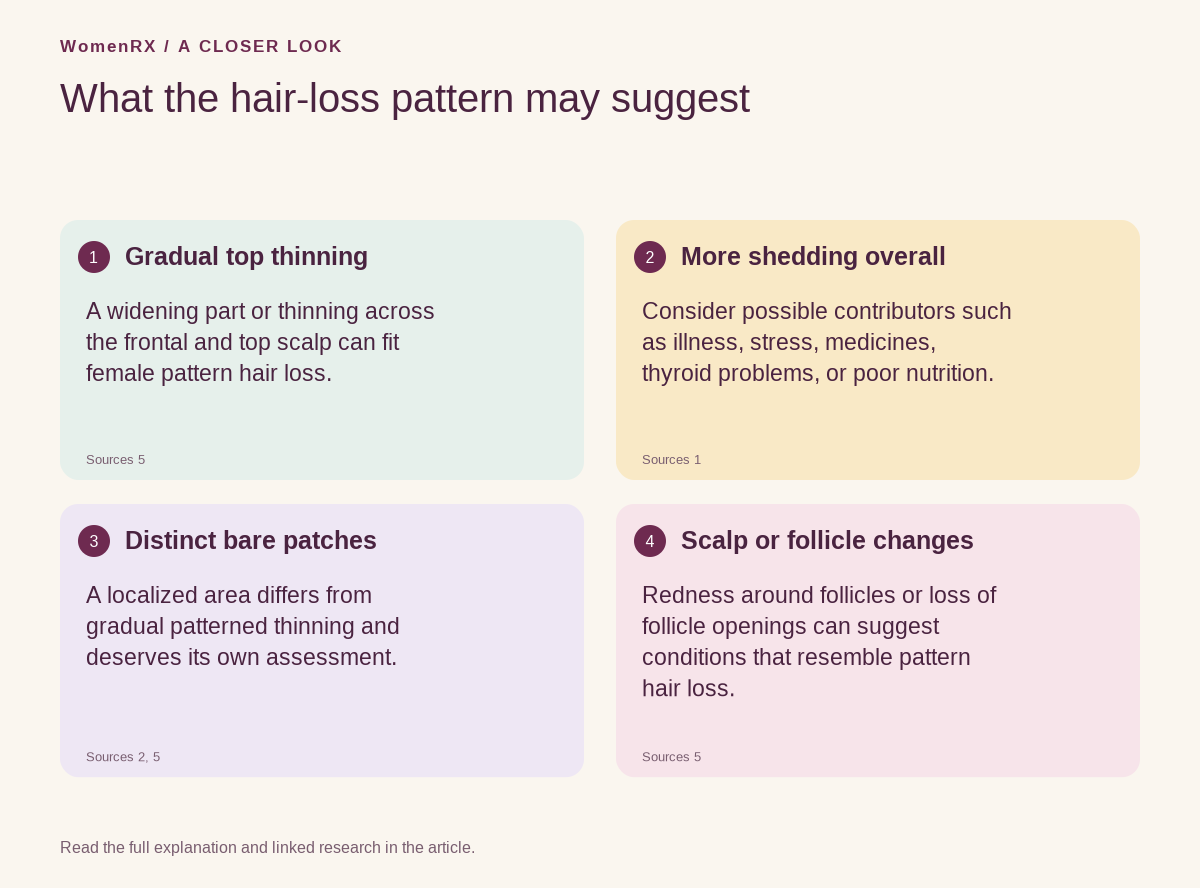
What the hair-loss pattern may suggest
Gradual top thinning: A widening part or thinning across the frontal and top scalp can fit female pattern hair loss.5
More shedding overall: Consider possible contributors such as illness, stress, medicines, thyroid problems, or poor nutrition.1
Distinct bare patches: A localized area differs from gradual patterned thinning and deserves its own assessment.25
Scalp or follicle changes: Redness around follicles or loss of follicle openings can suggest conditions that resemble pattern hair loss.5
Read the figure as text
Different changes can point toward different questions. This comparison is a starting point for a scalp assessment, not a way to diagnose yourself.- Gradual top thinning: A widening part or thinning across the frontal and top scalp can fit female pattern hair loss.5
- More shedding overall: Consider possible contributors such as illness, stress, medicines, thyroid problems, or poor nutrition.1
- Distinct bare patches: A localized area differs from gradual patterned thinning and deserves its own assessment.25
- Scalp or follicle changes: Redness around follicles or loss of follicle openings can suggest conditions that resemble pattern hair loss.5
More questions, answered
Does hair loss mean I’m in perimenopause?
No. Hair changes can occur in midlife, but they don’t establish that perimenopause is the cause. Pattern hair loss, health conditions, medicines, stress, and nutrition can also be relevant. 1 4
Is minoxidil used for female pattern hair loss?
Yes. It’s one option used for female pattern hair loss, but it isn’t a treatment for every cause of shedding or thinning. Discuss whether your pattern fits before choosing a treatment. 1 2
Sources you can check
- Hair Loss | Alopecia | Alopecia Areata | MedlinePlusAccessed 2026-09-25Return to first citation
- Hair loss - NHSAccessed 2026-09-25Return to first citation
- Consensus Recommendations for the Management of Androgenetic Alopecia in Egypt: A Modified Delphi Study.Mohy SM, Abozeid MF, Seoudy WM, Elshahid A, Moubasher AEA, Hassan A, Elmorsy E, Hofny ERM, Mohamed EM, Saleh HM, Sabry H, Gharib K, Gaber MA, Hegazy MS, Atwa MA, Moftah N, Bedair N... · Clinical, cosmetic and investigational dermatology · 2025Return to first citation
- Effects of dietary supplements on androgenetic alopecia: a systematic review and network meta-analysis.Zhou L, Zhu W, Chen Y. · Frontiers in nutrition · 2025Return to first citation
- Trichoscopy of Androgenetic Alopecia: A Systematic Review.Kuczara A, Waśkiel-Burnat A, Rakowska A, Olszewska M, Rudnicka L. · Journal of clinical medicine · 2024Return to first citation
- The 2022 hormone therapy position statement of The North American Menopause Society.“The 2022 Hormone Therapy Position Statement of The North American Menopause Society” Advisory Panel. · Menopause (New York, N.Y.) · 2022Return to first citation