Hair Thinning in Your 40s: Could Hormones Be Involved?
A widening part, sudden shedding, and a new patch are different changes to describe, even if they all begin in your 40s.
Hormonal changes could be part of the picture, but thinning hair in your 40s doesn’t identify the cause. Research links menopause with some hair-loss conditions, especially after menopause; it doesn’t establish what caused thinning during perimenopause. Notice whether the change is gradual or rapid, where it appears, and whether your scalp feels or looks different. If the loss worries you, arrange an assessment. 1 4
Start with how the change happened
If your part seems wider than it used to, think back to when you first noticed it. Has the change been gradual, or did a lot more hair seem to come out over a short period? Those descriptions help you explain what changed, but they don’t identify a cause on their own. Female pattern hair loss is a progressive form of thinning, while temporary hair loss can happen after an illness. 1 5
Where the change appears matters too. A slowly widening part or thinning across the top of the scalp may raise a different question from a distinct bald patch. Sharply defined, round or oval patches are characteristic of alopecia areata. Thinning near the temples has several possible explanations, including traction-related loss, female pattern hair loss, temporary shedding, and conditions that can scar. You can’t reliably sort those out from the location alone. 2 3 6
Where perimenopause fits
Hormonal changes may be relevant, but your age doesn’t make a new hair change hormonal. A systematic review found associations between menopause and female pattern hair loss and frontal fibrosing alopecia; the review describes these associations in postmenopausal women. That does not establish the cause of hair loss during perimenopause or in any individual woman. 4
It’s useful to keep both possibilities in view: hormone-related changes may be relevant, and something else may need attention. Think about what else changed around the time the hair loss began, such as an illness, pregnancy or postpartum period, or a medication change. These are details to share, not clues that prove a diagnosis. Illness is one recognized context for temporary hair loss. 1
When to get a closer look
If the hair loss worries you, arrange an assessment rather than assuming it’s related to age. Whether a lot more hair came out over a short period, you noticed a new patch, or your scalp feels sore or itchy or looks different, describe that change. These observations won’t identify the cause on their own. Several conditions can affect the temples, and prompt diagnosis matters for those that can scar. The location of thinning alone won’t tell you whether scarring is involved. 1 2
A clinician may be able to identify a likely cause by looking at your hair. Age alone doesn’t establish a hormone cause. A useful question is what the examination suggests, and whether any test would help answer a specific concern. 1
If the finding is female pattern hair loss, topical minoxidil is one treatment you can discuss. It isn’t a test for whether hormones caused the thinning, and it won’t address every type of hair loss. 5
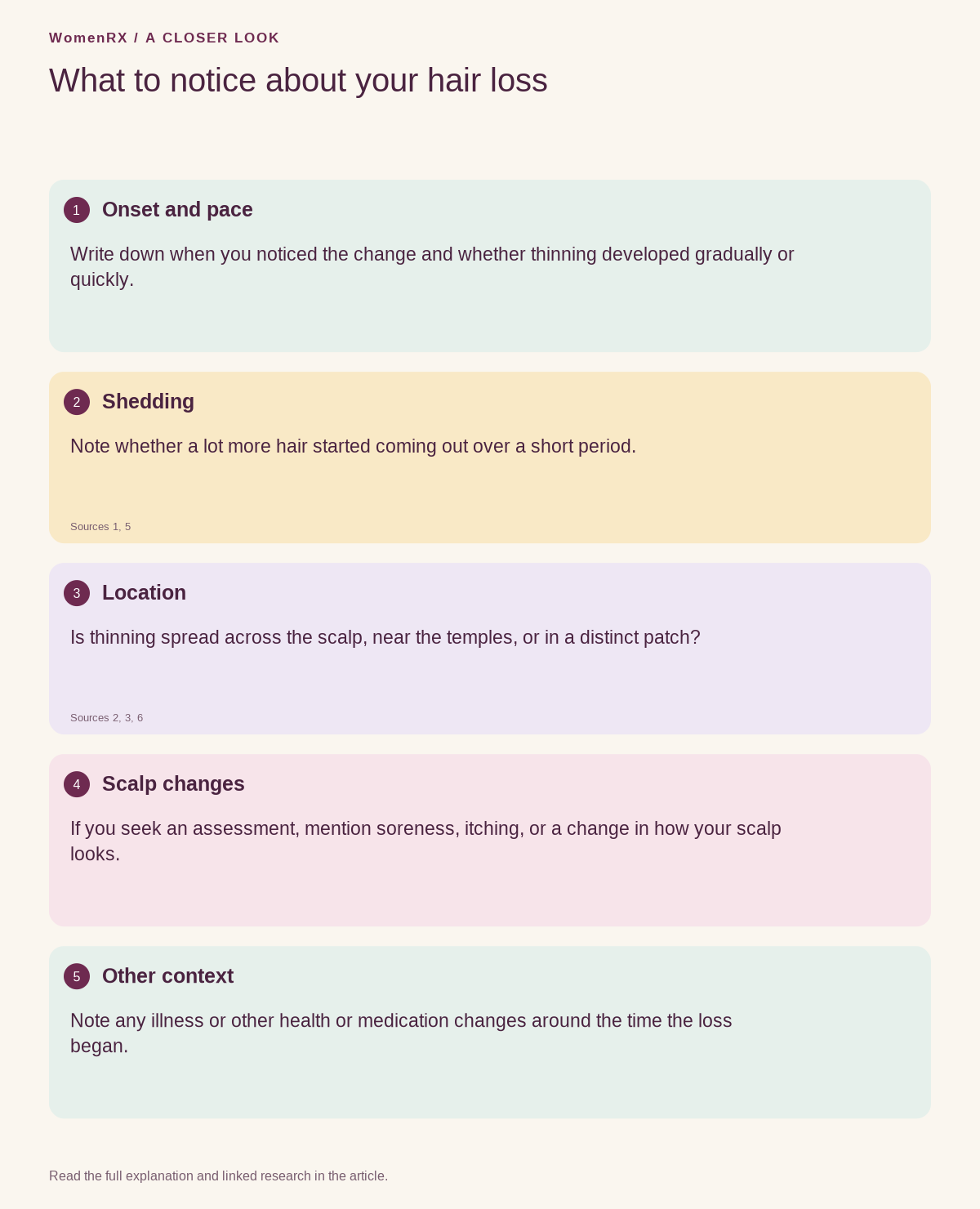
What to notice about your hair loss
Onset and pace: Write down when you noticed the change and whether thinning developed gradually or quickly.
Shedding: Note whether a lot more hair started coming out over a short period.15
Location: Is thinning spread across the scalp, near the temples, or in a distinct patch?236
Scalp changes: If you seek an assessment, mention soreness, itching, or a change in how your scalp looks.
Other context: Note any illness or other health or medication changes around the time the loss began.
Read the figure as text
Use these observations to describe what changed, not to diagnose the cause.- Onset and pace: Write down when you noticed the change and whether thinning developed gradually or quickly.
- Shedding: Note whether a lot more hair started coming out over a short period.15
- Location: Is thinning spread across the scalp, near the temples, or in a distinct patch?236
- Scalp changes: If you seek an assessment, mention soreness, itching, or a change in how your scalp looks.
- Other context: Note any illness or other health or medication changes around the time the loss began.
Sources you can check
- Hair loss - NHSAccessed 2026-09-25Return to first citation
- Bitemporal Scalp Hair Loss: Differential Diagnosis of Nonscarring and Scarring Conditions.De Souza B, Tovar-Garza A, Uwakwe LN, McMichael A. · The Journal of clinical and aesthetic dermatology · 2021Return to first citation
- The Role of Vitamin D in Non-Scarring Alopecia.Gerkowicz A, Chyl-Surdacka K, Krasowska D, Chodorowska G. · International journal of molecular sciences · 2017Return to first citation
- Menopause and Common Dermatoses: A Systematic Review.Roster K, Fleshner L, Karatas TB, Ecanow A, Sayegh A, Farabi B, Marmon S. · American journal of clinical dermatology · 2026Return to first citation
- A systematic review of clinical evidence on the efficacy and safety of conditioned media, platelet-rich fibrin, stromal vascular fraction, extracellular vesicles, and stem cells in androgenetic alopecia.Behrangi E, Amiri S, Zeinali R, Goodarzi A, Roohaninasab M, Khosravi M, Jafarzadeh A. · Stem cell research & therapy · 2026Return to first citation
- Effects of dietary supplements on androgenetic alopecia: a systematic review and network meta-analysis.Zhou L, Zhu W, Chen Y. · Frontiers in nutrition · 2025Return to first citation