Can Menopause Hormone Therapy Help Thinning Hair?
Hair thinning may become noticeable around menopause, but hormone therapy isn’t an established hair-loss treatment, and the pattern of loss matters.
Menopausal hormone therapy hasn’t been shown reliably to regrow thinning hair. Research on its hair effects is limited and inconsistent, so hair changes alone aren’t a sound reason to assume you need estrogen. A gradual change, increased shedding, or eyebrow loss can point toward different explanations. Identifying the pattern is more useful than treating every change as menopause-related. 314
Menopause may be part of the picture, not the diagnosis
You might notice more hair in the shower during perimenopause, or realize after menopause that your part looks wider than it used to. Those changes are worth taking seriously, especially if they’re upsetting. They don’t, by themselves, tell you why your hair is changing.
A systematic review found associations between postmenopause and some forms of alopecia, particularly female pattern hair loss and frontal fibrosing alopecia. An association doesn’t mean estrogen loss explains an individual woman’s hair loss, and the review found that evidence on menopausal hormone therapy and skin or hair conditions was limited and inconsistent. It did not establish hormone therapy as a treatment that restores thinning hair. 3
There’s also a reason not to assume that more hormone exposure must mean better hair. In the review, menopausal hormone therapy was associated with frontal fibrosing alopecia in some research. That finding does not show that therapy causes the condition: the studies varied, and many involved formulations less commonly used today. It does mean the evidence cannot support a simple promise that hormone therapy protects hair. 3
If you’re weighing hormone therapy for other menopause symptoms, consider its potential hair effects a separate, uncertain question rather than an expected benefit. If hair loss is the main concern, finding out what type you have gives you a clearer route to treatment. 31
The pattern can change the next step
Gradual thinning may raise the question of female pattern hair loss, especially if pattern hair loss runs in your family. It can be persistent rather than a short-lived bout of shedding. Minoxidil is a treatment used for female pattern hair loss; that’s a more direct hair-treatment conversation than starting menopausal hormone therapy in hopes of regrowth. An examination can help establish whether this is actually the type of loss you have. 1
More shedding after an illness or weight loss suggests a different conversation. Both are recognized causes of potentially temporary hair loss. Note what changed around the time you first noticed the shedding, without assuming one event proves the cause. 1
Hair loss alongside heavy periods makes iron status particularly relevant during the cycling years or perimenopause. Heavy menstrual bleeding increases the risk of iron deficiency, and iron deficiency can be associated with hair loss. A clinician may use ferritin, which reflects iron stores, alongside other findings to assess iron status; a normal hemoglobin result alone doesn’t rule out depleted stores. Iron supplements aren’t a substitute for finding out whether iron is low, and excess supplemental iron can cause harm. 21
Eyebrow thinning as well as scalp hair loss deserves a closer look rather than being filed away as ordinary menopause thinning. Reduced eyebrows were reported more often among people with frontal fibrosing alopecia in a retrospective study of patients with lichen planopilaris and its subtypes. That sign isn’t a diagnosis, but it’s useful to mention when seeking an assessment. 4
What to bring into a hair-loss evaluation
You don’t need to diagnose yourself before making an appointment. Be ready to describe whether the change is gradual or feels like increased shedding, where you see it, and whether your eyebrows have changed. Mention a recent illness or weight loss, heavy periods if you still have them, and any hormone therapy you use. These details help distinguish possible causes; a clinician can also examine your hair and discuss treatment suited to the type of loss. 1243
The useful question isn’t simply, “Is this menopause?” It’s, “What kind of hair loss does this look like, and is there a treatable contributor?”
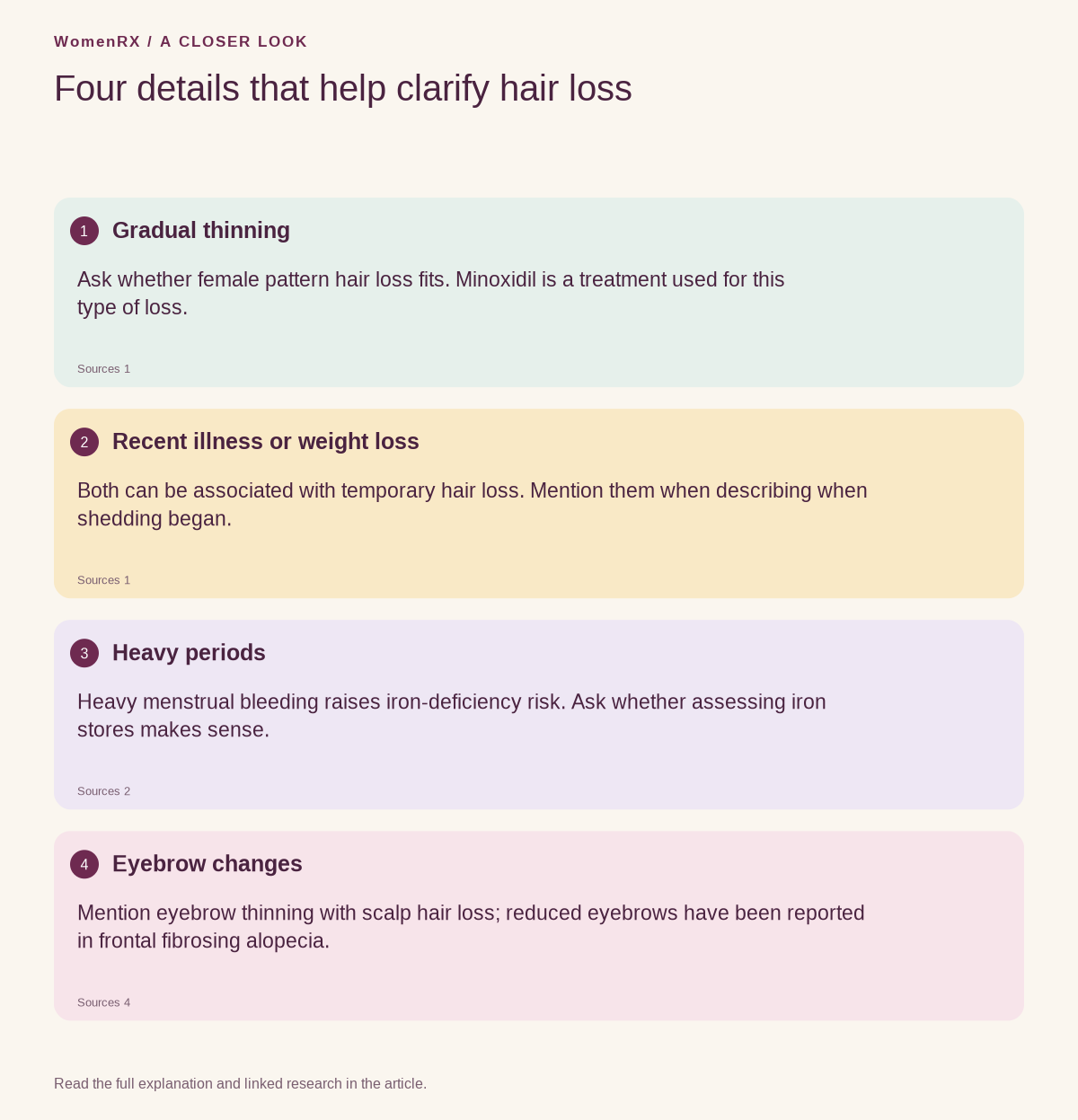
Four details that help clarify hair loss
Gradual thinning: Ask whether female pattern hair loss fits. Minoxidil is a treatment used for this type of loss.1
Recent illness or weight loss: Both can be associated with temporary hair loss. Mention them when describing when shedding began.1
Heavy periods: Heavy menstrual bleeding raises iron-deficiency risk. Ask whether assessing iron stores makes sense.2
Eyebrow changes: Mention eyebrow thinning with scalp hair loss; reduced eyebrows have been reported in frontal fibrosing alopecia.4
Read the figure as text
These observations can help organize a conversation about the type of hair loss; they are not a self-diagnosis.- Gradual thinning: Ask whether female pattern hair loss fits. Minoxidil is a treatment used for this type of loss.1
- Recent illness or weight loss: Both can be associated with temporary hair loss. Mention them when describing when shedding began.1
- Heavy periods: Heavy menstrual bleeding raises iron-deficiency risk. Ask whether assessing iron stores makes sense.2
- Eyebrow changes: Mention eyebrow thinning with scalp hair loss; reduced eyebrows have been reported in frontal fibrosing alopecia.4
More questions, answered
Can low iron matter if I’m not anemic?
Yes. Iron stores can become depleted before hemoglobin falls enough to indicate anemia. Ferritin helps assess those stores, although inflammation can affect the result, so it needs interpretation in context. 2
If I already use hormone therapy, should I stop because my hair is thinning?
Hair thinning alone can’t establish that hormone therapy caused it. Research has found associations with certain hair-loss conditions, but not proof of cause. Note when the change began and discuss the hair pattern and your treatment history before making a decision about therapy. 31
Sources you can check
- Hair loss - NHSAccessed 2026-09-25Return to first citation
- Iron - Health Professional Fact SheetAccessed 2026-09-25Return to first citation
- Menopause and Common Dermatoses: A Systematic Review.Roster K, Fleshner L, Karatas TB, Ecanow A, Sayegh A, Farabi B, Marmon S. · American journal of clinical dermatology · 2026Return to first citation
- Lichen planopilaris: Epidemiology and prevalence of subtypes - a retrospective analysis in 104 patients.Meinhard J, Stroux A, Lünnemann L, Vogt A, Blume-Peytavi U. · Journal der Deutschen Dermatologischen Gesellschaft = Journal of the German Society of Dermatology : JDDG · 2014Return to first citation