Can Menopause Hormone Therapy Treat Hair Loss?
Hormone therapy may be appropriate for menopause symptoms, but it isn’t an established treatment for thinning hair.
Menopause hormone therapy (also called HRT) isn’t recommended solely to treat hair loss, and current evidence doesn’t establish it as a hair-regrowth treatment. A gradual widening part or thinning at the crown can fit female pattern hair loss; sudden, diffuse shedding can have other triggers. The useful first step is identifying the pattern and possible cause, since treatments differ. 5 9
Start with how the hair is changing
Hair loss around midlife can feel like one more clue that hormones are shifting, but it doesn’t diagnose menopause or point to one cause. Two common patterns can look similar at first.
Female pattern hair loss usually develops gradually. Hair may become finer and less dense around the crown or along the central part. Telogen effluvium, a type of diffuse shedding, tends to mean more hairs coming out across the scalp. Shedding can sometimes happen alongside pattern thinning, which makes the distinction harder to judge by appearance alone. 4 5
A sudden increase in shedding is a reason to think about what changed in the preceding months. Illness, surgery, childbirth, medication changes, rapid weight loss, thyroid problems, and iron or other nutrient deficiencies are among the contributors discussed in clinical reviews. A trigger can be temporary, but it’s still worth identifying rather than assuming menopause is the explanation. 3 4
Where hormone therapy fits
A 2026 review says hormone therapy is not indicated for hair loss alone. That’s different from using it for a separate, established reason: menopause hormone therapy remains an effective treatment for bothersome hot flashes and other vasomotor symptoms, and its benefit-risk balance depends on factors such as age, timing, type, route, and whether a progestogen is used. Hair preservation isn’t a reason to start it. 7 8 9
If you already take hormone therapy for menopause symptoms, new hair changes don’t automatically mean you need to stop. Bring the timing to the person who prescribes it, especially if the shedding began after starting or changing a product. Some specific estrogen patch product information lists hair loss among reported adverse effects. That listing is specific to those products; it doesn’t show that every form of hormone therapy causes hair loss. 1 2
Match the next step to the pattern
Gradual widening of the part or crown thinning: Ask whether the change fits female pattern hair loss. A clinician can examine the scalp and, when useful, use magnification to look at differences in hair-shaft thickness. Topical minoxidil is the only FDA-approved treatment for female pattern hair loss described in a recent review. It targets a different problem than hormone therapy does, so a discussion of treatment starts with getting the pattern right. 5 6
Diffuse shedding or a clear recent trigger: Review recent illness, surgery, childbirth, weight change, and medication changes. Depending on your history and exam, testing may include thyroid-stimulating hormone, a complete blood count, or iron studies; these aren’t a universal checklist for everyone. Treating an underlying contributor is different from treating pattern thinning. 3 4
Scalp findings that suggest inflammation or scarring: Have the scalp examined rather than treating this as ordinary menopause-related thinning. Hair-loss evaluation includes looking for inflammatory or scarring conditions, and a scalp biopsy may be used when scarring needs confirmation. 3 4
Make the appointment more useful
You don’t need to work out the diagnosis yourself. A concise history can help: when the change began, whether you’re seeing more shedding or gradual thinning, whether the part is widening, and what illnesses, procedures, childbirth, weight changes, or medication changes preceded it. Bring the names of hormone products or other medicines you use, and mention whether hair changes followed a start or dose change. The exam and that timeline can guide whether targeted tests or a dermatology evaluation make sense. 4
The key choice isn’t “hormones or no hormones” for your hair. It’s whether the hair pattern points to a treatable scalp condition, a shedding trigger, or both. If menopause symptoms are also affecting you, discuss hormone therapy for those symptoms on their own merits, not as a promised way to regrow hair. 5 7 9
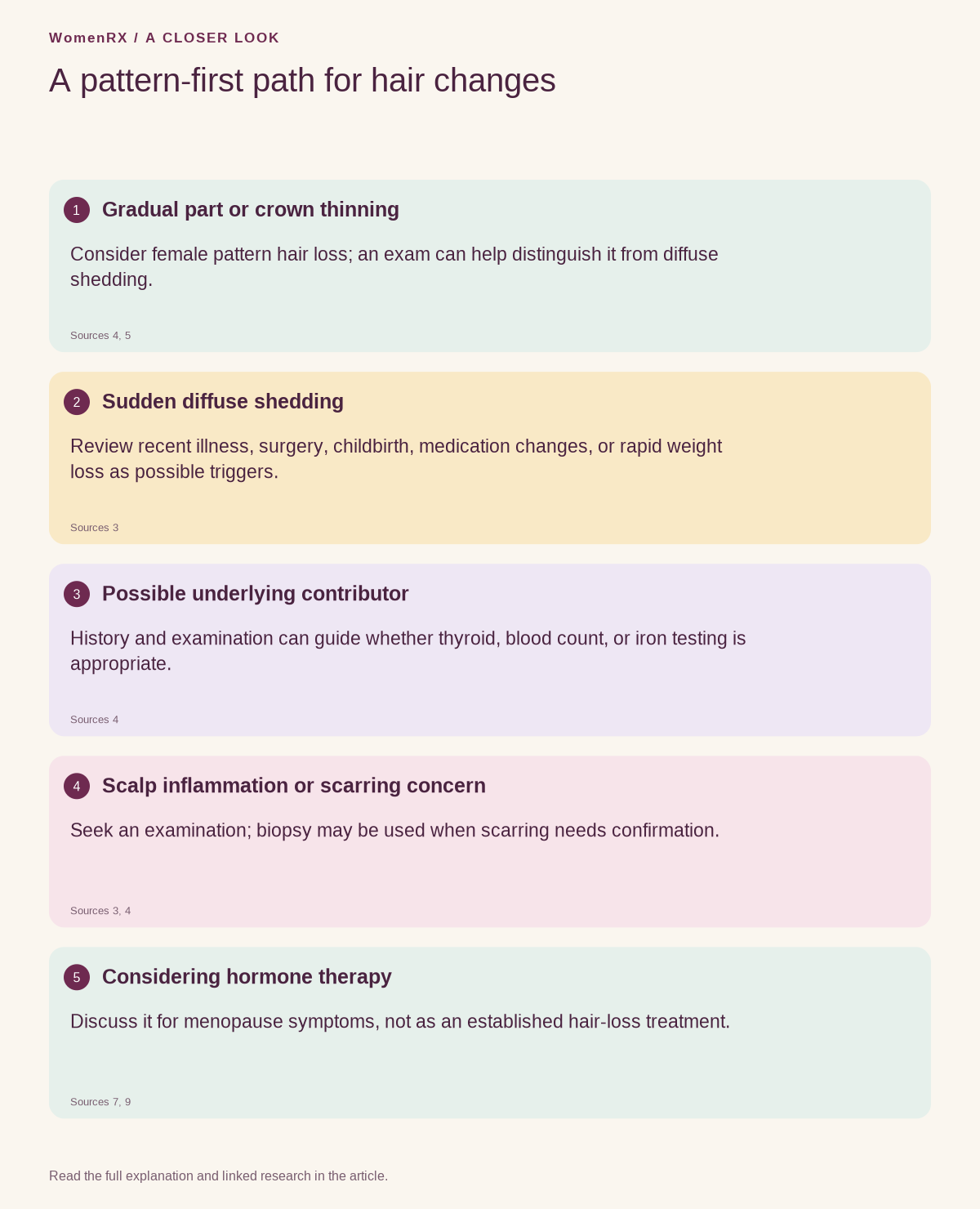
A pattern-first path for hair changes
Gradual part or crown thinning: Consider female pattern hair loss; an exam can help distinguish it from diffuse shedding.45
Sudden diffuse shedding: Review recent illness, surgery, childbirth, medication changes, or rapid weight loss as possible triggers.3
Possible underlying contributor: History and examination can guide whether thyroid, blood count, or iron testing is appropriate.4
Scalp inflammation or scarring concern: Seek an examination; biopsy may be used when scarring needs confirmation.34
Considering hormone therapy: Discuss it for menopause symptoms, not as an established hair-loss treatment.79
Read the figure as text
The appearance and onset of hair changes can guide a more useful evaluation than assuming menopause is the cause.- Gradual part or crown thinning: Consider female pattern hair loss; an exam can help distinguish it from diffuse shedding.45
- Sudden diffuse shedding: Review recent illness, surgery, childbirth, medication changes, or rapid weight loss as possible triggers.3
- Possible underlying contributor: History and examination can guide whether thyroid, blood count, or iron testing is appropriate.4
- Scalp inflammation or scarring concern: Seek an examination; biopsy may be used when scarring needs confirmation.34
- Considering hormone therapy: Discuss it for menopause symptoms, not as an established hair-loss treatment.79
More questions, answered
Can hormone therapy prevent menopause-related hair thinning?
There isn’t established evidence that hormone therapy prevents hair loss, and a 2026 review says it isn’t indicated for hair loss alone. If you’re considering it for hot flashes or another menopause symptom, weigh that benefit separately from any hoped-for effect on hair. 7 9
Does a lot of shedding mean female pattern hair loss?
Not necessarily. Diffuse shedding can have other triggers, and it can occur alongside female pattern hair loss. Gradual thinning around the part or crown and sudden shedding are useful clues, but an examination may be needed to distinguish them. 4 5
Sources you can check
- CLIMARA PRO (ESTRADIOL AND LEVONORGESTREL) PATCH [BAYER HEALTHCARE PHARMACEUTICALS INC.] | US prescribing information and patient instructionsAccessed 2026-09-25Return to first citation
- CLIMARA (ESTRADIOL) PATCH [BAYER HEALTHCARE PHARMACEUTICALS INC.] | US prescribing information and patient instructionsAccessed 2026-09-25Return to first citation
- Revisiting Diffuse Unpatterned Alopecia: Reappraisal of a Controversial Diagnosis.Spindler A, Maas D, Zappi I, Roa GG, Rubin AI, Moshiri AS, Flamm A, Occidental MA, Washenik K, Avram M, Seykora JT, Elston DM, Shapiro J, Lo Sicco KI. · Skin appendage disorders · 2026Return to first citation
- Hair loss: A systematic approach to evaluation, diagnosis, and management.Walker CW, Champigny D, Hartman T, Hulsey B, Hoffart C. · JAAPA : official journal of the American Academy of Physician Assistants · 2026Return to first citation
- Trichoscopic Features, Clinical Correlates, and Risk Prediction in Female Pattern Hair Loss: A Retrospective Case-Control Study.Long B, Long Q, Pan W, Chen S, Ye Z, Guo H. · Clinical, cosmetic and investigational dermatology · 2026Return to first citation
- Androgenetic Alopecia in Women: A Narrative Review of Pathophysiology, Clinical Evaluation, and Treatments.Kearney CA, Brinks AL, Lawrence CN, Maas DE, Spindler AJ, Coric C, Gener-Pangilinan LA, Lasheras-Pérez MA, Shapiro J, Lo Sicco KI. · American journal of clinical dermatology · 2026Return to first citation
- The 2022 hormone therapy position statement of The North American Menopause Society.“The 2022 Hormone Therapy Position Statement of The North American Menopause Society” Advisory Panel. · Menopause (New York, N.Y.) · 2022Return to first citation
- The 2023 nonhormone therapy position statement of The North American Menopause Society.Menopause (New York, N.Y.) · 2023Return to first citation
- Hormone Replacement Therapy and Hair: A Review for Trichologists Treating Menopausal Women.Lee J, Krishnegowda R, Miteva MI. · Dermatology (Basel, Switzerland) · 2026Return to first citation