Does menopause hormone therapy help hair loss? What evidence can and cannot show
Menopause can coincide with hair thinning, but hormone therapy isn’t an established hair-loss treatment, so the pattern and other possible causes matter.
Menopause-related hormone changes are associated with some hair disorders, but that doesn’t show that menopausal hormone therapy (MHT) treats hair loss. A recent review says MHT isn’t indicated for hair loss alone. If you’re considering it, first look for a menopause-related reason to use it and discuss other possible explanations for the hair change. 3 5 6
A menopause link isn’t proof that hormones will regrow hair
Hair can change around perimenopause and after menopause. Reviews describe associations between menopause and female pattern hair loss, as well as frontal fibrosing alopecia, a separate hair-loss condition. But an association doesn’t tell us that falling estrogen is the cause of a particular woman’s hair loss, or that replacing estrogen will reverse it. Researchers say more work is needed to understand how menopause affects hair and what role hormone therapy might have. 5 6
That distinction matters: evidence that hormone therapy can treat certain menopause symptoms is not evidence that it treats hair loss. The North American Menopause Society identifies hormone therapy as an effective treatment for bothersome hot flashes and genitourinary symptoms, and notes that it prevents bone loss and fracture. Its position statement does not establish hair loss as a treatment indication. 2
A 2026 review specifically concludes that hormone therapy is not currently indicated for hair loss alone in menopausal patients. It says that women who are good candidates for therapy for another reason can continue the particular estrogen and progestogen therapies it discusses without additional concern about hair loss. That is a limited reassurance about those patients and treatments, not proof that every hormone regimen has the same effect on every hair condition. 3
What kind of change are you seeing?
The first useful question is whether the change looks like shedding or gradual thinning in a pattern. Some hair loss is temporary, and illness can be one cause; other types, including female pattern hair loss, may be long-lasting and can run in families. A clinician may be able to learn something about the cause by examining the hair and scalp. 1
Menopause is one piece of the picture, not a diagnosis by itself. When you discuss the change, mention when it began and whether it has been steady or sudden. Also bring up recent illness, medication changes, and major changes in eating or diet. Those details can help frame a search for possible causes, but they don’t prove that a medication or nutrient is responsible. A review of nutrition and hair loss in menopausal women discusses diet and pharmacotherapy as relevant context; it does not establish that a particular deficiency explains an individual case. 1 4
A gradual change in density can also point toward a pattern hair-loss condition rather than a temporary episode of shedding. A menopause-and-hair review describes female pattern hair loss among conditions associated with the perimenopausal and postmenopausal years. Because different causes can overlap in time, the appearance and history of the change are more useful than assuming that menopause alone explains it. 5 6
When hormone therapy is being considered for another reason
If you also have bothersome hot flashes or genitourinary symptoms, or have questions about bone health, discuss those separately from the hair concern. The potential benefits and risks of hormone therapy vary with factors such as the type, dose, route, timing, duration, and whether a progestogen is used. The menopause position statement recommends individualizing treatment and periodically revisiting its benefits and risks. 2
A useful conversation could include:
- “Does my hair change look more like shedding, pattern thinning, or another scalp condition?”
- “Could a recent illness, a medication change, or a major diet change be relevant?”
- “If I’m considering hormone therapy, what menopause-related symptom or health goal would it be treating?”
- “What should we do next to clarify the hair-loss cause, separately from the hormone-therapy decision?”
The point isn’t to rule out a menopause connection. It’s to avoid treating the connection as proof of a hair benefit. If hair loss is worrying you, getting an assessment of its likely cause is a more useful next step than starting hormone therapy for hair alone. 1 3
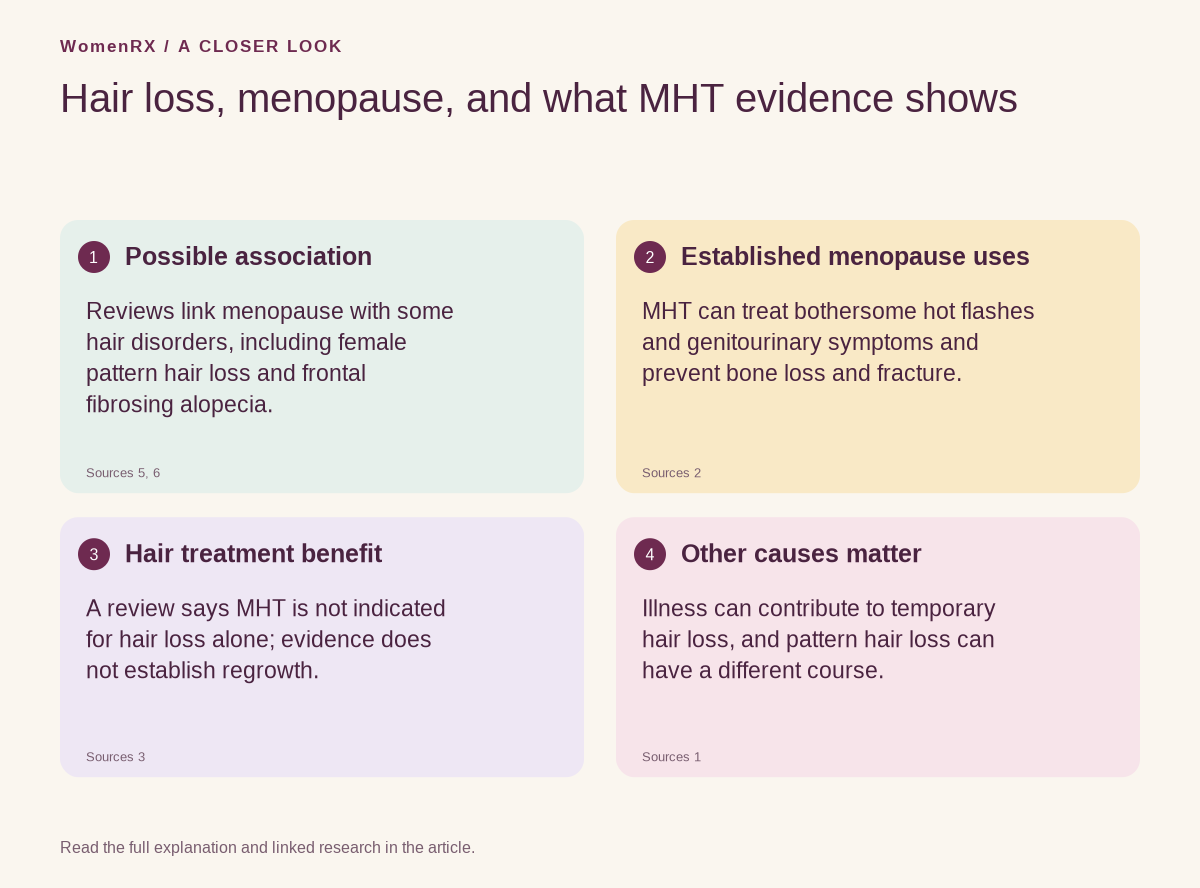
Hair loss, menopause, and what MHT evidence shows
Possible association: Reviews link menopause with some hair disorders, including female pattern hair loss and frontal fibrosing alopecia.56
Established menopause uses: MHT can treat bothersome hot flashes and genitourinary symptoms and prevent bone loss and fracture.2
Hair treatment benefit: A review says MHT is not indicated for hair loss alone; evidence does not establish regrowth.3
Other causes matter: Illness can contribute to temporary hair loss, and pattern hair loss can have a different course.1
Read the figure as text
These distinctions keep an observed menopause association separate from proven hair-loss treatment benefit.- Possible association: Reviews link menopause with some hair disorders, including female pattern hair loss and frontal fibrosing alopecia.56
- Established menopause uses: MHT can treat bothersome hot flashes and genitourinary symptoms and prevent bone loss and fracture.2
- Hair treatment benefit: A review says MHT is not indicated for hair loss alone; evidence does not establish regrowth.3
- Other causes matter: Illness can contribute to temporary hair loss, and pattern hair loss can have a different course.1
More questions, answered
Does hair loss mean my estrogen is low?
Not on its own. Menopause and some hair conditions are associated, but the available reviews say the effects of hormonal changes on hair and the role of hormone therapy need more study. Hair loss can also have other explanations, so the pattern and health history matter. 5 6
Can hormone therapy affect hair?
The evidence doesn’t support a single answer for every hair condition or hormone regimen. A systematic review found an association between MHT and frontal fibrosing alopecia, while noting that MHT findings are limited and inconsistent and that most studies involved formulations less commonly used today. An association does not prove that MHT caused the condition. 5
Sources you can check
- Hair loss - NHSAccessed 2026-09-25Return to first citation
- The 2022 hormone therapy position statement of The North American Menopause Society.“The 2022 Hormone Therapy Position Statement of The North American Menopause Society” Advisory Panel. · Menopause (New York, N.Y.) · 2022Return to first citation
- Hormone Replacement Therapy and Hair: A Review for Trichologists Treating Menopausal Women.Lee J, Krishnegowda R, Miteva MI. · Dermatology (Basel, Switzerland) · 2026Return to first citation
- Nutrition of women with hair loss problem during the period of menopause.Goluch-Koniuszy ZS. · Przeglad menopauzalny = Menopause review · 2016Return to first citation
- Menopause and Common Dermatoses: A Systematic Review.Roster K, Fleshner L, Karatas TB, Ecanow A, Sayegh A, Farabi B, Marmon S. · American journal of clinical dermatology · 2026Return to first citation
- Menopause, skin and common dermatoses. Part 1: hair disorders.Kamp E, Ashraf M, Musbahi E, DeGiovanni C. · Clinical and experimental dermatology · 2022Return to first citation