Estrogen and Heart Health: What Menopause Hormone Therapy Can and Cannot Do
Menopause hormone therapy can ease symptoms, but it isn’t a proven way to prevent heart disease.
Heart disease risk tends to rise after menopause, but that association doesn’t prove that falling estrogen alone causes it. Hormone therapy isn’t recommended to prevent cardiovascular disease. For bothersome menopause symptoms, age, time since menopause, route, and personal cardiovascular risk all matter: starting before age 60 or within 10 years of menopause generally has a more favorable benefit-risk balance than starting later, but it isn’t risk-free. 1 2 4
Menopause and heart risk are connected, but not interchangeable
Heart disease risk increases after menopause, and declining estrogen is one part of the biological picture. But an association between menopause and rising risk doesn’t show that estrogen loss is the only cause, or that replacing estrogen will prevent heart disease. Age and a woman’s existing health risks also matter. 1 3
That distinction helps make sense of two findings that can sound contradictory: hormone therapy may have a more favorable balance of benefits and risks when started earlier, yet it is not a treatment for preventing heart disease. The timing finding concerns the overall balance for treatment, especially for menopause symptoms, not a guarantee of cardiovascular protection. 2 4
What hormone therapy is for
Systemic menopause hormone therapy is an effective treatment for bothersome hot flashes and other vasomotor symptoms. Its risks vary with factors including the type of hormone, route, timing, duration, and whether a progestogen is used. It isn’t recommended as a way to prevent cardiovascular disease. 2 4
For women younger than 60 or within 10 years of menopause onset who have no contraindications, the North American Menopause Society describes the benefit-risk balance as generally favorable when therapy is used for bothersome vasomotor symptoms or to prevent bone loss. That is a treatment decision, not a heart-prevention recommendation. Starting after age 60 or more than 10 years after menopause is generally less favorable, in part because absolute risks of coronary heart disease, stroke, and blood clots are greater. 2
These age and timing markers are guides, not a personal safety guarantee. Your own cardiovascular history and risk factors can change the discussion. Women with cardiovascular risk factors need risk assessment tailored to the individual; a 2026 joint position paper says systemic therapy may still be considered for symptom relief for some women with established ischemic heart disease, but only after careful review of risks and benefits. 2 3
Route changes the discussion, not the goal
Oral and transdermal estrogen don’t have identical effects on cardiovascular risk. A 2026 review reports higher blood-clot and stroke risk with oral estrogen than with transdermal formulations. That suggests route can matter when weighing options, but it doesn’t establish that a patch is universally safe, prevents heart disease, or removes the need to consider your individual risks. 4
Hormone therapy can also include a progestogen, depending on the treatment regimen. Because the balance of risks varies with formulation as well as route and timing, it’s more useful to discuss the specific option being considered than to treat “estrogen” as one uniform therapy. 2
Low-dose vaginal estrogen is a separate option for certain genitourinary symptoms when systemic hormone therapy isn’t indicated. It shouldn’t be confused with systemic therapy for hot flashes or used as a heart-health strategy. 2
Make the decision about the symptom and the person
A practical conversation can start with three questions: Which symptoms are you trying to treat? How do your age, time since menopause, and cardiovascular history affect the balance for you? Would the route or formulation change that balance? If you have established heart disease or significant cardiovascular risk, make sure that history is part of the decision rather than assuming that an earlier start or a particular route makes therapy risk-free. Treatment decisions should be individualized and revisited over time. 2 3
Heart disease prevention remains a separate task. Menopause hormone therapy shouldn’t replace assessment or management of cardiovascular risk. Keeping symptom relief and heart prevention as two related but distinct goals makes it easier to judge whether a treatment is serving the reason you’re considering it. 1 4
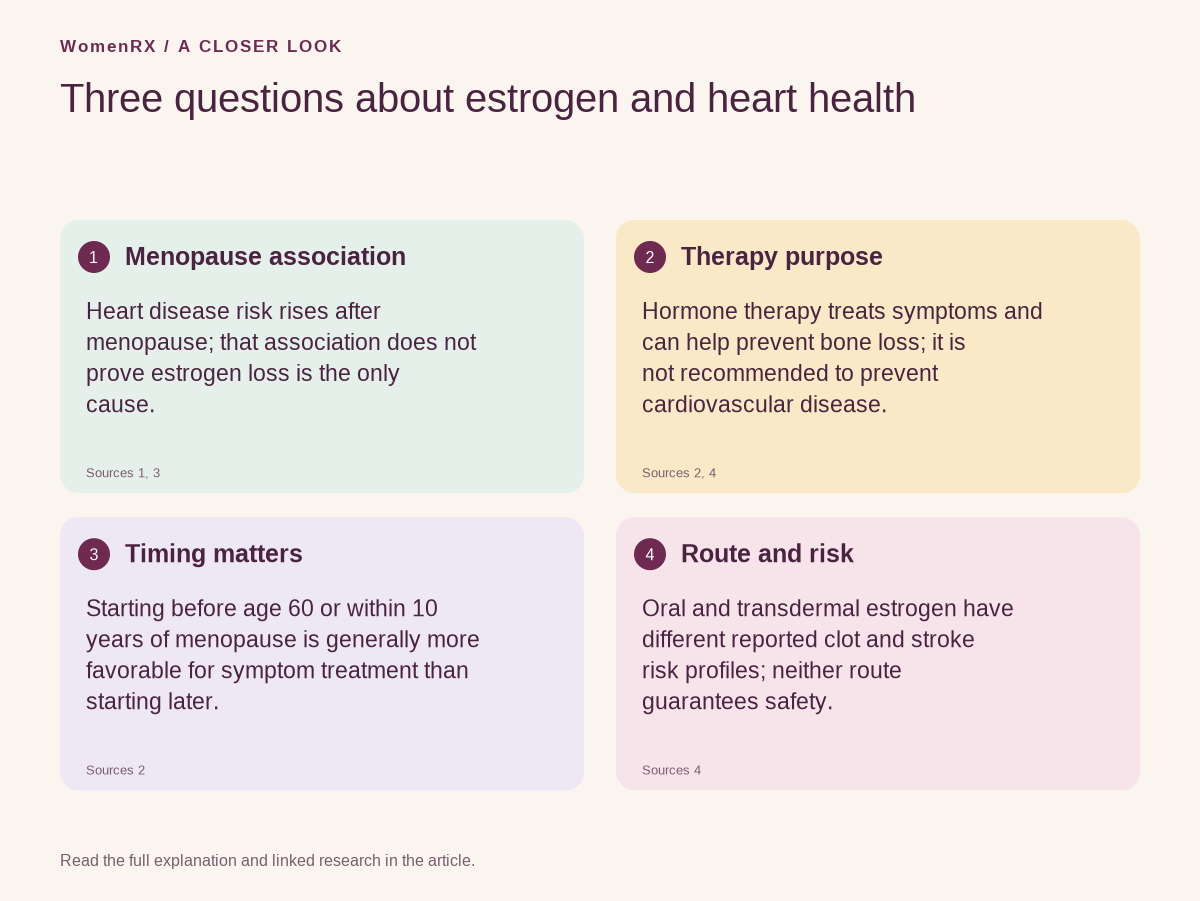
Three questions about estrogen and heart health
Menopause association: Heart disease risk rises after menopause; that association does not prove estrogen loss is the only cause.13
Therapy purpose: Hormone therapy treats symptoms and can help prevent bone loss; it is not recommended to prevent cardiovascular disease.24
Timing matters: Starting before age 60 or within 10 years of menopause is generally more favorable for symptom treatment than starting later.2
Route and risk: Oral and transdermal estrogen have different reported clot and stroke risk profiles; neither route guarantees safety.4
Read the figure as text
Separate what menopause-related risk associations show from what hormone therapy is used for and what personal risk assessment adds.- Menopause association: Heart disease risk rises after menopause; that association does not prove estrogen loss is the only cause.13
- Therapy purpose: Hormone therapy treats symptoms and can help prevent bone loss; it is not recommended to prevent cardiovascular disease.24
- Timing matters: Starting before age 60 or within 10 years of menopause is generally more favorable for symptom treatment than starting later.2
- Route and risk: Oral and transdermal estrogen have different reported clot and stroke risk profiles; neither route guarantees safety.4
More questions, answered
Does starting hormone therapy early mean it will protect my heart?
No. Starting before age 60 or within 10 years of menopause can make the overall benefit-risk balance more favorable for some women using therapy for symptoms, but hormone therapy isn’t recommended to prevent cardiovascular disease. 2 4
Does the route of estrogen make a difference?
It can affect the risk discussion. A review reports higher blood-clot and stroke risk with oral than transdermal estrogen, but that doesn’t mean transdermal therapy is risk-free or the right choice for everyone. 4
Sources you can check
- Heart Disease in Women | MedlinePlusAccessed 2026-09-25Return to first citation
- The 2022 hormone therapy position statement of The North American Menopause Society.“The 2022 Hormone Therapy Position Statement of The North American Menopause Society” Advisory Panel. · Menopause (New York, N.Y.) · 2022Return to first citation
- Menopause hormone therapy in women with cardiovascular risk factors or established ischemic heart disease: A joint FIGO and WHF position paper.Benedetto C, Gulati M, Khadilkar SS, Maas AHEM, Frezet F, de Oliveira GMM, Genazzani AR, Divakar H, Poppas A, World Heart Federation (WHF) and the International Federation of Gynec... · International journal of gynaecology and obstetrics: the official organ of the International Federation of Gynaecology and Obstetrics · 2026Return to first citation
- Menopausal Hormone Therapy and Cardiovascular Risk: Current Evidence and Clinical Implications.Buzduga CM, Bobu AM, Covali R, Costea CF, Cucu AI, Graur M, Patrascanu E, Solomon-Condriuc I, Carauleanu A. · Medical sciences (Basel, Switzerland) · 2026Return to first citation