Menopause, Estrogen, and Anxiety: What the Evidence Can and Cannot Show
Anxiety may overlap with menopause, but its timing doesn’t prove estrogen is the cause or that hormone therapy will treat it.
Anxiety during perimenopause or after menopause can have more than one possible contributor. Researchers have proposed ways estrogen may affect mood, but that doesn’t establish the cause of your anxiety. Hormone therapy is an established option for bothersome hot flashes and night sweats, not an established anxiety treatment. Persistent or disruptive anxiety deserves attention in its own right. 1 2 4
A menopause connection is possible, not proven
Anxiety can coincide with the menopause transition, but timing alone can’t show that hormone changes caused it or tell you what your estrogen level is. Researchers have proposed that estrogen signaling may influence brain systems involved in mood. That gives scientists a possible pathway to study, not a way to diagnose the cause of anxiety in an individual woman. 3 5
The treatment evidence needs the same care. A 2026 narrative review found no definitive consensus on hormone therapy for menopausal mental-health symptoms. It describes possible antidepressant effects of estrogen therapy during perimenopause and less clear findings for depression after menopause. Those findings concern depression; they don’t establish that hormone therapy treats anxiety in either stage. 4
Treating hot flashes isn’t the same as treating anxiety
Menopausal hormone therapy is an established treatment for bothersome hot flashes and night sweats. Whether it makes sense depends on individual factors, including the type and timing of therapy and personal health history. The menopause treatment guidance cited here does not identify anxiety as an established reason to use hormone therapy. 2
If anxiety and hot flashes happen together, it may help to separate the questions: Are the hot flashes bothersome enough to consider treatment? And does the anxiety need its own assessment or treatment? Addressing one doesn’t automatically resolve the other.
There is a small, limited observation worth interpreting cautiously. In a cross-sectional study of 45 women with painful temporomandibular disorders, the 16 menopausal women using hormone therapy had a lower average anxiety-symptom score than the 14 menopausal women not using it. The study captured one point in time, involved a selected group with painful jaw disorders, and did not assign treatment. It can’t show that hormone therapy caused the score difference or that it would reduce anxiety more broadly. 3
Look beyond hormones when anxiety persists
Stress can bring on temporary anxiety, and caffeine, other substances, or certain medicines can make symptoms worse. Health problems can also contribute to symptoms that feel like anxiety. An evaluation may include questions about your health and symptoms, a physical exam, or lab tests to check for another cause. 1
Anxiety deserves attention beyond a menopause explanation when it doesn’t go away, gets worse, is hard to control, or interferes with work, relationships, or everyday activities. Cognitive behavioral therapy is one treatment option for anxiety disorders; medication may also be considered based on the type of anxiety and your needs. You don’t have to determine whether menopause is involved before addressing anxiety that is affecting your life. 1
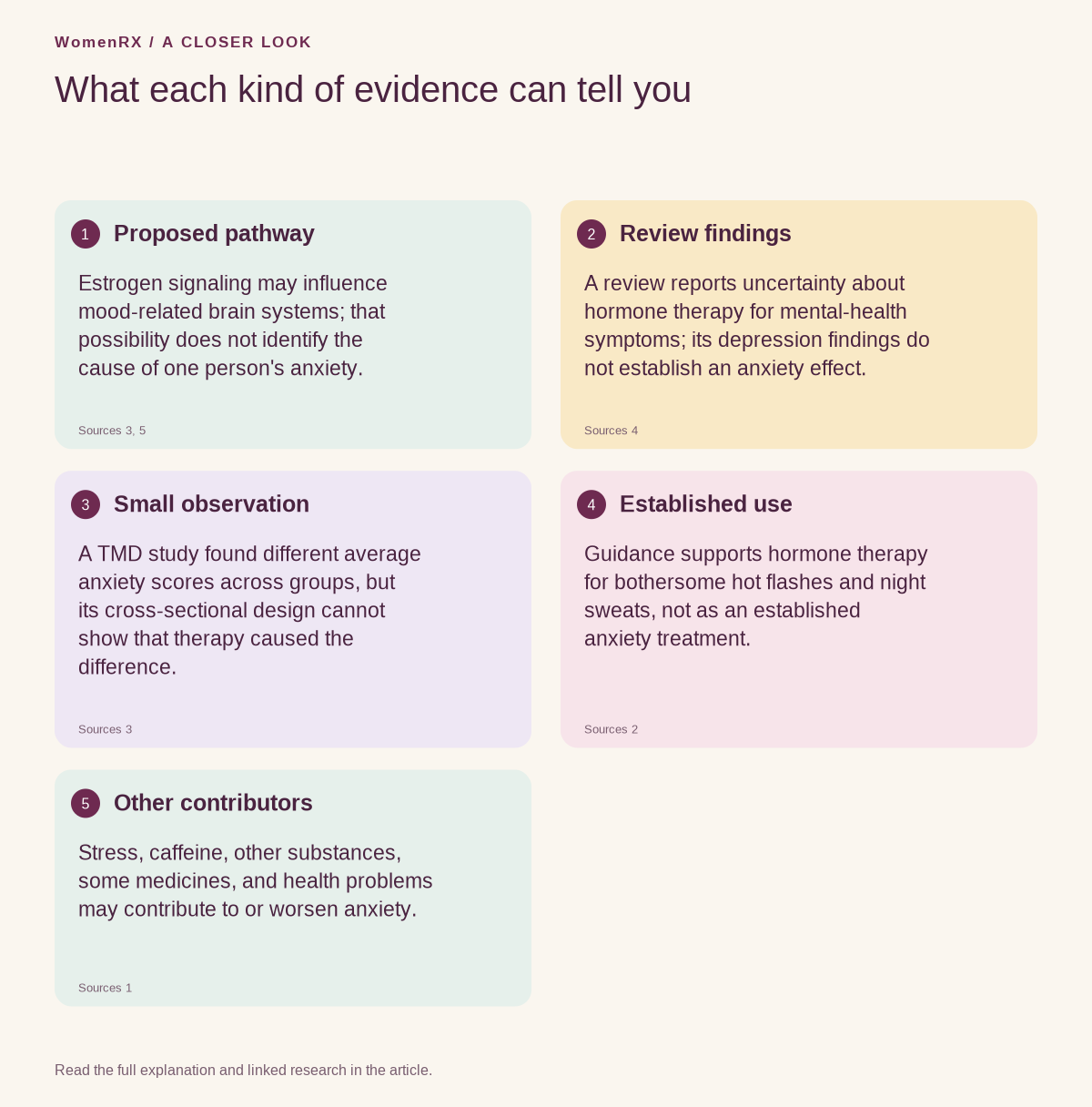
What each kind of evidence can tell you
Proposed pathway: Estrogen signaling may influence mood-related brain systems; that possibility does not identify the cause of one person's anxiety.35
Review findings: A review reports uncertainty about hormone therapy for mental-health symptoms; its depression findings do not establish an anxiety effect.4
Small observation: A TMD study found different average anxiety scores across groups, but its cross-sectional design cannot show that therapy caused the difference.3
Established use: Guidance supports hormone therapy for bothersome hot flashes and night sweats, not as an established anxiety treatment.2
Other contributors: Stress, caffeine, other substances, some medicines, and health problems may contribute to or worsen anxiety.1
Read the figure as text
These distinctions help separate a plausible hormone connection from evidence that a treatment works for anxiety.- Proposed pathway: Estrogen signaling may influence mood-related brain systems; that possibility does not identify the cause of one person's anxiety.35
- Review findings: A review reports uncertainty about hormone therapy for mental-health symptoms; its depression findings do not establish an anxiety effect.4
- Small observation: A TMD study found different average anxiety scores across groups, but its cross-sectional design cannot show that therapy caused the difference.3
- Established use: Guidance supports hormone therapy for bothersome hot flashes and night sweats, not as an established anxiety treatment.2
- Other contributors: Stress, caffeine, other substances, some medicines, and health problems may contribute to or worsen anxiety.1
More questions, answered
Does anxiety after menopause mean my estrogen is low?
No. Anxiety’s timing doesn’t establish its cause or your individual estrogen level. Hormone signaling is one proposed influence on mood, but stress, substances, medicines, and health problems can also contribute to or worsen anxiety. 1 3
Is hormone therapy an established treatment for anxiety?
The evidence cited here doesn’t establish hormone therapy as an anxiety treatment. Guidance supports it for certain menopausal symptoms, including bothersome hot flashes and night sweats. Those are separate treatment goals from anxiety itself. 2 4
Sources you can check
- Anxiety: MedlinePlusAccessed 2026-09-25Return to first citation
- The 2022 hormone therapy position statement of The North American Menopause Society.“The 2022 Hormone Therapy Position Statement of The North American Menopause Society” Advisory Panel. · Menopause (New York, N.Y.) · 2022Return to first citation
- Hormone therapy and psychosocial factors in menopausal women with painful TMD: a pilot cross-sectional study.Farias LNG, Costa Neto RED, Pinheiro MA, Cavalcanti YW. · Journal of applied oral science : revista FOB · 2026Return to first citation
- The role of hormone replacement therapy in the management of perimenopausal mental health symptoms: A narrative review.Langhe R, Kelly T, Ibrahim R, Al-Janabi R, Mohammed G, Mousa N. · International journal of gynaecology and obstetrics: the official organ of the International Federation of Gynaecology and Obstetrics · 2026Return to first citation
- Beyond Hot Flashes: The Role of Estrogen Receptors in Menopausal Mental Health and Cognitive Decline.Cho JM, Lee J, Ahn EM, Bae J. · Brain sciences · 2025Return to first citation