Menopause Hormone Therapy, Cholesterol, and Heart Risk
Hormone therapy can change some cholesterol measurements, but a more favorable lab result doesn’t prove fewer heart attacks or strokes.
Oral menopause hormone therapy can improve some lipid measurements, while transdermal estrogen generally has less effect on lipids; adding a progestogen can also blunt estrogen’s lipid effects. But changes in cholesterol numbers aren’t proof that therapy prevents heart attacks or strokes. Hormone therapy isn’t recommended to prevent cardiovascular disease or treat cholesterol; decisions about cholesterol should be made separately from decisions about menopause symptoms. 4
A better cholesterol result isn’t the same as a heart benefit
Menopause hormone therapy (sometimes called MHT or HT) can affect blood lipids, including cholesterol carried by different lipoproteins. Oral estrogen generally has more favorable effects on these measurements than estrogen delivered through the skin. But a change in a lab value is a marker, not a heart attack or stroke outcome. A treatment can improve a risk-related number without being shown to prevent those events. 4
That distinction matters if you’re considering hormone therapy and notice that cholesterol is part of the conversation. Hormone therapy is not recommended for primary or secondary cardiovascular disease prevention. Its benefits and risks are assessed for reasons such as bothersome menopause symptoms, not as a substitute for cholesterol treatment. 34
Route and formulation can change the lipid picture
Oral estrogen has favorable effects on some lipoprotein levels. Adding a progestogen can reduce, or blunt, those lipid-related effects. Transdermal estrogen, such as a patch, has less effect on lipids than oral estrogen, according to a review of the evidence. That means the route may matter to lab results, but it doesn’t make one route a proven way to prevent heart disease. 4
The same review notes that clinical outcome evidence for transdermal and other alternative hormone regimens is limited. Observational studies suggest transdermal estrogen may carry lower risks of blood clots in veins and stroke than oral estrogen, but observational findings don’t establish that it prevents heart attacks or strokes. 4
What studies of heart events add
Randomized trials of oral conjugated equine estrogen, with or without medroxyprogesterone acetate, have examined coronary events in postmenopausal women. A later analysis of these trials found that coronary risk varied by participants’ starting lipid profiles. For example, in the estrogen-plus-progestogen trial, women with very high untreated LDL had higher coronary risk than placebo-treated participants; women with lower LDL did not show that same pattern. These results describe differences by baseline cholesterol in particular oral-treatment trials. They do not show that taking hormone therapy to improve cholesterol prevents heart disease. 5
The position statement from The North American Menopause Society also emphasizes that hormone therapy’s risks vary with factors such as formulation, route, timing, and whether a progestogen is used. Starting treatment later after menopause or at an older age is associated with a less favorable benefit-risk balance, including greater absolute risks of coronary disease, stroke, and blood clots. 3
Keep cholesterol care separate from menopause care
If you’re considering systemic hormone therapy for symptoms, ask how your health history and treatment options affect the overall benefit-risk balance. A lipid result can be one part of that discussion, but it can’t establish that hormone therapy will protect your heart.
If your cholesterol is high, address it as a cardiovascular risk factor in its own right. Heart-healthy eating, physical activity, and medicines when needed are established approaches to lowering or controlling cholesterol. Which approach makes sense depends on your health and risk, not on whether hormone therapy improves a particular number. 12
The practical takeaway: choose hormone therapy, if appropriate, for a menopause-related reason; evaluate and treat cholesterol on its own merits. A favorable lipid shift during therapy shouldn’t be mistaken for proven heart protection.
Lipid changes versus heart outcomes
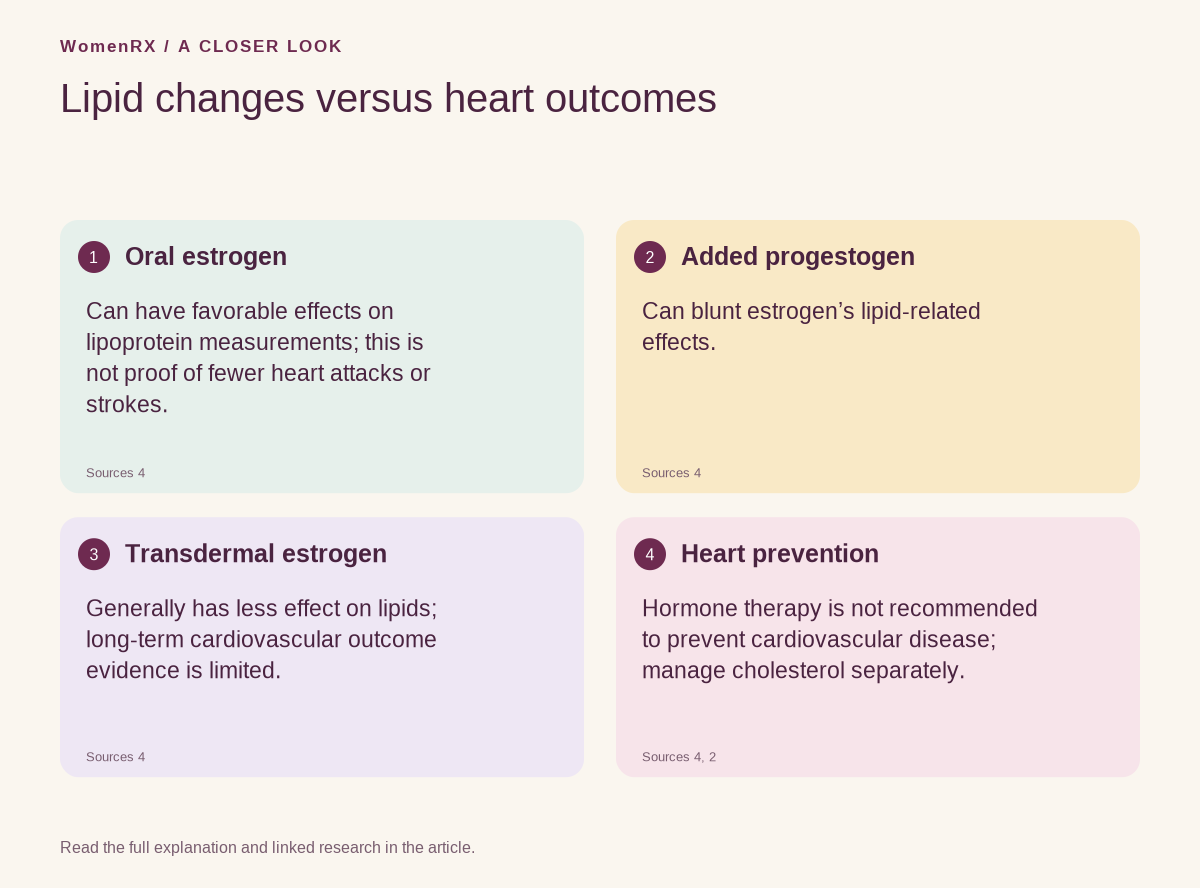
Oral estrogen: Can have favorable effects on lipoprotein measurements; this is not proof of fewer heart attacks or strokes.4
Added progestogen: Can blunt estrogen’s lipid-related effects.4
Transdermal estrogen: Generally has less effect on lipids; long-term cardiovascular outcome evidence is limited.4
Heart prevention: Hormone therapy is not recommended to prevent cardiovascular disease; manage cholesterol separately.42
Read the figure as text
A lab result and a clinical outcome answer different questions. Route can affect lipid measurements, but that alone doesn’t establish heart protection.- Oral estrogen: Can have favorable effects on lipoprotein measurements; this is not proof of fewer heart attacks or strokes.4
- Added progestogen: Can blunt estrogen’s lipid-related effects.4
- Transdermal estrogen: Generally has less effect on lipids; long-term cardiovascular outcome evidence is limited.4
- Heart prevention: Hormone therapy is not recommended to prevent cardiovascular disease; manage cholesterol separately.42
More questions, answered
If hormone therapy changes my cholesterol, should I stop cholesterol medicine?
A lipid change during hormone therapy doesn’t establish that your cholesterol is adequately controlled or that heart risk has fallen. Cholesterol medicines are a separate treatment option when lifestyle changes aren’t enough; decisions about them should be based on your cholesterol and overall health plan. 2
Does the cholesterol effect mean a patch is better for heart prevention?
No. Transdermal estrogen has less effect on lipids than oral estrogen, but that difference doesn’t show that a patch prevents heart attacks or strokes. Long-term trials of cardiovascular outcomes with transdermal and other alternative regimens are limited. 4
Sources you can check
- Heart Disease Prevention | MedlinePlusAccessed 2026-09-25Return to first citation
- How to Lower Cholesterol: MedlinePlusAccessed 2026-09-25Return to first citation
- The 2022 hormone therapy position statement of The North American Menopause Society.“The 2022 Hormone Therapy Position Statement of The North American Menopause Society” Advisory Panel. · Menopause (New York, N.Y.) · 2022Return to first citation
- Menopausal Hormone Therapy and Cardiovascular Disease: The Role of Formulation, Dose, and Route of Delivery.Shufelt CL, Manson JE. · The Journal of clinical endocrinology and metabolism · 2021Return to first citation
- Influence of Cardiometabolic Status on Cardiovascular Effects of Oral Menopausal Hormone Therapy.Rossouw JE, Aragaki AK, Manson JE, Szmuilowicz ED, Harrington LB, Allison M, Haring B, Nudy M, Davis JW, LaCroix AZ. · Obstetrics and gynecology · 2026Return to first citation