Menopause, Migraines, and the Hormone Therapy Conversation
Migraine can become less predictable during perimenopause, and hormone therapy may help, worsen, or leave attacks unchanged.
Fluctuating hormones during perimenopause can make migraine more frequent or less predictable. After menopause, attacks often improve, especially migraine without aura, but not for everyone. Menopause hormone therapy treats menopausal symptoms, not migraine reliably; its effect on attacks varies. If you’re considering it, discuss aura, your migraine pattern, and the proposed route and schedule. 3 4 5
Why your usual pattern might change
If migraine used to arrive just before your period, irregular cycles can make its timing harder to anticipate. Changing estradiol and progesterone levels during perimenopause are linked to more frequent and less predictable attacks. Sleep disturbance and other midlife changes may add to the difficulty of working out what’s driving a particular headache. 1 4
Migraine often improves after natural menopause, especially migraine without aura. Migraine with aura may persist. But improvement isn’t guaranteed, and there’s no established timetable for it. A systematic review found that population-based studies generally reported improvement after menopause, while studies of people attending headache clinics found no improvement or sometimes worsening. The difference is a reminder that an average pattern can’t predict yours. 2 4 5 10
What hormone therapy can and can’t do
Menopause hormone therapy (MHT) is an effective treatment for bothersome hot flashes and other vasomotor symptoms. Migraine is a different treatment goal: MHT may change attacks, but research hasn’t established it as a dependable migraine preventive. Observational studies have associated postmenopausal hormone therapy with worsening migraine, though they can’t show that the therapy caused it. A recent review also found no research trials testing MHT for migraine specifically during perimenopause. 3 5 9
That leaves room for two things to be true at once. MHT might be worth considering for menopausal symptoms, and you might still need a separate plan to treat or prevent migraine. If headaches change after starting MHT, the timing is worth discussing rather than assuming either that the therapy is responsible or that you must put up with the change. 1 3 4
Why the route and schedule come up
The practical question isn’t simply whether MHT contains estrogen. It’s how hormones are delivered and whether levels rise and fall with the treatment schedule. Reviews suggest that transdermal estradiol, delivered through the skin by a patch or gel, may provide steadier levels and be better tolerated for migraine than oral estrogen. They also suggest that continuous regimens may cause fewer withdrawal-related attacks than cyclical regimens, particularly after menopause. Those are useful considerations, not proof that a patch or continuous schedule will prevent your attacks. 4 6 9
Perimenopause adds a complication: your own hormone levels may still fluctuate even if you use MHT. A review raises the possibility that adding MHT during this stage could worsen migraine for some people, but trials have not established which approach works best for perimenopausal migraine. MHT’s broader benefits and risks also vary by dose, route, timing, duration, and whether a progestogen is used. 3 9
If you’re weighing options, try asking: What menopausal symptom are we treating? Is the proposed estrogen oral or transdermal? Is the regimen continuous or cyclical? What would prompt us to review it if my attacks change? Those questions keep the menopause treatment goal and the migraine question in view together. 3 4
Make aura part of the decision
Aura can include temporary visual changes such as flashing lights or zigzag lines. Migraine with aura is associated with a higher risk of ischemic stroke, so mention it when discussing MHT, along with other vascular risk factors such as high blood pressure or smoking. 1 4 8
This does not mean the rules for estrogen-containing contraceptives automatically apply to menopause therapy. The two uses shouldn’t be treated as interchangeable: evidence measuring stroke risk from modern MHT specifically in people with aura remains limited. A medical-record study found that MHT was prescribed to people with aura, but it measured use, not whether treatment caused strokes. Aura calls for an individual risk discussion, not a blanket prediction about every formulation. 7 10
If attacks become severe, worsen, or last longer than usual, get the change assessed. Aura symptoms should not last longer than an hour. Seek prompt assessment if a migraine attack lasts longer than 72 hours. 2
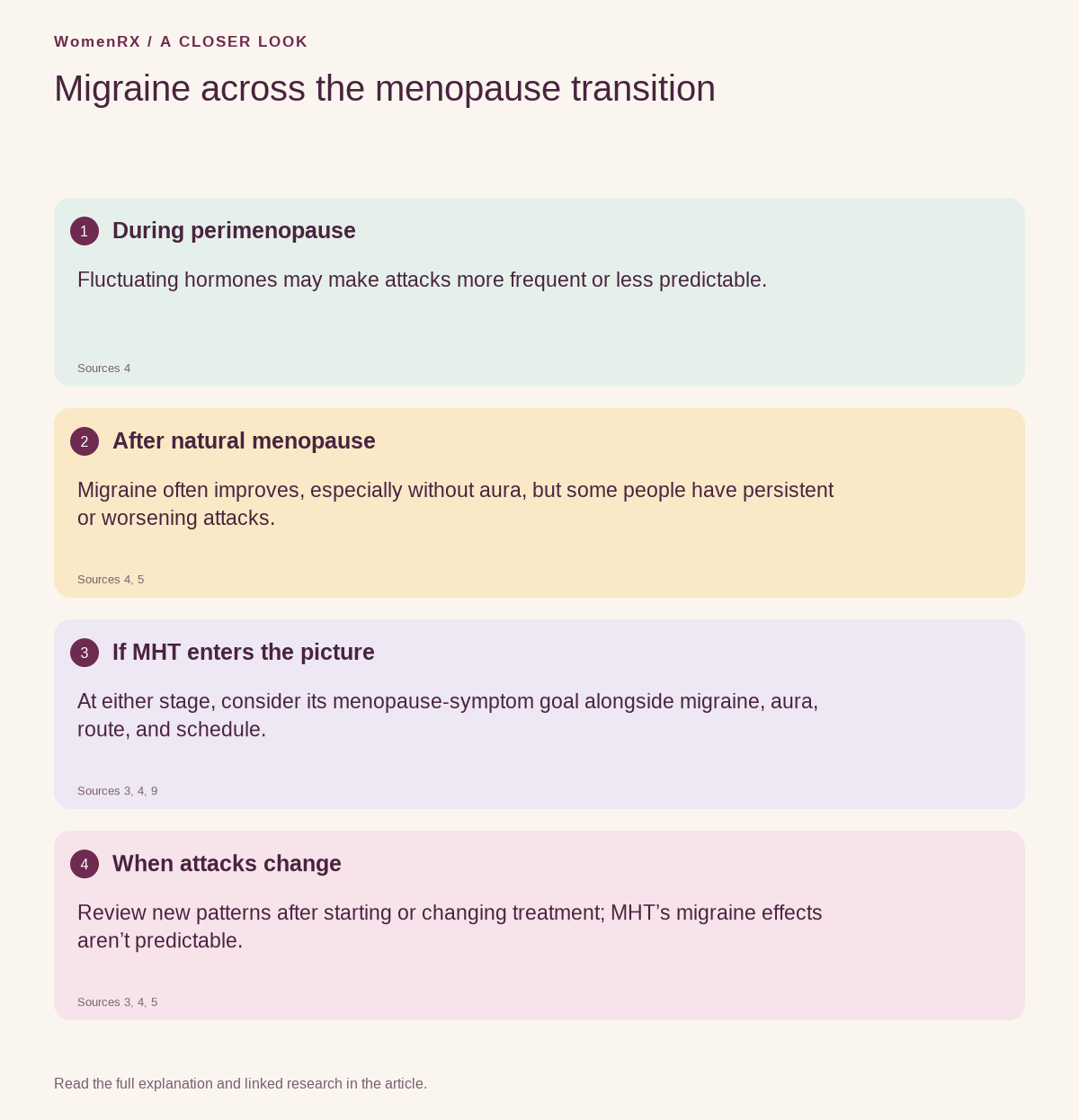
Migraine across the menopause transition
During perimenopause: Fluctuating hormones may make attacks more frequent or less predictable.4
After natural menopause: Migraine often improves, especially without aura, but some people have persistent or worsening attacks.45
If MHT enters the picture: At either stage, consider its menopause-symptom goal alongside migraine, aura, route, and schedule.349
When attacks change: Review new patterns after starting or changing treatment; MHT’s migraine effects aren’t predictable.345
Read the figure as text
A stage-by-stage view of common migraine patterns, with hormone-therapy review relevant whenever treatment is being considered or used.- During perimenopause: Fluctuating hormones may make attacks more frequent or less predictable.4
- After natural menopause: Migraine often improves, especially without aura, but some people have persistent or worsening attacks.45
- If MHT enters the picture: At either stage, consider its menopause-symptom goal alongside migraine, aura, route, and schedule.349
- When attacks change: Review new patterns after starting or changing treatment; MHT’s migraine effects aren’t predictable.345
Sources you can check
- Migraine | MedlinePlusAccessed 2026-09-25Return to first citation
- Migraine - NHSAccessed 2026-09-25Return to first citation
- The 2022 hormone therapy position statement of The North American Menopause Society.“The 2022 Hormone Therapy Position Statement of The North American Menopause Society” Advisory Panel. · Menopause (New York, N.Y.) · 2022Return to first citation
- Migraine across the menopausal transition and beyond: A narrative review.Korn TF, Bernstein C. · Headache · 2026Return to first citation
- Migraine in menopausal women: a systematic review.Ripa P, Ornello R, Degan D, Tiseo C, Stewart J, Pistoia F, Carolei A, Sacco S. · International journal of women's health · 2015Return to first citation
- Migraine in perimenopausal women.Allais G, Chiarle G, Bergandi F, Benedetto C. · Neurological sciences : official journal of the Italian Neurological Society and of the Italian Society of Clinical Neurophysiology · 2015Return to first citation
- Utilization of Oral Contraceptives and Hormone Therapy for Menopause Among Female Individuals With Migraine With Aura: A Descriptive Study.Gibbs LR, Fox MP, Aparicio HJ, Jick S. · Pharmacoepidemiology and drug safety · 2025Return to first citation
- Menopause hormone therapy, migraines, and thromboembolism.Khandelwal S, Meeta M, Tanvir T. · Best practice & research. Clinical obstetrics & gynaecology · 2022Return to first citation
- Perimenopausal migraine: a narrative review.Kamourieh S, MacGregor EA. · Climacteric : the journal of the International Menopause Society · 2026Return to first citation
- Migraine and menopause - a narrative review.Bernstein C, O'Neal MA. · Menopause (New York, N.Y.) · 2020Return to first citation