What Hormone Therapy Trials Tell Us About Headaches
Hormone therapy can relieve menopause symptoms, but migraine may respond differently depending on your pattern and the treatment being considered.
Menopausal hormone therapy (MHT) treats menopause symptoms; it isn’t an established way to prevent migraine. Hormone shifts during perimenopause can change migraine patterns even without treatment, and MHT’s effects on headaches vary. If you’re considering it, separate the symptoms you want relieved from your migraine goals, then discuss your aura history and the proposed route and regimen. 234
Start with what you want treatment to do
If hot flashes or night sweats are disrupting your days or sleep, MHT may help with those menopause symptoms. But relief from hot flashes doesn’t necessarily mean fewer migraines. Migraine prevention is a separate treatment goal. 24
That distinction is especially useful during perimenopause, when migraine may change before you start any hormone treatment. A 2026 narrative review describes fluctuating estradiol and progesterone levels as contributors to attacks becoming more frequent or less predictable. It also reports that migraine without aura often improves after menopause, while migraine with aura may persist. These are population patterns, not a forecast for your next few years. 4
What a hormone-therapy trial analysis can tell us
A secondary analysis of two randomized Women’s Health Initiative trials looked at self-reported headache severity from baseline to one year in 22,876 postmenopausal participants. Their average age was 64, and the trials studied oral estrogen alone or oral estrogen plus progestin, each against placebo. This was an analysis of headache outcomes, not a trial designed to test MHT as migraine prevention. 3
Among participants with a history of migraine, assignment to estrogen alone was not associated with clearly worse headache severity or a worsening headache trajectory after one year. Assignment to estrogen plus progestin was associated with a greater likelihood of a worsening headache trajectory. Its association with greater headache severity did not reach statistical significance. These findings don’t mean every estrogen-plus-progestin plan will worsen migraine, or that estrogen alone will leave it unchanged. 3
The study also doesn’t answer the question many people face during perimenopause: what will happen with a particular patch, pill, or regimen started while periods and migraine patterns are changing? Its reported results concern oral treatments in postmenopausal participants, and the abstract does not give separate results for migraine with aura. 34
Why the route and schedule come up
MHT isn’t one uniform treatment. Menopause guidance says its overall benefits and risks vary by type, dose, route, timing, duration, and whether a progestogen is used. These choices matter even if migraine is not the main reason you’re considering treatment. 2
For headaches specifically, a narrative review reports that oral estrogen, particularly at higher doses, may worsen migraine, while low-dose transdermal estrogen appears better tolerated. It also suggests that continuous progestogen regimens may mean fewer withdrawal-related attacks than cyclic regimens. These are reasons to discuss a proposed plan, not proof that a patch or continuous schedule will prevent your migraines. The Women’s Health Initiative headache analysis did not test those comparisons. 34
A practical question is: What menopause symptom is this plan intended to relieve, and why this route and schedule for me? If preventing migraine is also a priority, ask what would address that goal separately. 24
Aura changes the risk conversation
Aura can involve symptoms such as flashing lights, zigzag lines, or difficulty speaking around a migraine attack. Mention whether you’ve had aura, particularly if your pattern has changed. Migraine with aura is associated with increased ischemic stroke risk, so it belongs in a discussion of your broader vascular health and the specific MHT option under consideration. It is not interchangeable with migraine without aura, and the hormone-therapy trial analysis does not provide an aura-specific answer. 134
Before that discussion, it helps to be clear about whether headaches became more frequent or severe before a treatment change or after one. Bring the pattern you’ve noticed, your aura history, and your main menopause symptom. That gives you and your clinician two distinct questions to work through: whether MHT fits your menopause goals, and how to manage migraine on its own terms.
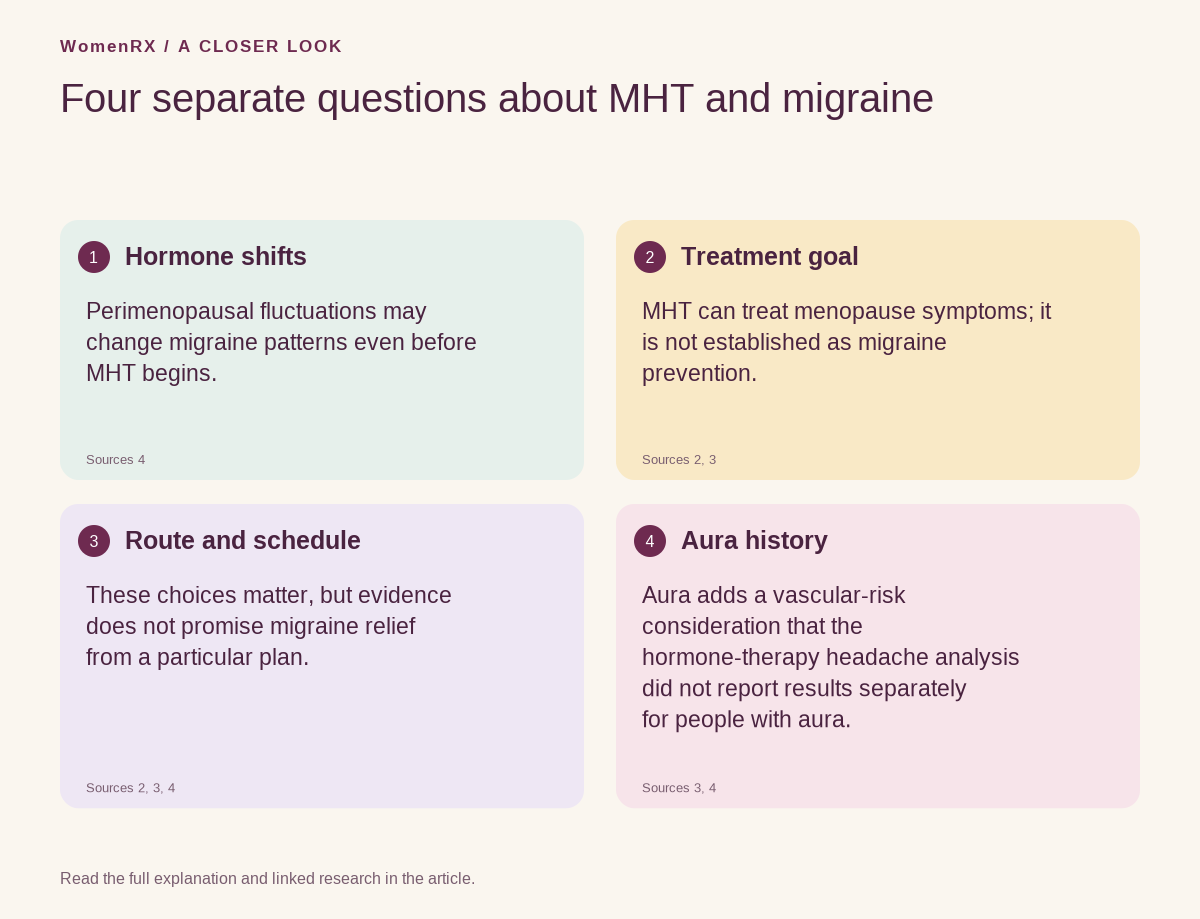
Four separate questions about MHT and migraine
Hormone shifts: Perimenopausal fluctuations may change migraine patterns even before MHT begins.4
Treatment goal: MHT can treat menopause symptoms; it is not established as migraine prevention.23
Route and schedule: These choices matter, but evidence does not promise migraine relief from a particular plan.234
Aura history: Aura adds a vascular-risk consideration that the hormone-therapy headache analysis did not report results separately for people with aura.34
Read the figure as text
Use these distinctions to keep menopause treatment goals, headache changes, and individual risk from becoming one yes-or-no question.- Hormone shifts: Perimenopausal fluctuations may change migraine patterns even before MHT begins.4
- Treatment goal: MHT can treat menopause symptoms; it is not established as migraine prevention.23
- Route and schedule: These choices matter, but evidence does not promise migraine relief from a particular plan.234
- Aura history: Aura adds a vascular-risk consideration that the hormone-therapy headache analysis did not report results separately for people with aura.34
More questions, answered
Does migraine with aura automatically rule out MHT?
Aura calls for an individualized discussion, not an assumption that all migraine types carry the same considerations. It is associated with increased ischemic stroke risk, while research on MHT headache outcomes has not adequately separated participants by aura status. 34
If MHT helps my sleep, will it also prevent migraine?
Not necessarily. MHT is an effective treatment for menopausal hot flashes and night sweats, but it is not established as migraine prevention. If migraine attacks remain a problem, treat that as a separate goal. 24
Sources you can check
- Migraine - NHSAccessed 2026-09-25Return to first citation
- The 2022 hormone therapy position statement of The North American Menopause Society.“The 2022 Hormone Therapy Position Statement of The North American Menopause Society” Advisory Panel. · Menopause (New York, N.Y.) · 2022Return to first citation
- Menopausal hormone therapy, migraine history, and headache severity: Results from the Women's Health Initiative Hormone Therapy clinical trials.Crowe HM, Madsen TE, Rich-Edwards JW, Shadyab AH, Liu L, Farland LV, Schnatz PF, Manson JE, Rexrode KM, Stefanick ML. · Headache · 2026Return to first citation
- Migraine across the menopausal transition and beyond: A narrative review.Korn TF, Bernstein C. · Headache · 2026Return to first citation