Menopause HRT and Hair Loss: What the Evidence Can and Cannot Tell You
Hair changes can happen around menopause, but timing alone doesn’t show that estrogen loss is the cause or that hormone therapy will treat them.
Some hair disorders are associated with the menopausal years, but that doesn’t tell you why your hair is changing. Inherited patterns, illness-related shedding, and scalp conditions are among other possibilities. Menopausal hormone therapy (HRT) isn’t currently indicated for hair loss alone. Ask to have the hair and scalp assessed, and consider HRT separately for menopause symptoms or another established reason. 1 3 4 5
Menopause may be part of the picture, not the whole explanation
Hair follicles respond to hormones, and reviews describe changes in the hair cycle after menopause. Female pattern hair loss and frontal fibrosing alopecia have also been associated with perimenopause and postmenopause. But an association with this life stage doesn’t establish that declining estrogen caused your hair change, or identify its cause in your case. 4 5
Hair loss can have other explanations. Some patterns are inherited, and illness can trigger temporary loss. Hair and scalp conditions are another reason the appearance and location of the change matter. Thinning or shedding that begins around menopause doesn’t distinguish among these possibilities by itself. 1 4
Keep the hair question separate from the HRT question
A 2026 review says HRT is not currently indicated for hair loss alone. That is not evidence that HRT restores hair or prevents thinning. 3
There is a finding worth discussing in context: a systematic review reported an association between menopausal hormone therapy and frontal fibrosing alopecia. An association does not prove that HRT causes the condition. The review also noted that most studies involved hormone formulations less commonly used in current practice, which limits how directly the finding applies to today’s choices. 4
If you’re considering HRT, ask two separate questions: whether it makes sense for your menopause symptoms or another established reason, and what may be causing your hair change. The North American Menopause Society identifies hormone therapy as an effective treatment for bothersome hot flashes and night sweats and emphasizes weighing benefits and risks for each person. Hair loss alone is not an indication to start it. 2 3
If you already take HRT, the evidence doesn’t establish that it is causing your hair loss or that changing it will improve your hair. Bring the timing of your hair change and your treatment to the person assessing your hair. Discuss any change to HRT in light of why you take it and its potential benefits and risks. 2 3 4
Use the pattern to focus the assessment
A clinician may get useful clues by looking at your hair. You can describe when the change began, whether you notice more shedding or gradual thinning, and where it is most apparent. Mention a recent illness if you’ve had one. These details don’t diagnose the cause, but they can help focus the conversation. 1
Useful questions include: “What types of hair loss could fit this pattern?” “Could a scalp condition or another medical cause be involved?” and “What evaluation and treatment make sense for what you’re seeing?” The answers should follow your hair and scalp findings, rather than assuming menopause is the explanation. 1 4
Set treatment expectations after identifying the likely cause
Treatment depends on the type of hair loss. Hair loss related to a medical condition may stop or grow back after recovery, while some inherited pattern hair loss can persist. Identifying the likely cause is therefore a more useful starting point than choosing HRT in the hope that it will help your hair. 1
Before starting a hair treatment, ask what improvement is realistic for the suspected cause and how you’ll know whether the plan is helping. If HRT is also being considered, weigh it for its menopause-related purpose, not as a promise of fuller hair. 2 3
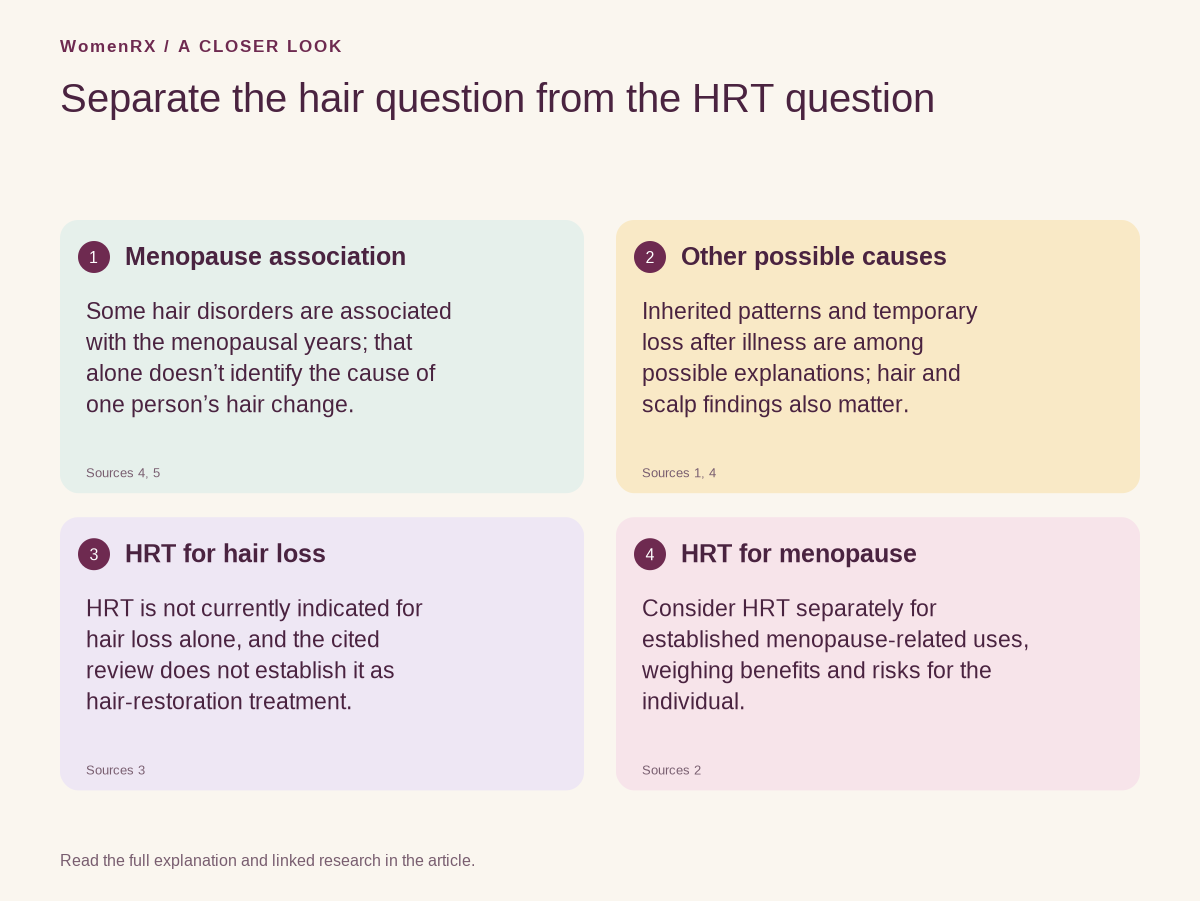
Separate the hair question from the HRT question
Menopause association: Some hair disorders are associated with the menopausal years; that alone doesn’t identify the cause of one person’s hair change.45
Other possible causes: Inherited patterns and temporary loss after illness are among possible explanations; hair and scalp findings also matter.14
HRT for hair loss: HRT is not currently indicated for hair loss alone, and the cited review does not establish it as hair-restoration treatment.3
HRT for menopause: Consider HRT separately for established menopause-related uses, weighing benefits and risks for the individual.2
Read the figure as text
This evidence map shows why a menopause association, an individual hair-loss cause, and a decision about HRT are related but distinct questions.- Menopause association: Some hair disorders are associated with the menopausal years; that alone doesn’t identify the cause of one person’s hair change.45
- Other possible causes: Inherited patterns and temporary loss after illness are among possible explanations; hair and scalp findings also matter.14
- HRT for hair loss: HRT is not currently indicated for hair loss alone, and the cited review does not establish it as hair-restoration treatment.3
- HRT for menopause: Consider HRT separately for established menopause-related uses, weighing benefits and risks for the individual.2
More questions, answered
Should I start HRT just for hair loss?
No. A review says HRT is not currently indicated for hair loss alone, and it doesn’t establish HRT as a hair-restoration treatment. First ask what type of hair loss may be happening. Consider HRT separately for a menopause-related reason. 2 3
Could HRT be related to a hair condition?
A systematic review reported an association between menopausal hormone therapy and frontal fibrosing alopecia, but it doesn’t prove HRT causes the condition. Most studies involved formulations less commonly used in current practice, so the finding can’t predict what will happen to an individual woman. 4
Sources you can check
- Hair loss - NHSAccessed 2026-09-25Return to first citation
- The 2022 hormone therapy position statement of The North American Menopause Society.“The 2022 Hormone Therapy Position Statement of The North American Menopause Society” Advisory Panel. · Menopause (New York, N.Y.) · 2022Return to first citation
- Hormone Replacement Therapy and Hair: A Review for Trichologists Treating Menopausal Women.Lee J, Krishnegowda R, Miteva MI. · Dermatology (Basel, Switzerland) · 2026Return to first citation
- Menopause and Common Dermatoses: A Systematic Review.Roster K, Fleshner L, Karatas TB, Ecanow A, Sayegh A, Farabi B, Marmon S. · American journal of clinical dermatology · 2026Return to first citation
- Menopause, skin and common dermatoses. Part 1: hair disorders.Kamp E, Ashraf M, Musbahi E, DeGiovanni C. · Clinical and experimental dermatology · 2022Return to first citation