Hair Changes Around Menopause: What Evidence Says About Estrogen
Estrogen may be part of the picture, but midlife hair changes have several possible causes, and hormone therapy isn’t an established hair-loss treatment.
Hair can thin or change in texture around menopause, and changing estrogen levels may affect hair follicles. But the timing doesn’t prove estrogen caused your hair changes. Research reports links between menopause and some hair disorders, yet it hasn’t established hormone therapy as a way to prevent or reverse hair loss. The pattern of change and other possible contributors matter too. 4 5
Estrogen may be involved, but timing isn’t proof
Hair follicles respond to hormones. A review of menopause and hair describes how hormonal changes may affect the hair cycle and hair shaft, potentially changing hair density, thickness, or texture. That makes estrogen a plausible part of the picture, but it doesn’t show that falling estrogen caused a particular person’s hair changes. 4
Reviews report that some hair disorders, including female-pattern hair loss and frontal fibrosing alopecia, are seen more often after menopause. Those are associations, not a diagnosis or proof of cause for an individual. Female-pattern hair loss also becomes more common with age, and its underlying biology remains unclear. 4 5 6
What hormone therapy evidence does and doesn’t show
Menopause hormone therapy has established uses, including treatment of bothersome hot flashes and prevention of bone loss in some women. The North American Menopause Society’s position statement discusses those benefits and the factors that affect therapy’s risks, but it does not establish hair loss as a reason to use hormone therapy. 3
A systematic review of menopause and skin conditions found limited and inconsistent findings about menopausal hormone therapy and dermatological conditions. It reported an association between hormone therapy and frontal fibrosing alopecia, but that does not prove the therapy caused the condition. The review also noted that most studies involved formulations less commonly used in current practice, limiting how directly those findings apply today. 5
So don’t count on hormone therapy to prevent or reverse hair loss. If you’re weighing it for another reason, hair outcomes shouldn’t be assumed; the benefits and risks depend on your circumstances and the type and duration of treatment. 3 5
The pattern can point to more than one explanation
“Hair changes” can mean more shedding, gradual thinning, or a change in the hair shaft. Midlife reviews discuss female-pattern hair loss, telogen effluvium, and hair-shaft changes related to hair care. These are different possibilities, and menopause timing alone can’t distinguish among them. 4 7
Other possible contributors include thyroid problems, illness, some medicines, stress, low protein intake, poor nutrition, and family history. Hair-care practices may also be relevant to changes in the hair shaft. That’s why a new change around menopause shouldn’t automatically be attributed to estrogen. 1 7
A useful first step is to describe what you notice: whether it’s more shedding, gradual thinning, or change in particular areas; when it began; and whether it’s continuing. If it concerns you, a clinician can examine your hair and scalp and consider your health history and other possible causes. Treatment depends on the cause, and addressing an underlying problem can help in some cases. 1 2
Menopause is useful context, not a diagnosis. Estrogen may influence hair biology, but the pattern of change and other possible contributors are a more useful starting point than assuming every midlife hair change is hormonal.
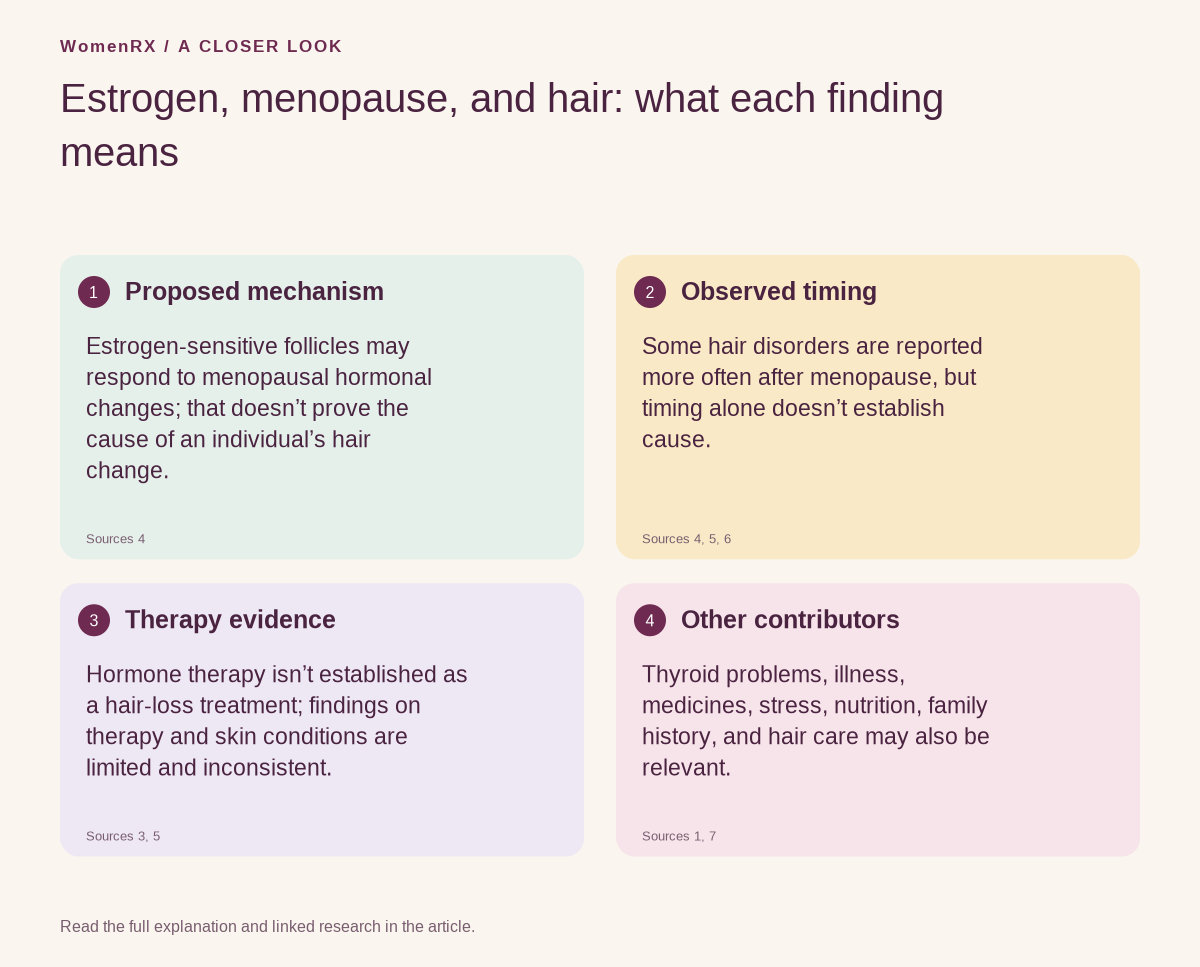
Estrogen, menopause, and hair: what each finding means
Proposed mechanism: Estrogen-sensitive follicles may respond to menopausal hormonal changes; that doesn’t prove the cause of an individual’s hair change.4
Observed timing: Some hair disorders are reported more often after menopause, but timing alone doesn’t establish cause.456
Therapy evidence: Hormone therapy isn’t established as a hair-loss treatment; findings on therapy and skin conditions are limited and inconsistent.35
Other contributors: Thyroid problems, illness, medicines, stress, nutrition, family history, and hair care may also be relevant.17
Read the figure as text
This evidence map separates a proposed hormone effect from observed associations, treatment findings, and other possible contributors.- Proposed mechanism: Estrogen-sensitive follicles may respond to menopausal hormonal changes; that doesn’t prove the cause of an individual’s hair change.4
- Observed timing: Some hair disorders are reported more often after menopause, but timing alone doesn’t establish cause.456
- Therapy evidence: Hormone therapy isn’t established as a hair-loss treatment; findings on therapy and skin conditions are limited and inconsistent.35
- Other contributors: Thyroid problems, illness, medicines, stress, nutrition, family history, and hair care may also be relevant.17
More questions, answered
Does thinning hair after menopause mean my estrogen is low?
Menopause involves a sustained decline in estrogen, but thinning hair by itself can’t identify its cause. Age, family history, health conditions, medicines, stress, and nutrition may also be relevant. 1 4
Can a change in hair texture happen without hair loss?
Yes. Menopause-related reviews describe possible changes in hair texture and in hair density or thickness. Hair-shaft changes related to hair care are also discussed in reviews of midlife hair concerns, so texture change doesn’t by itself establish a hormone-related hair-loss condition. 4 7
Sources you can check
- Hair Loss | Alopecia | Alopecia Areata | MedlinePlusAccessed 2026-09-25Return to first citation
- Hair loss - NHSAccessed 2026-09-25Return to first citation
- The 2022 hormone therapy position statement of The North American Menopause Society.“The 2022 Hormone Therapy Position Statement of The North American Menopause Society” Advisory Panel. · Menopause (New York, N.Y.) · 2022Return to first citation
- Menopause and hair loss in women: Exploring the hormonal transition.Gupta AK, Economopoulos V, Mann A, Wang T, Mirmirani P. · Maturitas · 2025Return to first citation
- Menopause and Common Dermatoses: A Systematic Review.Roster K, Fleshner L, Karatas TB, Ecanow A, Sayegh A, Farabi B, Marmon S. · American journal of clinical dermatology · 2026Return to first citation
- The role of hormones in female androgenetic alopecia: focus on menopause.Anderson A, Konopelski P, Skorzewska K, Kuchnicka A, Waskiel-Burnat A, Rudnicka L. · Climacteric : the journal of the International Menopause Society · 2026Return to first citation
- Managing hair loss in midlife women.Mirmirani P. · Maturitas · 2013Return to first citation