Brain Fog Around Menopause: What Is Known About Estrogen?
Memory and concentration changes can happen around menopause, but they don’t prove that low estrogen is the cause or that hormone therapy will fix them.
Some women notice more forgetfulness or trouble concentrating during the menopause transition, and changing estrogen is one possible part of a broader picture that can include shifts in sleep, mood, and body rhythms. But studies of cognitive test performance don’t show a consistent overall benefit from menopause hormone therapy. Brain fog alone doesn’t establish low estrogen or predict dementia. 3
A real experience, not an estrogen test
You might lose your train of thought, struggle to find a word, or walk into a room and forget why you went there. These experiences are often called “brain fog,” but the phrase doesn’t identify a single cause or tell you what a cognitive test would show. A change you notice in daily life and a change measured on a standardized memory or attention test are related questions, not interchangeable results.
Memory complaints are reported by many women around menopause. The menopause transition is also associated with changes in mood, circadian rhythms, and other brain-related functions. That makes estrogen a plausible piece of the story, but it doesn’t establish that falling estrogen is the sole cause of an individual woman’s symptoms. 3
It’s also possible to feel less mentally sharp while formal test scores remain stable. Conversely, a study’s average test result can’t tell you exactly what one person is experiencing. That distinction matters when interpreting claims that estrogen either “causes brain fog” or “protects the brain.”
What studies of cognitive performance find
A 2024 systematic review and meta-analysis combined results from 34 randomized trials, including 14,914 participants assigned to hormone therapy and 12,679 assigned to placebo. Overall, it found no effect of menopause hormone therapy on cognitive-domain scores. Some analyses did find differences in particular groups or tests: for example, estrogen therapy started in midlife or near menopause was associated with better verbal-memory scores, while estrogen-progestogen therapy did not show a significant effect in midlife. Results varied by treatment formulation, timing, and the test used. 3
Those subgroup findings are not proof that hormone therapy reliably clears brain fog. They sit alongside neutral results from several trials of younger women, and the review authors describe the research as variable and in need of more consistent studies. A result on one verbal-memory test also doesn’t necessarily translate into a noticeable improvement in everyday concentration. 3
A separate cross-sectional study of 7,251 postmenopausal women found associations between earlier menopause and lower scores in some cognitive domains. It also found different associations between estrogen-based therapy and particular test scores depending on the route and cognitive domain. Because participants weren’t randomly assigned to treatment and the study measured them at one point in time, it can’t show that menopause timing or hormone therapy caused those scores. It also doesn’t establish which treatment, if any, would help a woman who is currently bothered by brain fog. 5
What hormone therapy can and can’t promise
The evidence does not establish menopause hormone therapy as a dependable treatment for memory or concentration complaints, or as a way to prevent dementia. A 2022 North American Menopause Society position statement describes hormone therapy as an effective treatment for bothersome hot flashes and other vasomotor symptoms, and as a way to prevent bone loss. Its benefits and risks vary with factors including a woman’s age, timing, treatment type, and whether a progestogen is used. Those are separate reasons for considering therapy, not proof that it will improve cognition. 2
A 2026 review says major medical societies do not recommend hormone therapy for primary prevention. That matters when a proposed benefit shifts from symptom treatment to preventing future disease: a theoretical or possible brain effect is not the same as demonstrated dementia prevention. 4
If hot flashes or night sweats are disrupting your sleep, that’s useful context to discuss when weighing menopause treatment. Hormone therapy may be considered for bothersome vasomotor symptoms, but whether it fits your situation depends on its benefits and risks for you, not on an assumption that brain fog means estrogen is low. 2
When the change deserves a closer look
If concentration or memory problems are persistent, worsening, or interfering with work or familiar daily tasks, it’s reasonable to seek an assessment rather than assume menopause explains everything. You can describe what has changed, when it began, and which situations are affected. Mention whether sleep disruption, hot flashes, or mood changes are happening at the same time; these can help put the timing in context, though they don’t prove a cause. 3
Memory problems can also have causes beyond menopause. MedlinePlus lists thyroid, kidney, and liver problems among possible causes of memory loss, as well as brain conditions. New difficulty with familiar tasks, such as using a phone, or finding your way home is a reason to take the change seriously. 1
The useful question isn’t only “Is my estrogen low?” It’s “What has changed, how much is it affecting my life, and what else could be contributing?” That keeps menopause on the table without letting it become the automatic explanation.
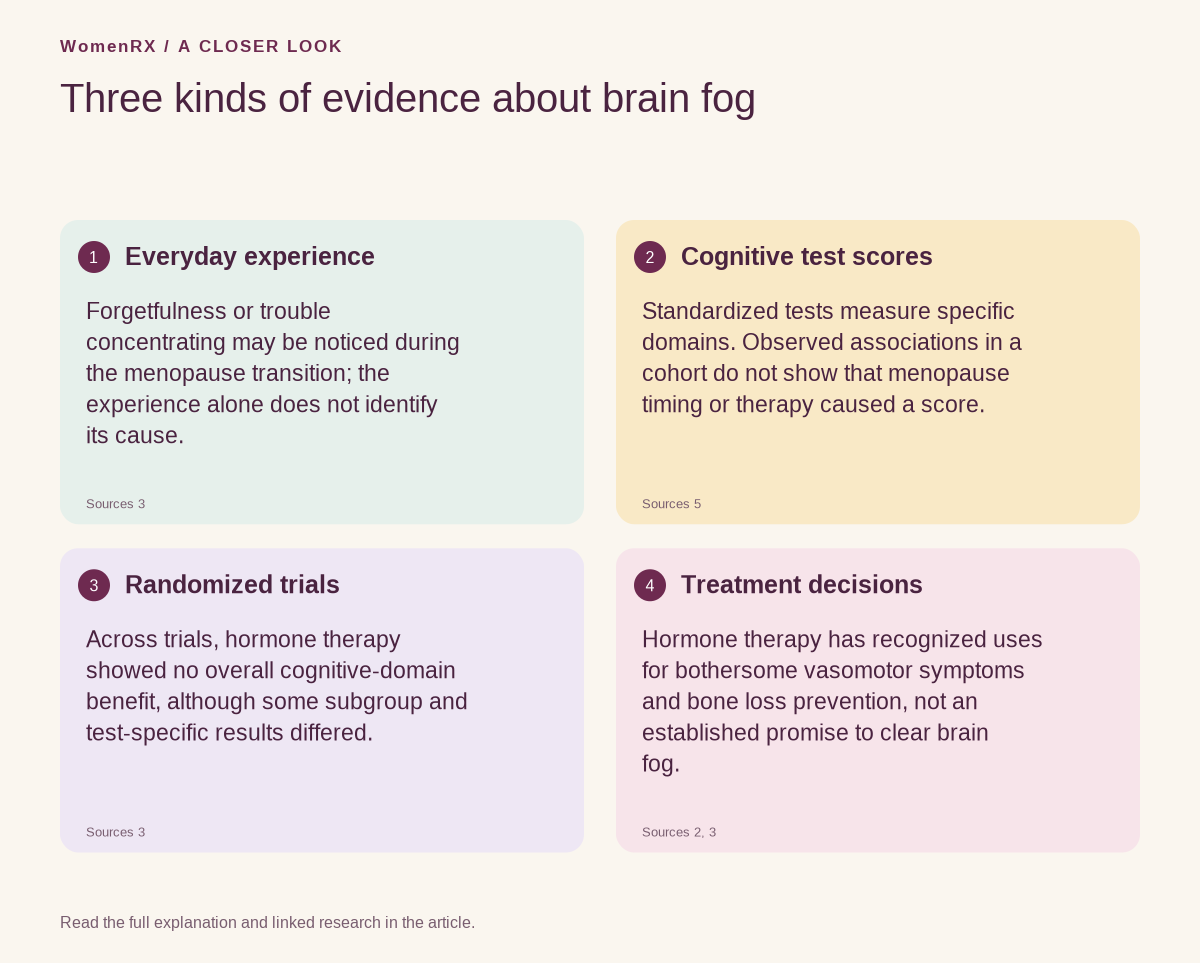
Three kinds of evidence about brain fog
Everyday experience: Forgetfulness or trouble concentrating may be noticed during the menopause transition; the experience alone does not identify its cause.3
Cognitive test scores: Standardized tests measure specific domains. Observed associations in a cohort do not show that menopause timing or therapy caused a score.5
Randomized trials: Across trials, hormone therapy showed no overall cognitive-domain benefit, although some subgroup and test-specific results differed.3
Treatment decisions: Hormone therapy has recognized uses for bothersome vasomotor symptoms and bone loss prevention, not an established promise to clear brain fog.23
Read the figure as text
A reported symptom, a cognitive test score, and a treatment effect answer different questions. Keeping them separate helps prevent overreading what estrogen research can show.- Everyday experience: Forgetfulness or trouble concentrating may be noticed during the menopause transition; the experience alone does not identify its cause.3
- Cognitive test scores: Standardized tests measure specific domains. Observed associations in a cohort do not show that menopause timing or therapy caused a score.5
- Randomized trials: Across trials, hormone therapy showed no overall cognitive-domain benefit, although some subgroup and test-specific results differed.3
- Treatment decisions: Hormone therapy has recognized uses for bothersome vasomotor symptoms and bone loss prevention, not an established promise to clear brain fog.23
More questions, answered
Does brain fog mean I have low estrogen?
No. Brain fog describes an experience, not a measurement of estrogen. Cognitive symptoms can occur during the menopause transition, but they don’t identify one cause by themselves. 3
Should I take hormone therapy to protect my memory?
Current evidence does not establish hormone therapy as a reliable way to improve cognition or prevent dementia. Its established uses include treating bothersome vasomotor symptoms and preventing bone loss for appropriate candidates; those benefits and risks are individual. 234
Sources you can check
- Memory | MedlinePlusAccessed 2026-09-25Return to first citation
- The 2022 hormone therapy position statement of The North American Menopause Society.“The 2022 Hormone Therapy Position Statement of The North American Menopause Society” Advisory Panel. · Menopause (New York, N.Y.) · 2022Return to first citation
- Systematic review and meta-analysis of the effects of menopause hormone therapy on cognition.Andy C, Nerattini M, Jett S, Carlton C, Zarate C, Boneu C, Fauci F, Ajila T, Battista M, Pahlajani S, Christos P, Fink ME, Williams S, Brinton RD, Mosconi L. · Frontiers in endocrinology · 2024Return to first citation
- Management of menopausal hormone therapy.Switzer J, Vignali L, Vignali J, Jackson R. · Current opinion in obstetrics & gynecology · 2026Return to first citation
- Association Between Menopause Age and Estradiol-Based Hormone Therapy With Cognitive Performance in Cognitively Normal Women in the CLSA.Puri TA, Gravelsins LL, Alexander MW, McGovern AJ, Guterman PD, Rabin JS, Murphy KJ, Galea LAM. · Neurology · 2025Return to first citation