Menopause Brain Fog: What May Help and When to Get Assessed
Memory slips and trouble concentrating can happen during the menopause transition, but a complaint doesn’t by itself show how you’ll perform on a cognitive test or predict dementia.
Menopause-related brain fog is a common complaint, but how forgetful you feel and how you perform on cognitive tests are different measures. Sleep disruption, mood changes, and menopause symptoms may also be part of the picture. Try practical memory supports, notice what’s changing around the same time, and seek assessment if you’re losing familiar abilities, such as finding your way home. 3 5 6 1
A real complaint, not a diagnosis
You might lose your train of thought, struggle to focus, or forget why you walked into a room. These experiences can feel unsettling. Cognitive complaints are reported during the menopause transition, but how you feel your memory is working and how you perform on a cognitive test are not the same measure. 4 5 3
Research doesn’t show one simple pattern. In an online study of 687 participants, the group combining early and late perimenopause performed less well on measures of learning efficiency than reproductive-age and postmenopausal participants. Yet the study found no significant early-versus-late difference in memory complaints or objective performance. The results offer a snapshot, not a prediction about any one person. 3
A smaller study followed 43 women in the menopause transition for 12 weeks. Changes in one estrogen measure were associated with some attention and everyday-memory measures. Sleep quality, depressive symptoms, and vasomotor symptoms were also associated with at least one aspect of cognition. These findings don’t establish a single cause for brain fog or show that treating one of these factors will resolve it. 6
The practical takeaway is to take your experience seriously without assuming that everyday lapses mean dementia or have one hormonal cause.
Make daily tasks easier while you observe the pattern
A small qualitative study found that women described cognitive challenges affecting psychological, social, and behavioral aspects of life, and reported using varied coping strategies. It didn’t test whether any particular strategy improved cognition. 4
Still, you can try simple workarounds as experiments, not proven treatments. For example, put appointments in one calendar, jot down the next step before switching tasks, or keep frequently used items in the same place. Keep the strategies that make your day feel easier.
Notice what else is happening when concentration feels harder. Are you sleeping poorly, dealing with disruptive hot flashes, or feeling persistently low? These symptoms have been associated with aspects of cognition in research on women in the transition, but an association doesn’t prove that one symptom is the cause. 6 5
If you’re arranging an assessment, describe what happens and how it affects your day. Include any medication changes in that account, without assuming they explain the problem.
It also helps to keep treatment evidence specific to the symptom studied. The North American Menopause Society’s 2023 nonhormone therapy position statement recommends cognitive behavioral therapy for vasomotor symptoms. That recommendation does not establish it as a treatment for cognitive complaints. 2
When a change deserves assessment
Forgetting a name or misplacing your keys can happen. Difficulty with a familiar ability, such as using your phone or finding your way home, is more concerning and may signal a problem that needs assessment. 1
Consider arranging an evaluation if changes are getting worse, disrupting responsibilities, or affecting tasks that used to feel familiar. Give concrete examples: what you forgot, what task became harder, and whether sleep, mood, or other menopause symptoms changed around the same time. Memory problems can have causes other than menopause, including thyroid, kidney, or liver problems. 1
The aim isn’t to label every lapse. It’s to recognize when a change is affecting familiar abilities and to look for an explanation.
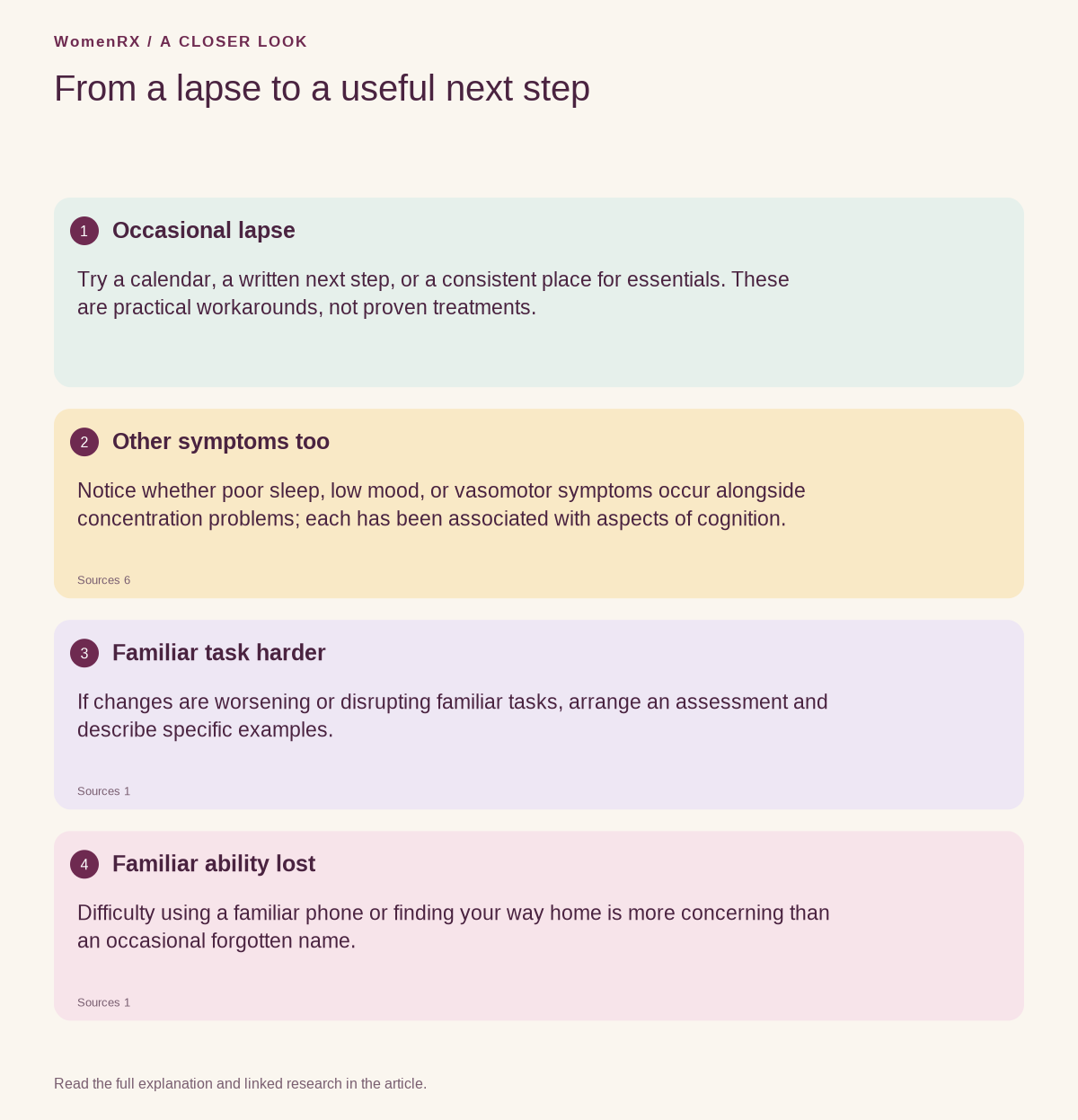
From a lapse to a useful next step
Occasional lapse: Try a calendar, a written next step, or a consistent place for essentials. These are practical workarounds, not proven treatments.
Other symptoms too: Notice whether poor sleep, low mood, or vasomotor symptoms occur alongside concentration problems; each has been associated with aspects of cognition.6
Familiar task harder: If changes are worsening or disrupting familiar tasks, arrange an assessment and describe specific examples.1
Familiar ability lost: Difficulty using a familiar phone or finding your way home is more concerning than an occasional forgotten name.1
Read the figure as text
Use the kind of change you’re noticing to choose a practical next step, without treating everyday forgetfulness as a diagnosis.- Occasional lapse: Try a calendar, a written next step, or a consistent place for essentials. These are practical workarounds, not proven treatments.
- Other symptoms too: Notice whether poor sleep, low mood, or vasomotor symptoms occur alongside concentration problems; each has been associated with aspects of cognition.6
- Familiar task harder: If changes are worsening or disrupting familiar tasks, arrange an assessment and describe specific examples.1
- Familiar ability lost: Difficulty using a familiar phone or finding your way home is more concerning than an occasional forgotten name.1
More questions, answered
Does menopause brain fog mean I’m developing dementia?
A memory complaint by itself isn’t a dementia diagnosis. Occasional lapses differ from losing familiar abilities, such as using your phone or finding your way home; changes like those deserve assessment. 1
Sources you can check
- Memory | MedlinePlusAccessed 2026-09-25Return to first citation
- The 2023 nonhormone therapy position statement of The North American Menopause Society.Menopause (New York, N.Y.) · 2023Return to first citation
- Subjective cognition and objective cognitive performance in early versus late perimenopause.Furey RT, Zhu C, Li Q, Gurvich C. · Journal of clinical and experimental neuropsychology · 2026Return to first citation
- Women's experience and management of cognition during menopause transition: a qualitative study.He L, Jaff NG, Bahhar N, Proctor D, Spector A. · Climacteric : the journal of the International Menopause Society · 2026Return to first citation
- A Review of Cognitive, Sleep, and Mood Changes in the Menopausal Transition: Beyond Vasomotor Symptoms.Williams M, Maki PM. · Obstetrics and gynecology · 2025Return to first citation
- Within-person changes in reproductive hormones and cognition in the menopause transition.Grummisch JA, Sykes Tottenham L, Gordon JL. · Maturitas · 2023Return to first citation