How Long Does Perimenopause Brain Fog Last?
Thinking can feel different during perimenopause, but research cannot give you a reliable date when brain fog will lift.
There’s no dependable timeline for how long brain fog lasts for an individual woman. In one study, women in perimenopause scored lower on a learning measure than reproductive-age or postmenopausal women, but early and late perimenopause groups did not differ significantly on memory complaints or cognitive tests. Those comparisons suggest a possible transition-related change, not a countdown to recovery. 6
What changes, and what has been measured
Brain fog can mean different things. You might notice that reading takes more effort, lose your train of thought, or struggle to pull up a word. In a small focus-group study, women described cognitive difficulties extending beyond memory and concentration, along with effects on their social and emotional lives. Their accounts show why a test score may not capture everything that matters in a day. The study was designed to explore experiences, not measure how long symptoms lasted. 5
In a separate study of 687 women, researchers compared self-reported memory complaints with results from online cognitive tests. Women in the combined perimenopause group performed less well on learning efficiency than reproductive-age and postmenopausal women. Yet the researchers found no significant difference between early and late perimenopause in either reported memory complaints or test performance. Hot flashes and other vasomotor symptoms were higher in the late-perimenopause group. Together, those results suggest that the intensity of one menopause symptom does not provide a simple guide to the cognitive results measured in this study. They do not show that an individual woman’s thinking steadily worsens, then improves. 6
Why there isn’t a recovery clock
Comparing women at different stages is not the same as following each woman’s brain fog from its start to its end. Researchers have also followed cognitive test scores over the menopause transition. For example, an analysis of 1,006 women in the Study of Women’s Health Across the Nation examined annual changes on memory and other cognitive tests; its reported findings focused on small associations between dietary intake and change in delayed-recall performance. It does not establish when everyday brain-fog complaints resolve. 7
That distinction is useful when you hear that cognition “gets better after menopause.” The stage comparison found better performance on one learning measure in the postmenopausal group than in the combined perimenopause group. It cannot show that the same women recovered, or predict when you’ll feel more like yourself. 6
Look at the whole picture, not just your cycle
A change in thinking can arrive alongside other changes. If night sweats are part of the picture, note whether difficult days tend to follow disrupted nights. That’s a way to describe your experience, not a test for the cause of brain fog. Treatments exist for bothersome hot flashes and night sweats, but evidence that a treatment helps those symptoms is not, by itself, evidence that it treats cognitive difficulties. 34
Mood and medicines deserve the same careful separation. The stage-comparison study assessed mood but did not establish that mood caused the cognitive differences it reported. And a medicine used for menopause symptoms may have effects worth noticing: NHS guidance lists drowsiness and depression among possible side effects of clonidine, and dizziness or agitation among possible effects of SSRIs and SNRIs. These are examples to consider if a change in thinking coincides with starting a medicine, not proof that a medicine is responsible. 62
Other health issues can matter too. General memory guidance identifies thyroid, kidney, and liver problems among possible explanations for more serious memory difficulties. Perimenopause can be part of the picture without being the whole explanation. 1
When not to write it off as brain fog
Occasionally forgetting a name or where you put your keys happens. Forgetting how to use a familiar phone or being unable to find your way home is different and deserves prompt medical assessment rather than an assumption that it’s menopause. 1
For a less dramatic but persistent change, a useful description is specific: I’m losing track of a conversation at work, this began around the time my night sweats worsened, and I also started a new medicine. That gives a clinician more to assess than “I have brain fog.” It also leaves room for more than one contributing factor.
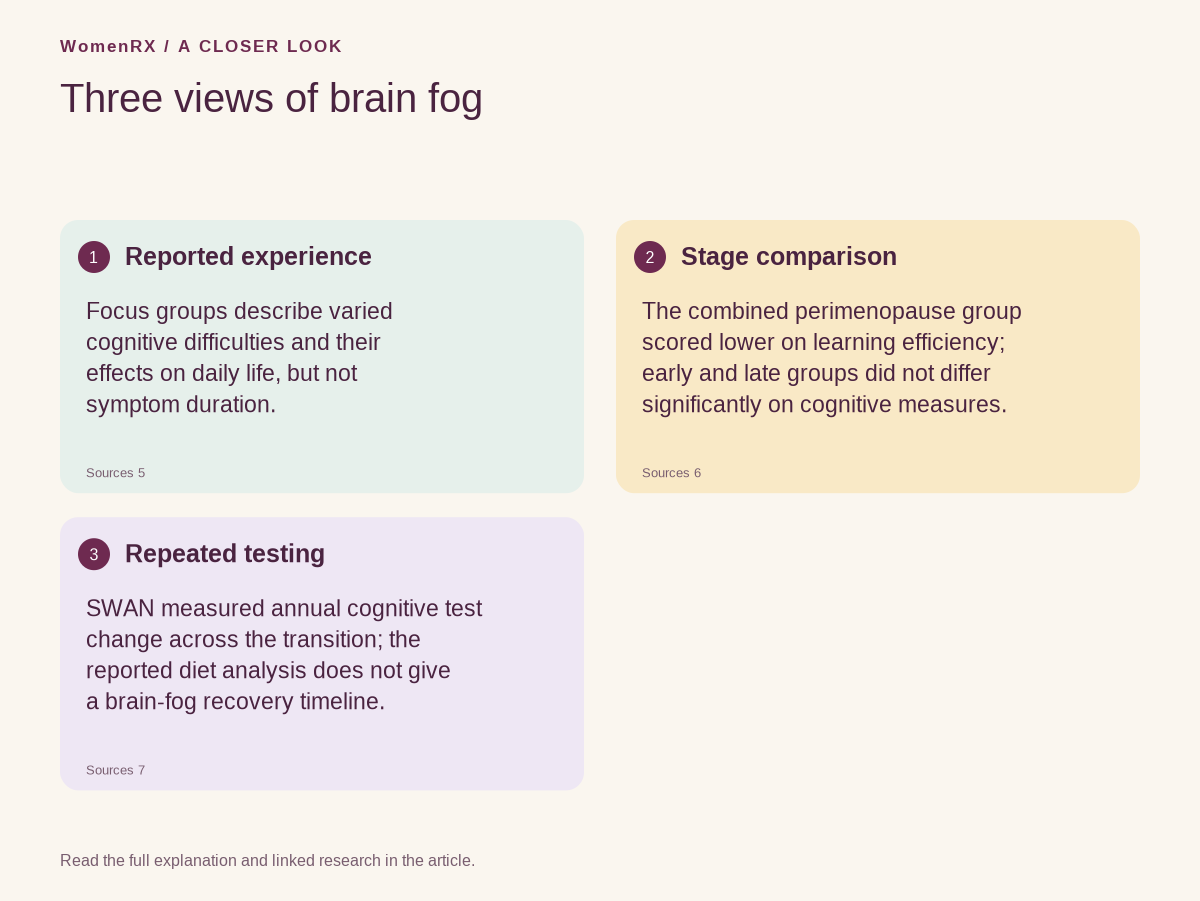
Three views of brain fog
Reported experience: Focus groups describe varied cognitive difficulties and their effects on daily life, but not symptom duration.5
Stage comparison: The combined perimenopause group scored lower on learning efficiency; early and late groups did not differ significantly on cognitive measures.6
Repeated testing: SWAN measured annual cognitive test change across the transition; the reported diet analysis does not give a brain-fog recovery timeline.7
Read the figure as text
What a woman feels, what a test measures, and what changes over time are related but different questions.- Reported experience: Focus groups describe varied cognitive difficulties and their effects on daily life, but not symptom duration.5
- Stage comparison: The combined perimenopause group scored lower on learning efficiency; early and late groups did not differ significantly on cognitive measures.6
- Repeated testing: SWAN measured annual cognitive test change across the transition; the reported diet analysis does not give a brain-fog recovery timeline.7
Sources you can check
- Memory | MedlinePlusAccessed 2026-09-25Return to first citation
- Other medicines for menopause symptoms - NHSAccessed 2026-09-25Return to first citation
- The 2022 hormone therapy position statement of The North American Menopause Society.“The 2022 Hormone Therapy Position Statement of The North American Menopause Society” Advisory Panel. · Menopause (New York, N.Y.) · 2022Return to first citation
- The 2023 nonhormone therapy position statement of The North American Menopause Society.Menopause (New York, N.Y.) · 2023Return to first citation
- Women's experience and management of cognition during menopause transition: a qualitative study.He L, Jaff NG, Bahhar N, Proctor D, Spector A. · Climacteric : the journal of the International Menopause Society · 2026Return to first citation
- Subjective cognition and objective cognitive performance in early versus late perimenopause.Furey RT, Zhu C, Li Q, Gurvich C. · Journal of clinical and experimental neuropsychology · 2026Return to first citation
- Dietary choline and betaine intake minimally impacts rate of annualized cognitive performance throughout the menopause transition: data from the Study of Women's Health Across the Nation.Cowan-Pyle AE, Wallace TC, Klatt KC, Slavin M, Bailey RL. · Menopause (New York, N.Y.) · 2024Return to first citation