How Long Does Perimenopause Last, and How Is It Counted?
The transition often lasts years, and the final period can only be identified in hindsight.
Perimenopause can last two to eight years before periods stop permanently; for most women, it lasts about four years. That’s a guide, not a personal deadline. 7 Changing cycle patterns help describe the transition, while menopause is identified in hindsight after 12 months without bleeding, including spotting, when natural periods are available to count and hormonal contraception isn’t affecting them. Symptoms can continue beyond that point. 457
The clock starts with a pattern, not one unusual period
If your periods have begun arriving at different intervals, it’s reasonable to wonder whether perimenopause has started and how long it will last. The US Office on Women’s Health describes a transition that can last two to eight years before periods stop permanently, with about four years being typical for most women. Those figures describe a range, not a way to predict your final period. 7
Bleeding-pattern changes can help describe a stage, but they cannot tell you how long it will be until the final period. Perimenopause describes the transition toward the final menstrual period; the 12-month rule helps identify its endpoint afterward. It does not mean everyone has a 12-month transition. 35
Researchers use bleeding patterns to describe stages within that transition. In a study that applied the STRAW+10 staging system, an early-transition pattern included at least two cycles differing in length by seven days or more. A late-transition pattern included a stretch of at least 60 days without a period. These are ways to describe a pattern over time, not a countdown from your first irregular cycle or a way to declare menopause after one long gap. 23
For example, if a period arrives much later than usual and then periods resume, that gap doesn’t tell you which future period will be the last. Ovulation may not happen every month during the transition, and periods can become more or less frequent, heavier or lighter. That variability helps explain why counting ahead from one changed cycle won’t give you a finish date. 47
The last period gets its name later
The final menstrual period is just that: the last period before periods stop. You generally can’t recognize it on the day it happens. When natural periods are available to count and you aren’t using hormonal contraception, menopause is identified after 12 months without bleeding, including spotting. At that point, you can look back and identify the final period. 57
That distinction matters when you’re counting. The 12 months are the interval used to confirm that a period was the last one, not a promise that symptoms will end then. Symptoms can occur during the transition and continue after menopause. The often-quoted estimate that symptoms usually last seven to nine years, sometimes longer, refers to symptoms, not to the length of perimenopause itself. 4
When bleeding can’t tell the whole story
Hormonal contraception can change or stop bleeding. A hormonal IUD or contraceptive injection may make periods irregular or absent, while a combined pill can produce monthly bleeds for as long as it’s taken. Neither pattern, by itself, tells you whether a natural final period has occurred. Pregnancy is also still possible during perimenopause, so an absent period while pregnancy is possible shouldn’t automatically be counted as menopause. 467
Surgery changes what you can count, too. After a hysterectomy, there are no uterine periods to use as a marker, so the usual bleeding-based count isn’t available. Removal of the ovaries can bring on menopause earlier than it would have happened naturally. The useful distinction is which surgery you had, rather than how many months have passed since your last bleed. 56
If your periods are still occurring but bleeding is getting heavier rather than lighter, that’s worth discussing with a clinician instead of assuming it’s simply the transition. And if bleeding occurs after you’ve met the usual 12-month menopause criterion, have it checked, even if it happens only once. 41
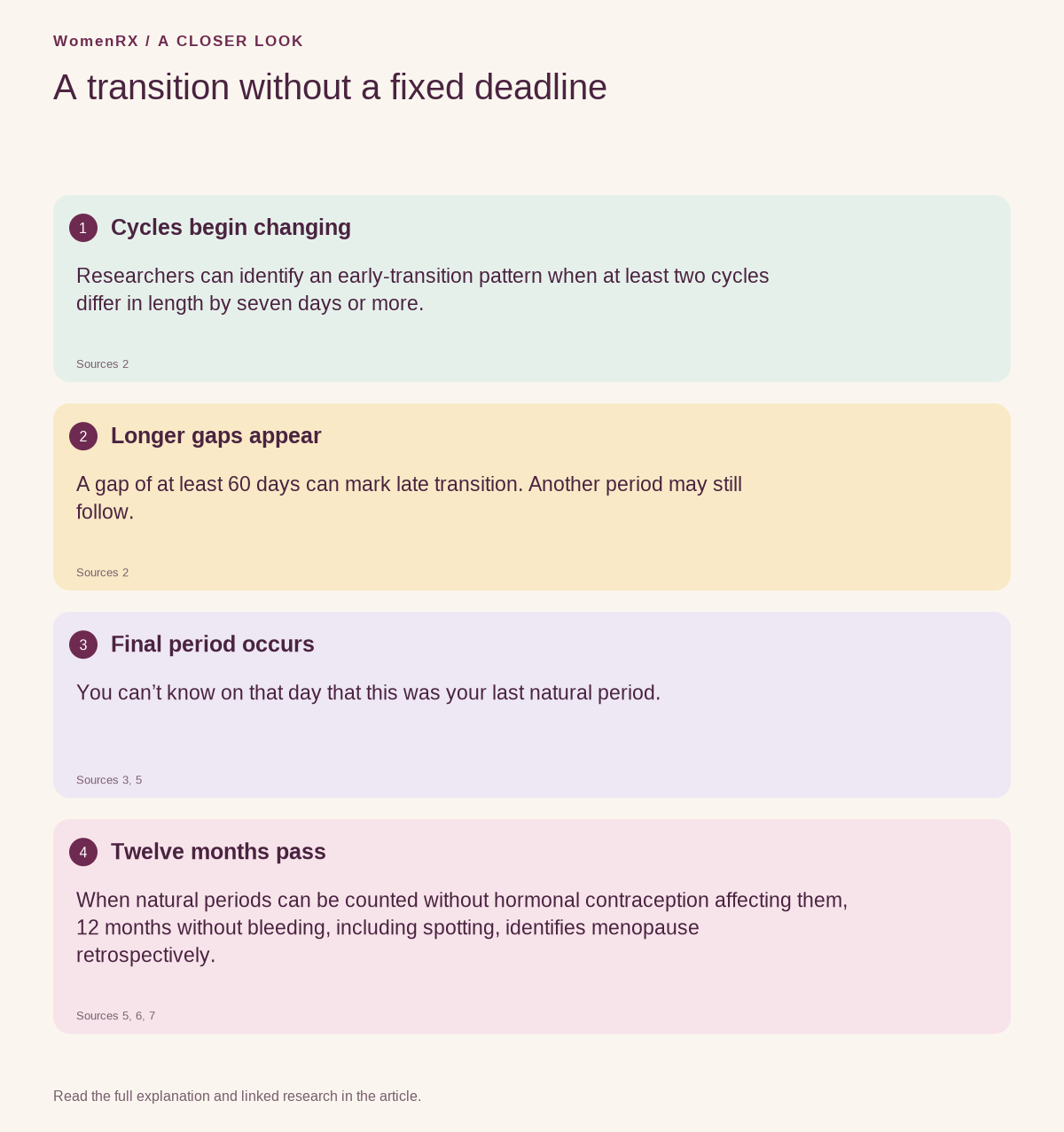
A transition without a fixed deadline
Cycles begin changing: Researchers can identify an early-transition pattern when at least two cycles differ in length by seven days or more.2
Longer gaps appear: A gap of at least 60 days can mark late transition. Another period may still follow.2
Final period occurs: You can’t know on that day that this was your last natural period.35
Twelve months pass: When natural periods can be counted without hormonal contraception affecting them, 12 months without bleeding, including spotting, identifies menopause retrospectively.567
Read the figure as text
The transition can last two to eight years, with about four years typical for most women. These stages describe bleeding patterns and a retrospective marker, not a personal schedule. 7- Cycles begin changing: Researchers can identify an early-transition pattern when at least two cycles differ in length by seven days or more.2
- Longer gaps appear: A gap of at least 60 days can mark late transition. Another period may still follow.2
- Final period occurs: You can’t know on that day that this was your last natural period.35
- Twelve months pass: When natural periods can be counted without hormonal contraception affecting them, 12 months without bleeding, including spotting, identifies menopause retrospectively.567
More questions, answered
Does a 60-day gap mean my periods are over?
No. A gap of at least 60 days is used as a marker of the late menopausal transition, not proof that the last period has happened. The usual menopause marker is 12 months without bleeding, including spotting, when you aren’t using hormonal contraception and have natural periods to count. After a hysterectomy, there are no uterine periods to count. 2567
Sources you can check
- Postmenopausal bleeding - NHSAccessed 2026-09-25Return to first citation
- Risk of Sarcopenic Obesity Across Menopausal Transition Stages in Middle-Aged Korean Women.Cho Y, Jang Y, Park JH, Chang Y, Ryu S. · Nutrients · 2025Return to first citation
- Executive summary of the Stages of Reproductive Aging Workshop + 10: addressing the unfinished agenda of staging reproductive aging.Harlow SD, Gass M, Hall JE, Lobo R, Maki P, Rebar RW, Sherman S, Sluss PM, de Villiers TJ, STRAW + 10 Collaborative Group. · Fertility and sterility · 2012Return to first citation
- Symptoms of menopause and perimenopause - NHSAccessed 2026-09-25Return to first citation
- What are menopause and perimenopause? - NHSAccessed 2026-09-25Return to first citation
- Recommendations | Menopause: identification and management | Guidance | NICEAccessed 2026-09-25Return to first citation
- Menopause basics | Office on Women's HealthAccessed 2026-09-25Return to first citation