How Long Can Perimenopause Last, and Why Do Estimates Vary?
Perimenopause can span several years, but a study’s definition of its start and end matters more than any single average.
There isn’t one reliable average that predicts how long perimenopause will last for you. In a small study of 12 women aged 45 to 47, the early transition averaged 47 months, measured from defined cycle irregularity to the final menstrual period. That estimate describes one small group and one part of the transition, not a personal countdown or a universal duration. 2
What a duration estimate is actually counting
Perimenopause is a transition marked by menstrual changes, but research studies may start counting at different cycle patterns and stop at different milestones. One study described the transition as beginning with cycle variability and continuing until 12 months after menstruation stopped. That’s one research definition, not a way to predict the timing of your own transition. 4
In a small study of 12 women, researchers defined the start of the early transition as more than two cycles in a sequence of 10 being shorter than 23 days or longer than 35 days. From that point to the final menstrual period, the early transition averaged 47 months. The participants were initially aged 45 to 47, and the finding applies to this small group and this particular definition, not to every stage of perimenopause or every woman. 2
Even the later transition can be defined in more than one way. The same study used the first observation of either 60 or 90 days without a period as a marker of entry into the late transition. Its authors couldn’t conclude which cutoff was more appropriate. When estimates use different start or end points, they’re not necessarily measuring the same span. 2
Cycle changes can explain the stages, not the finish date
Cycle patterns can become less predictable as ovulation changes. In a three-year study of 804 women aged 42 to 52, short and long intervals between periods were often associated with cycles without ovulation. That helps explain why irregularity can be part of the transition, but it doesn’t tell an individual when her final menstrual period will occur. 3
Age and menstrual history are relevant to interpreting a study because they describe who was included and what cycle changes counted. The 47-month estimate came from just 12 women initially aged 45 to 47; another study followed women aged 42 to 52 and examined bleeding patterns, not the length of the transition. These studies don’t provide a dependable age-based timeline or a forecast from your past cycle history. 2 3
A symptom’s timeline is a different measure
The duration of perimenopause isn’t the same as the duration of hot flashes or night sweats. A meta-analysis of 10 studies, including two longitudinal and eight cross-sectional studies with 35,445 participants, estimated a median vasomotor-symptom duration of about four years among women who experienced those symptoms. That estimate concerns symptoms around the final menstrual period, not the length of the transition itself. 1
So if you encounter a number, check what it measures: a particular stage of cycle change, the span to the final menstrual period, the broader transition, or a symptom. Keeping those clocks separate makes it easier to use population estimates as context rather than as a deadline.
When a bleeding change deserves a closer look
Irregular timing can occur during the transition, but heavy bleeding shouldn’t automatically be written off as a hormone change. In the study of women aged 42 to 52, heavy bleeding was associated with obesity and self-reported uterine fibroids, and it was less likely in cycles without ovulation. If bleeding is unusually heavy for you, getting it assessed can help identify explanations beyond perimenopause. 3
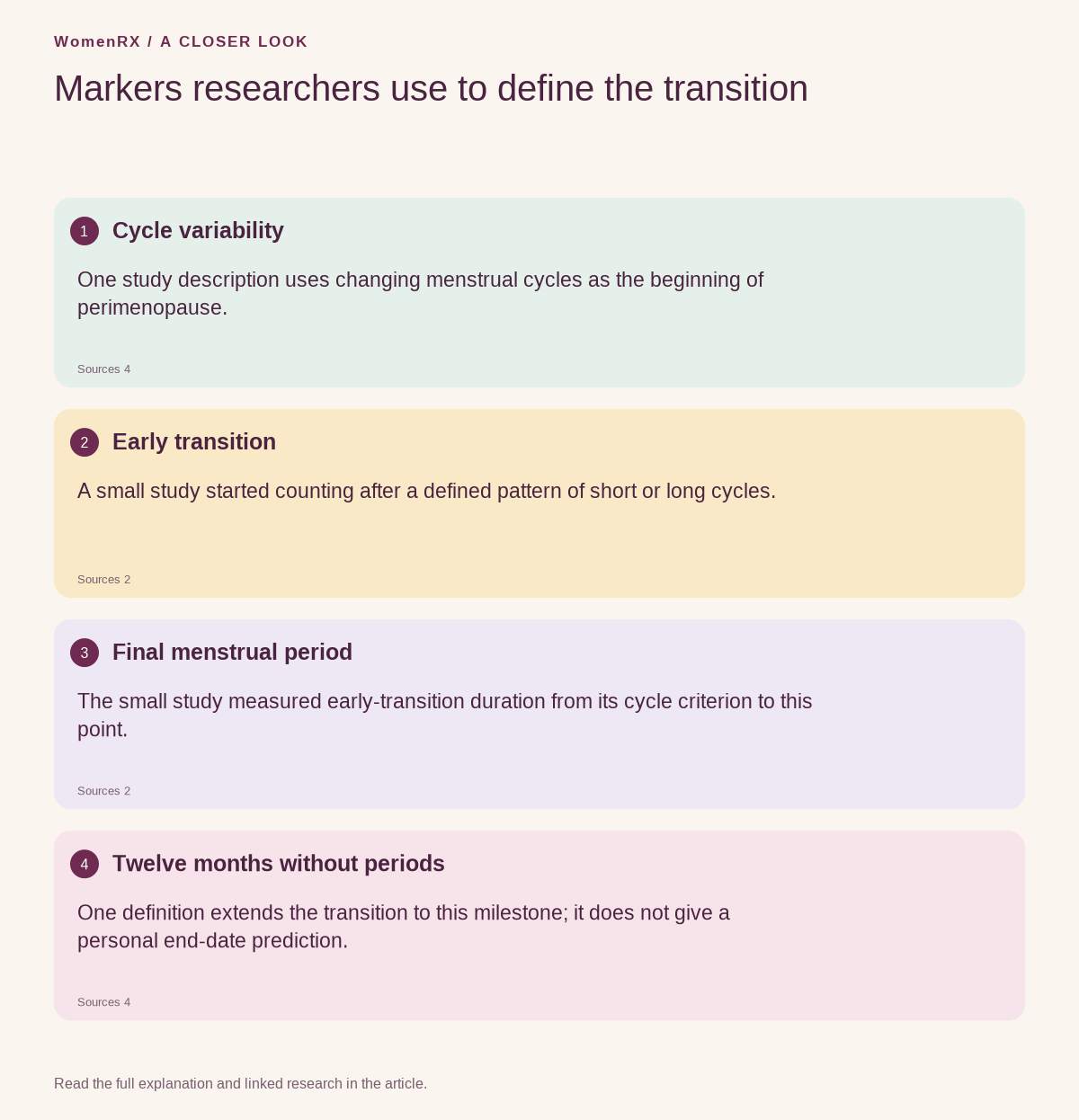
Markers researchers use to define the transition
Cycle variability: One study description uses changing menstrual cycles as the beginning of perimenopause.4
Early transition: A small study started counting after a defined pattern of short or long cycles.2
Final menstrual period: The small study measured early-transition duration from its cycle criterion to this point.2
Twelve months without periods: One definition extends the transition to this milestone; it does not give a personal end-date prediction.4
Read the figure as text
A not-to-scale sequence of possible research markers, not a forecast of how long your transition will last.- Cycle variability: One study description uses changing menstrual cycles as the beginning of perimenopause.4
- Early transition: A small study started counting after a defined pattern of short or long cycles.2
- Final menstrual period: The small study measured early-transition duration from its cycle criterion to this point.2
- Twelve months without periods: One definition extends the transition to this milestone; it does not give a personal end-date prediction.4
More questions, answered
Does the four-year estimate mean hot flashes end when perimenopause ends?
No. The estimate refers to vasomotor symptoms among women who experienced them. It measures symptom duration, not the length of perimenopause. 1
Sources you can check
- Revisiting the duration of vasomotor symptoms of menopause: a meta-analysis.Politi MC, Schleinitz MD, Col NF. · Journal of general internal medicine · 2008Return to first citation
- The relationship between the endocrine characteristics and the regularity of menstrual cycles in the approach to menopause.Burger HG, Robertson DM, Baksheev L, Collins A, Csemiczky G, Landgren BM. · Menopause (New York, N.Y.) · 2005Return to first citation
- The relationship of bleeding patterns to daily reproductive hormones in women approaching menopause.Van Voorhis BJ, Santoro N, Harlow S, Crawford SL, Randolph J. · Obstetrics and gynecology · 2008Return to first citation
- Depressive symptoms and physical activity among community-dwelling perimenopausal women: a prospective longitudinal study.Huang C, Luo B, Wang J, Ao Y, Xiong W, Liao S. · BMC psychiatry · 2023Return to first citation