Perimenopause Is a Transition, Not a Treatment: What to Expect
Perimenopause doesn’t switch symptoms off; it’s a changing stage, and support can address symptoms while it’s happening.
Perimenopause isn’t a treatment that takes time to work. It’s the transition toward your final menstrual period, when cycles and symptoms can change, and there’s no single timetable for how they’ll feel or last. You don’t have to wait for the transition to end to ask about help: bothersome symptoms can be discussed and treated during this stage. 1 3 4
There’s no “working” date to wait for
Perimenopause is a life stage, not a remedy. It’s the transition toward the final menstrual period. Changes in your cycle may happen during this time, and symptoms associated with menopause can be mild or severe and last for shorter or longer periods. There isn’t one predictable schedule that tells you when symptoms will begin, ease, or stop. 1 2
That means the final period isn’t a promised finish line for symptoms. A research study can identify the final menstrual period retrospectively as the period before 12 months without menstruation, but that marker doesn’t predict an individual’s symptom course. 1 2
Cycle changes and symptoms are related, but not a countdown
Your menstrual cycle can change during the transition, but cycle changes alone don’t tell you exactly where you are or when symptoms will resolve. In a longitudinal study of participants from the Study of Women’s Health Across the Nation, hormone levels changed in different ways in relation to the final menstrual period: estradiol declined around it, while follicle-stimulating hormone rose and peaked afterward. Those group patterns help describe the transition, but they don’t provide a personal forecast. 2
So if your periods are changing while you’re also having symptoms, it’s reasonable to consider perimenopause as one possibility, not to assume every change has the same cause. NICE guidance specifically flags people aged 40 to 45 with menopause-associated symptoms, including a cycle change, and people under 40 when menopause is suspected. Those are reasons to raise the pattern for assessment rather than trying to diagnose yourself from a calendar. 1
Support doesn’t have to wait until your periods stop
If symptoms are bothering you, the useful question is not “When will perimenopause work?” but “What could help with this symptom, given my situation?” Hormone therapy is identified by the North American Menopause Society as the most effective treatment for hot flashes and night sweats. Its benefits and risks depend on individual factors, so treatment is a discussion rather than a one-size-fits-all answer. 3
There are also evidence-supported nonhormonal options for vasomotor symptoms. The Society’s position statement recommends options including cognitive behavioral therapy, clinical hypnosis, certain prescription medicines, and weight loss, with differing evidence levels. That doesn’t mean each option suits every person; it means you can discuss symptom relief without waiting for the transition to finish. 4
For a useful conversation, keep a short record if it helps you: when bleeding happens, which symptom is most disruptive, and what it interferes with, such as sleep or daily activities. This is a practical way to describe your experience, not a test for perimenopause. You can also simply bring up a specific change, such as a cycle shift alongside hot flashes or night sweats, or a symptom that feels severe or hard to manage. Symptoms vary widely, and care can be tailored as they change. 1
The takeaway: perimenopause doesn’t need to “work” before you can seek relief. It’s a transition with an individual course, and symptom support can be considered along the way.
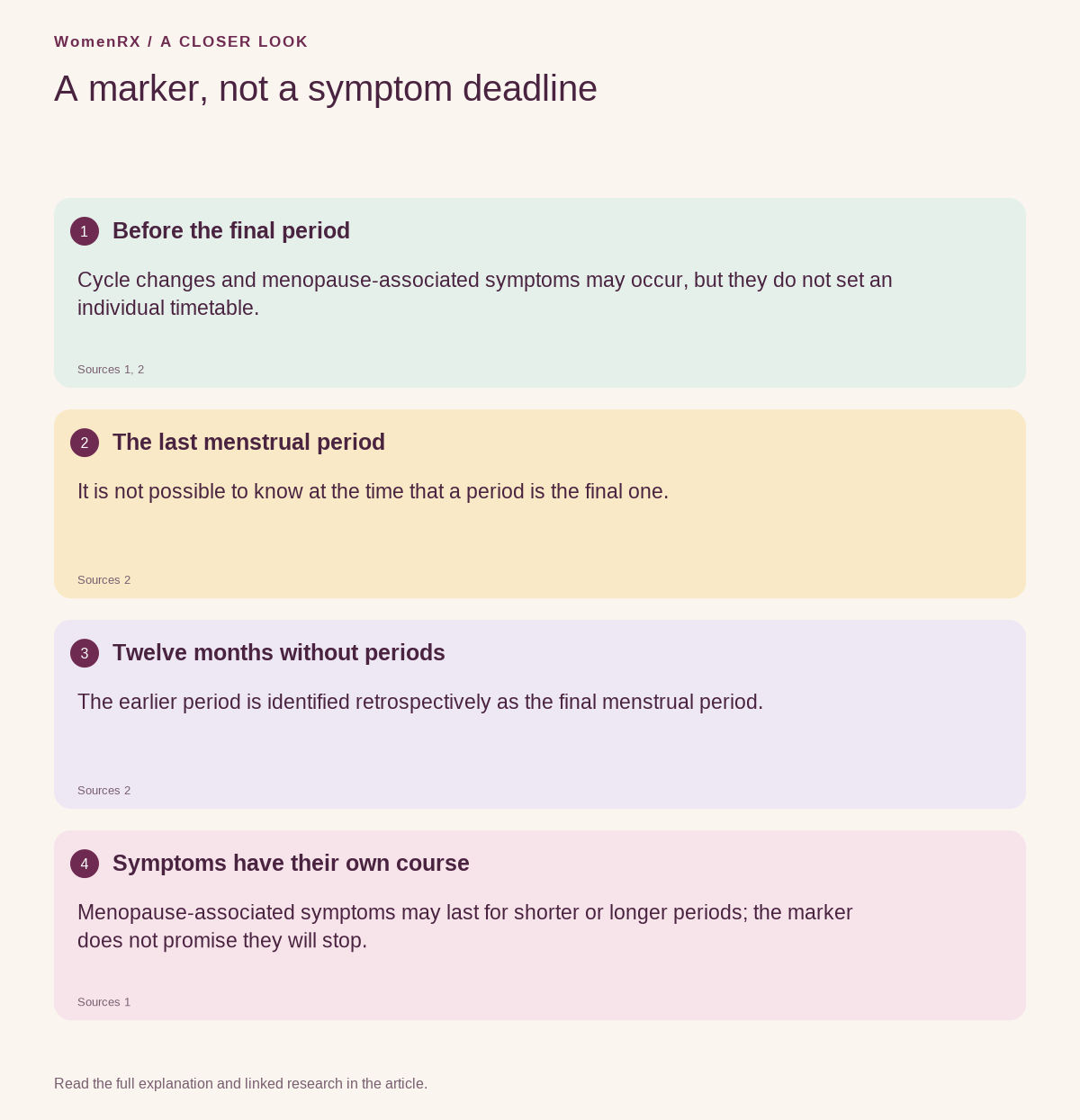
A marker, not a symptom deadline
Before the final period: Cycle changes and menopause-associated symptoms may occur, but they do not set an individual timetable.12
The last menstrual period: It is not possible to know at the time that a period is the final one.2
Twelve months without periods: The earlier period is identified retrospectively as the final menstrual period.2
Symptoms have their own course: Menopause-associated symptoms may last for shorter or longer periods; the marker does not promise they will stop.1
Read the figure as text
This timeline shows how the final menstrual period is recognized and why it can’t serve as a countdown for symptom relief.- Before the final period: Cycle changes and menopause-associated symptoms may occur, but they do not set an individual timetable.12
- The last menstrual period: It is not possible to know at the time that a period is the final one.2
- Twelve months without periods: The earlier period is identified retrospectively as the final menstrual period.2
- Symptoms have their own course: Menopause-associated symptoms may last for shorter or longer periods; the marker does not promise they will stop.1
More questions, answered
Will symptoms stop when my periods stop?
Not on a predictable schedule. Menopause is identified retrospectively using 12 months without a period, but menopause-associated symptoms can last for shorter or longer periods. The marker doesn’t promise that symptoms will end at that point. 1 2
Do I have to wait until menopause to discuss treatment?
No. Treatment options for bothersome hot flashes and night sweats include hormone and nonhormonal approaches. Which options fit depends on your circumstances and preferences. 3 4
Sources you can check
- Recommendations | Menopause: identification and management | Guidance | NICEAccessed 2026-09-25Return to first citation
- Insulin Levels Early in Perimenopause Inform Vasomotor Symptom Incidence Across the Menopausal Transition.Athar F, Gregory S, Houston EJ, Templeman NM. · The Journal of clinical endocrinology and metabolism · 2026Return to first citation
- The 2022 hormone therapy position statement of The North American Menopause Society.“The 2022 Hormone Therapy Position Statement of The North American Menopause Society” Advisory Panel. · Menopause (New York, N.Y.) · 2022Return to first citation
- The 2023 nonhormone therapy position statement of The North American Menopause Society.Menopause (New York, N.Y.) · 2023Return to first citation