Depression During Perimenopause: What Raises Risk?
Stress and menopause symptoms can add context to a mood change, but study findings can’t predict what will happen to you.
In a survey of perimenopausal women with bipolar disorder, stress was a statistical predictor of depression symptom scores. A separate survey associated greater menopause symptom severity with depressive symptoms, not specifically symptom scores. These group findings can’t tell you your own odds. 2 5 A separate study linked past psychiatric conditions to broader perimenopausal symptoms, not future depression. 6 Persistent low mood or loss of interest that affects daily life merits assessment. 1
What “predictor” means in a study
A study may call something a predictor because it was statistically linked with symptoms in the group being studied. That doesn’t necessarily mean it caused those symptoms, predicts a future episode, or tells you what will happen to you.
For example, a 2021 online survey of 100 perimenopausal women with bipolar disorder found that stress scores were the strongest predictor of depression symptom scores in the researchers’ model. Stress accounted for 40% of the variation in scores in that study group. This is a reason to take stress seriously when discussing mood, not evidence that stress explains 40% of any one woman’s symptoms or predicts depression for all women in perimenopause. 2
A separate cross-sectional survey of 1,146 women aged 45 to 55 in Türkiye linked depressive symptoms with more severe menopause symptoms and lower mental quality-of-life scores. Because the survey measured participants at one point in time, it can’t establish which came first or show that one caused the other. Its findings also aren’t a personal forecast for women in other settings. 5
Together, these findings make stress and overall symptom burden useful parts of the conversation. They don’t provide a checklist that identifies who will become depressed.
Past mood history is useful context, not destiny
A history of depression, bipolar disorder, postpartum depression or psychosis, or another mental-health condition is worth mentioning when you’re discussing new mood symptoms. A Korean study found that histories of postpartum depression, postpartum psychosis, and other psychiatric disorders were associated with greater perimenopausal psychosomatic symptom burden. But the study measured a broader group of symptoms, not later depression specifically. It can’t show that a past postpartum condition predicts a future depressive episode. 6
Family history of depression, trauma, and stressful life events are also recognized risk factors for depression generally. They may help explain the context around current symptoms, but they don’t determine what will happen during menopause. 1
Hormones and menopause symptoms aren’t a personal forecast
A clinical trial in selected perimenopausal women examined estradiol fluctuations alongside anxiety and loss of pleasure, also called anhedonia. It reported that greater fluctuations were associated with greater anhedonia, particularly among women with more stressful life events. The trial’s outcomes and participants don’t establish a hormone test that can predict depression in an individual woman. 3
Hot flashes, sleep problems, and mood changes can overlap, but that overlap isn’t the same as a depression diagnosis. In a study of 2,066 women across the menopausal transition and early postmenopause, vasomotor symptoms were associated with sleep disturbances and, separately, with frequent mood changes. The study measured frequent mood changes, not clinical depression. 4
When mood symptoms deserve attention
Depression is more than feeling sad or irritable for a few days. MedlinePlus describes major depression symptoms as depressed mood or loss of interest that affects daily activities and lasts at least two weeks. If either is present most of the day, nearly every day, for at least two weeks, an assessment can help, especially if sleeping, eating, working, or ordinary tasks are becoming difficult. 1
An assessment can consider duration and effect on daily life alongside prior mood history, current stress, and sleep disruption. It can also consider whether a medical condition or medicine might be contributing: thyroid disorders and certain medicines, for example, can cause symptoms that resemble depression. 1
If you’re trying to describe a possible transition-related pattern, consider what changed and when. Did low mood or loss of interest begin around the same time as other menopause symptoms? Is it present most days, or does it come and go? What has changed in your sleep, stress, or ability to manage everyday tasks? Have you experienced a similar period before? Those details can make an assessment more specific without assuming that menopause, hormones, or stress is the sole cause.
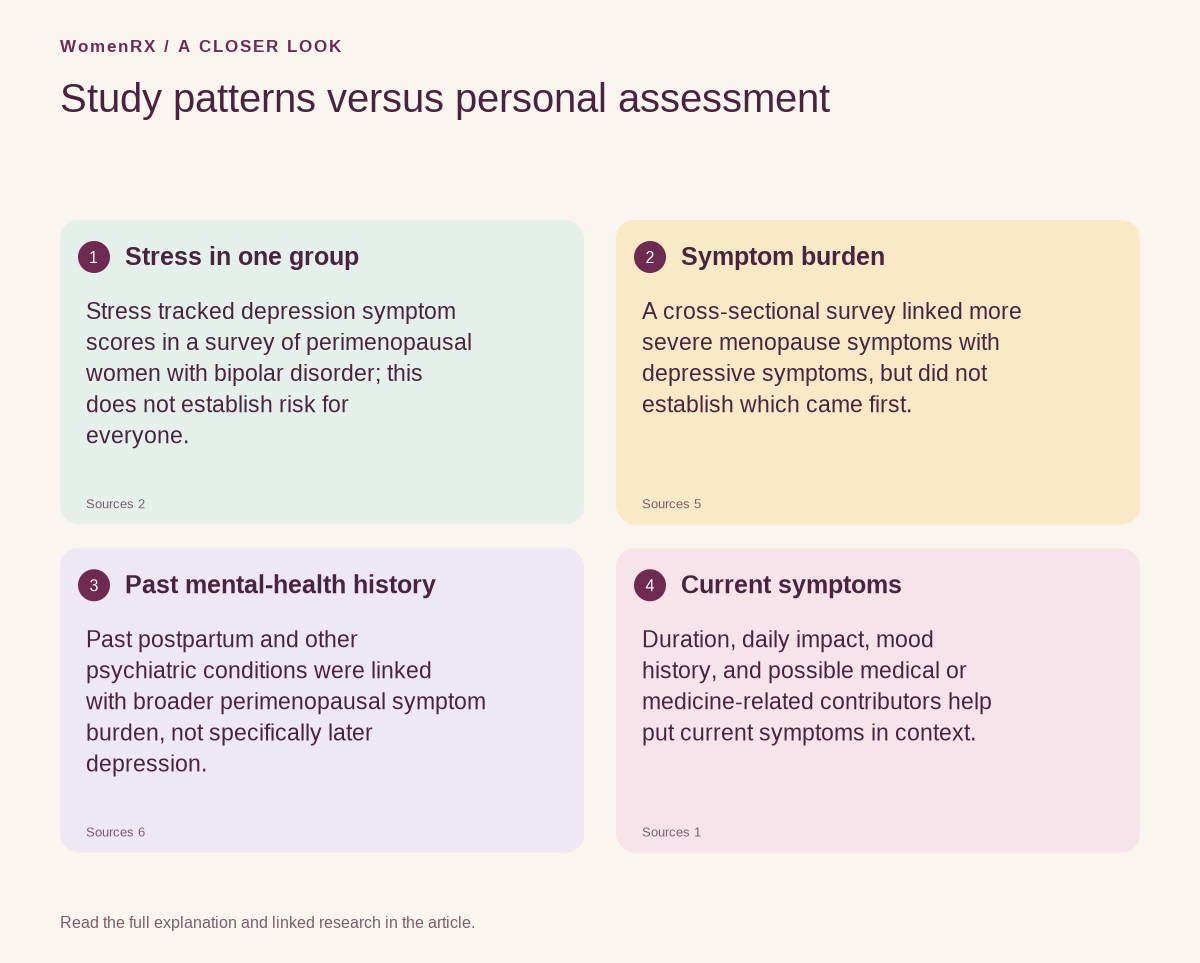
Study patterns versus personal assessment
Stress in one group: Stress tracked depression symptom scores in a survey of perimenopausal women with bipolar disorder; this does not establish risk for everyone.2
Symptom burden: A cross-sectional survey linked more severe menopause symptoms with depressive symptoms, but did not establish which came first.5
Past mental-health history: Past postpartum and other psychiatric conditions were linked with broader perimenopausal symptom burden, not specifically later depression.6
Current symptoms: Duration, daily impact, mood history, and possible medical or medicine-related contributors help put current symptoms in context.1
Read the figure as text
These findings can add context to a conversation, but they aren’t a personal risk score or diagnosis.- Stress in one group: Stress tracked depression symptom scores in a survey of perimenopausal women with bipolar disorder; this does not establish risk for everyone.2
- Symptom burden: A cross-sectional survey linked more severe menopause symptoms with depressive symptoms, but did not establish which came first.5
- Past mental-health history: Past postpartum and other psychiatric conditions were linked with broader perimenopausal symptom burden, not specifically later depression.6
- Current symptoms: Duration, daily impact, mood history, and possible medical or medicine-related contributors help put current symptoms in context.1
More questions, answered
Can a hormone test tell me whether I’ll become depressed?
The estradiol trial discussed here does not establish a test that predicts an individual woman’s depression risk. It examined fluctuations alongside anxiety and anhedonia in selected perimenopausal women, not a hormone cutoff for future depression. 3
Sources you can check
- Depression: MedlinePlusAccessed 2026-09-25Return to first citation
- Stress predicts depression symptoms for women living with bipolar disorder during the menopause transition.Perich T, Ussher J. · Menopause (New York, N.Y.) · 2021Return to first citation
- Baseline anxiety-sensitivity to estradiol fluctuations predicts anxiety symptom response to transdermal estradiol treatment in perimenopausal women - A randomized clinical trial.Lozza-Fiacco S, Gordon JL, Andersen EH, Kozik RG, Neely O, Schiller C, Munoz M, Rubinow DR, Girdler SS. · Psychoneuroendocrinology · 2022Return to first citation
- Associations between vasomotor symptoms, sleep disturbances, and frequent mood changes individually and within symptom groups across the menopausal transition and early postmenopause: observations from the Study of Women's Health Across the Nation.Maki PM, Inan Eroglu E, Janssenswillen C, Frenz AK, Heeg S, Nadimi M, Genga K, Schoof N, Moeller C, Soehngen L, Halvorson L, Dinkel-Keuthage C. · Menopause (New York, N.Y.) · 2026Return to first citation
- Prevalence of depressive symptoms during the menopausal transition in Türkiye: impact of symptom severity, aging anxiety and health-related quality of life.Aslan B, Önal Ö. · Climacteric : the journal of the International Menopause Society · 2025Return to first citation
- Obstetric and psychiatric history as predictors for psychosomatic symptoms among Korean perimenopausal women.Kim DS, Kim HJ, Kim MK, Jin JC, Han DH, Kim SM. · Maturitas · 2023Return to first citation