Weight and Body Composition During the Menopause Transition
The menopause transition can change the balance of fat and lean mass without speeding up weight gain on the scale.
Weight changes during midlife don’t have a single explanation. In a longitudinal study, women’s fat mass increased faster and lean mass declined during the menopause transition, while the overall rate of weight gain did not speed up when the transition began. 5 Sleep, medicines, and changes in daily habits may also be worth reviewing, without assuming any one of them caused the change.
The scale and body composition tell different stories
A change in weight doesn’t tell you by itself whether you’ve gained fat, lost muscle, retained water, or experienced some mix of changes. MedlinePlus notes that body weight includes fat, muscle, bone, and water, and that the scale can’t tell the whole story. 1
That distinction matters during the menopause transition. In a longitudinal analysis from the Study of Women’s Health Across the Nation (SWAN), researchers followed changes in body composition in relation to the final menstrual period. Fat mass was increasing before the transition; around its start, the rate of fat gain doubled and lean mass began to decline. These changes continued until about two years after the final menstrual period, then slowed. Weight itself rose steadily before the transition, without speeding up at its start, and its trajectory later flattened. 5
Those are patterns in a study cohort, not a forecast for any one woman. The SWAN results cannot tell you when your transition will occur or which symptoms you will have. 5 They do help explain why someone’s shape or clothing fit might change even when the scale doesn’t show a sudden jump. They also challenge the idea that the menopause transition necessarily makes weight rise faster. A separate American Heart Association scientific statement says longitudinal studies have helped distinguish chronological from ovarian aging with respect to cardiovascular risk and have documented body-composition changes over the menopause transition. 4
Four factors to review before choosing a response
1. What changed in weight, shape, or both? If you’re comfortable doing so, consider whether the change is mainly a scale number, a change in waist or clothing fit, or a sudden shift. These observations aren’t a diagnosis. They can help you describe what you’ve noticed. BMI also has limits: it doesn’t distinguish fat from muscle or bone, and MedlinePlus notes that waist circumference and health history may add useful context. 1
2. Could the menopause transition be part of the picture? It may be relevant to body composition, but it shouldn’t be treated as the sole explanation for a weight change. The SWAN findings show a transition-related pattern in fat and lean mass, not an acceleration in total weight gain at the transition’s start. 5 A clinical review of menopause-related cardiometabolic changes discusses sleep disturbances among midlife symptoms. Sleep is worth noting if it has changed, but that review doesn’t establish that sleep disruption caused a particular weight change. 3
3. Have medicines or health circumstances changed? Review new medicines, dose changes, and the timing of the weight change rather than assuming hormones are responsible. One example: a systematic review and meta-analysis of medicines studied for insomnia in people with depression reported weight gain and sedation with mirtazapine. That finding is specific to the populations and treatments reviewed; it isn’t evidence that every medicine, or mirtazapine in every person, will have the same effect. 6 If you think a medicine could be relevant, ask the prescriber what options make sense.
4. Has your everyday routine shifted? Consider whether meals, activity, or other regular habits have changed alongside the weight. This is a practical review, not proof that routine is the cause. MedlinePlus lists diet among everyday factors that can play a role in body weight, and NIH’s Office of Dietary Supplements describes nutrition changes and physical activity as foundations of long-term weight loss. Neither source makes a midlife-specific claim about what caused an individual’s gain. 1 2
Choose a response that fits what you found
If the main concern is body shape rather than a fast change on the scale, it may help to think in terms of body composition and overall health, not just weight. If you’re considering weight loss, the basic evidence-supported starting point is sustainable changes to eating patterns and physical activity, not a menopause-specific supplement or a promise that one hormone explains everything. 2
If the change is sudden or unintentional, MedlinePlus recommends discussing it with a health care provider because an unexpected change can sometimes signal a medical problem. Bring the timing of the change and any recent medication or routine changes into that conversation. 1
The useful distinction is not “age or hormones?” as if only one can matter. Aging, the menopause transition, sleep symptoms, medicines, and daily habits can overlap. The evidence supports a transition-related shift in fat and lean mass, but it does not let you assign every weight change to that shift. 4 5
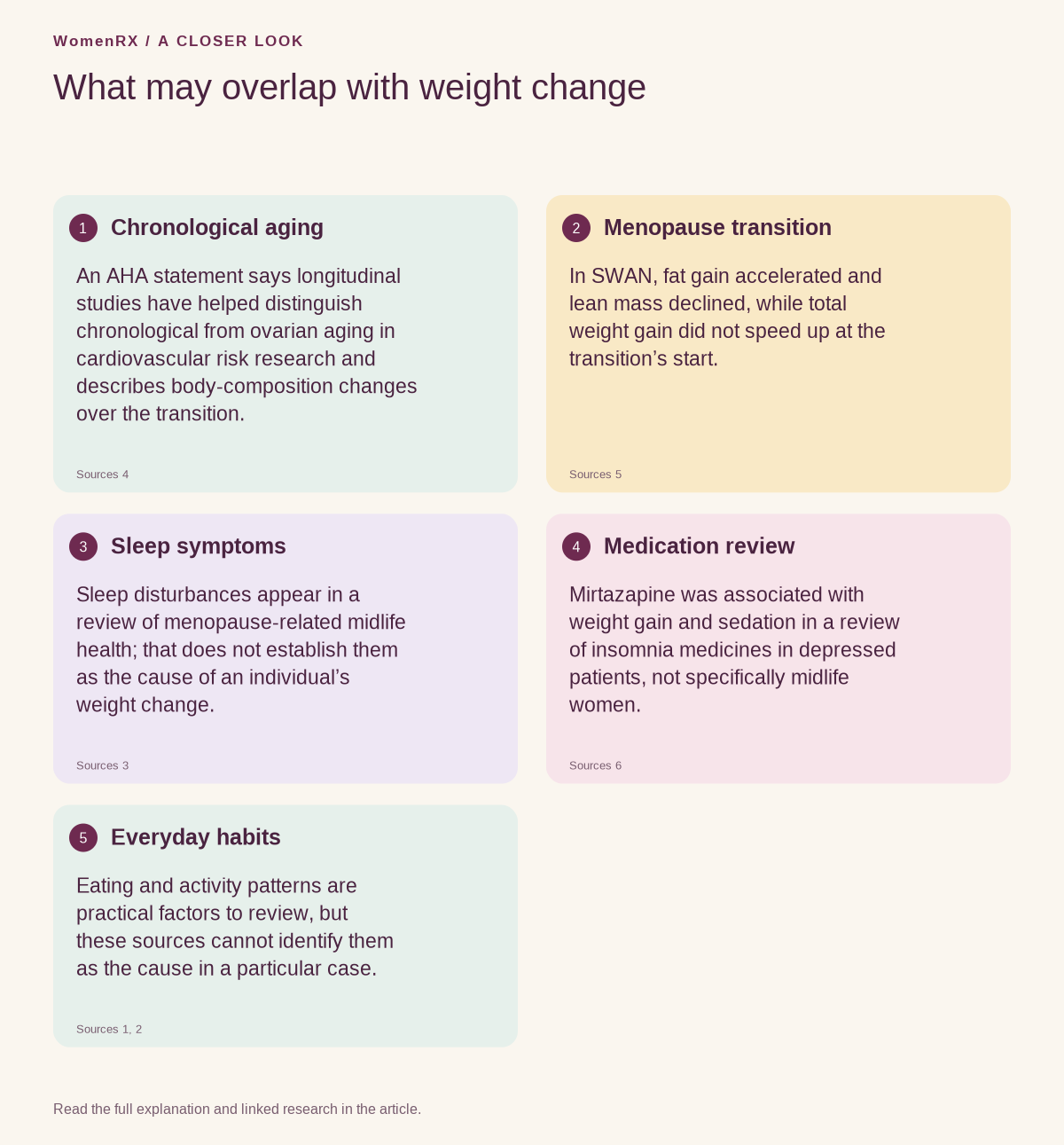
What may overlap with weight change
Chronological aging: An AHA statement says longitudinal studies have helped distinguish chronological from ovarian aging in cardiovascular risk research and describes body-composition changes over the transition.4
Menopause transition: In SWAN, fat gain accelerated and lean mass declined, while total weight gain did not speed up at the transition’s start.5
Sleep symptoms: Sleep disturbances appear in a review of menopause-related midlife health; that does not establish them as the cause of an individual’s weight change.3
Medication review: Mirtazapine was associated with weight gain and sedation in a review of insomnia medicines in depressed patients, not specifically midlife women.6
Everyday habits: Eating and activity patterns are practical factors to review, but these sources cannot identify them as the cause in a particular case.12
Read the figure as text
Weight is one signal, while body composition and other midlife influences can follow different patterns. This map separates what the evidence describes from what still needs individual context.- Chronological aging: An AHA statement says longitudinal studies have helped distinguish chronological from ovarian aging in cardiovascular risk research and describes body-composition changes over the transition.4
- Menopause transition: In SWAN, fat gain accelerated and lean mass declined, while total weight gain did not speed up at the transition’s start.5
- Sleep symptoms: Sleep disturbances appear in a review of menopause-related midlife health; that does not establish them as the cause of an individual’s weight change.3
- Medication review: Mirtazapine was associated with weight gain and sedation in a review of insomnia medicines in depressed patients, not specifically midlife women.6
- Everyday habits: Eating and activity patterns are practical factors to review, but these sources cannot identify them as the cause in a particular case.12
More questions, answered
Can body composition change even if my weight barely changes?
Yes. Weight combines fat, muscle, bone, and water, so a similar scale reading can coexist with a different balance of body tissues. In SWAN, fat mass and lean mass followed different patterns during the menopause transition. Those cohort patterns cannot predict the timing or symptoms of your own transition. 1 5
What if I gain or lose weight without trying?
A sudden, unexpected change is worth discussing with a health care provider. MedlinePlus notes that unintentional gain or loss can sometimes be a sign of a medical problem. 1
Sources you can check
- Body Weight: MedlinePlusAccessed 2026-09-25Return to first citation
- Dietary Supplements for Weight Loss - Health Professional Fact SheetAccessed 2026-09-25Return to first citation
- The Cardiometabolic Effects of Menopause.Karam J, Lau ES, Shufelt CL. · Obstetrics and gynecology · 2026Return to first citation
- Menopause Transition and Cardiovascular Disease Risk: Implications for Timing of Early Prevention: A Scientific Statement From the American Heart Association.El Khoudary SR, Aggarwal B, Beckie TM, Hodis HN, Johnson AE, Langer RD, Limacher MC, Manson JE, Stefanick ML, Allison MA, American Heart Association Prevention Science Committee of... · Circulation · 2020Return to first citation
- Changes in body composition and weight during the menopause transition.Greendale GA, Sternfeld B, Huang M, Han W, Karvonen-Gutierrez C, Ruppert K, Cauley JA, Finkelstein JS, Jiang SF, Karlamangla AS. · JCI insight · 2019Return to first citation
- Management of insomnia symptoms in depressed patients treated with agomelatine, mirtazapine and trazodone: A systematic review and meta-analysis.Zhang X, Chen Y, Deng R, Tao S, Zou M, Wang Q. · Journal of affective disorders · 2026Return to first citation