Does Menopause Lead to Weight Loss? What Changes to Expect
Menopause isn’t a reliable explanation for weight loss: body composition can shift, but ongoing, unexplained weight loss deserves its own attention.
Menopause isn’t a predictable cause of weight loss. In a longitudinal study of women, weight rose before the menopause transition without speeding up at its start, then the average weight trajectory flattened after the transition; fat and lean mass changed differently. Don’t automatically blame a falling scale number on hormones. If you keep losing weight without changing your routine, contact a clinician. 3 1
Weight and body composition can tell different stories
A change on the scale is not the same thing as a change in body composition. In the Study of Women’s Health Across the Nation, researchers followed women through the menopause transition and measured fat and lean mass. Fat gain accelerated and lean mass declined around the start of the transition. Those changes continued until about two years after the final menstrual period, then their trajectories leveled off. Weight itself rose linearly before the transition, without accelerating when it began, and its average trajectory became flat after the transition. 3
That study describes group patterns, not what must happen to every woman. It also helps explain why the scale may not tell the whole story: changes in fat and lean mass can occur at the same time. The findings do not make weight loss an expected menopause effect. Menopause is reached after 12 months without a period; the transition leading up to it can last several years. 2 3
When falling weight needs another explanation
A small change on the scale and a continued, unexplained decline are different situations. A useful first distinction is whether your eating or activity has changed. If it hasn’t and your weight keeps falling, don’t assume menopause is responsible. Unintentional weight loss can have many causes, including stress, depression or anxiety, digestive problems, an overactive thyroid, diabetes, poor appetite or nutrition, and side effects of some medicines. 1
Weight loss can sometimes be associated with a serious illness, including cancer, but weight loss alone does not identify the cause. The practical point is not to guess which explanation fits: ongoing loss without an obvious change is a reason to contact a clinician for assessment. If weight loss comes with other symptoms, seek advice promptly rather than waiting for menopause to pass. 1
A useful way to sort out the pattern
Consider what has changed and what has stayed the same. For example, a new exercise routine or a change in how much you’re eating gives a different context from weight continuing to fall while your usual habits remain stable. Also note whether you’ve had a change in appetite, stress, digestion, or medicines; these are examples of factors that can be relevant to unexplained weight loss. 1
If the decline continues without a clear explanation, share that pattern with a clinician. They can ask about your health and consider whether tests or other evaluation are needed. The menopause transition may be part of the timing, but timing alone doesn’t establish the cause. 1 3
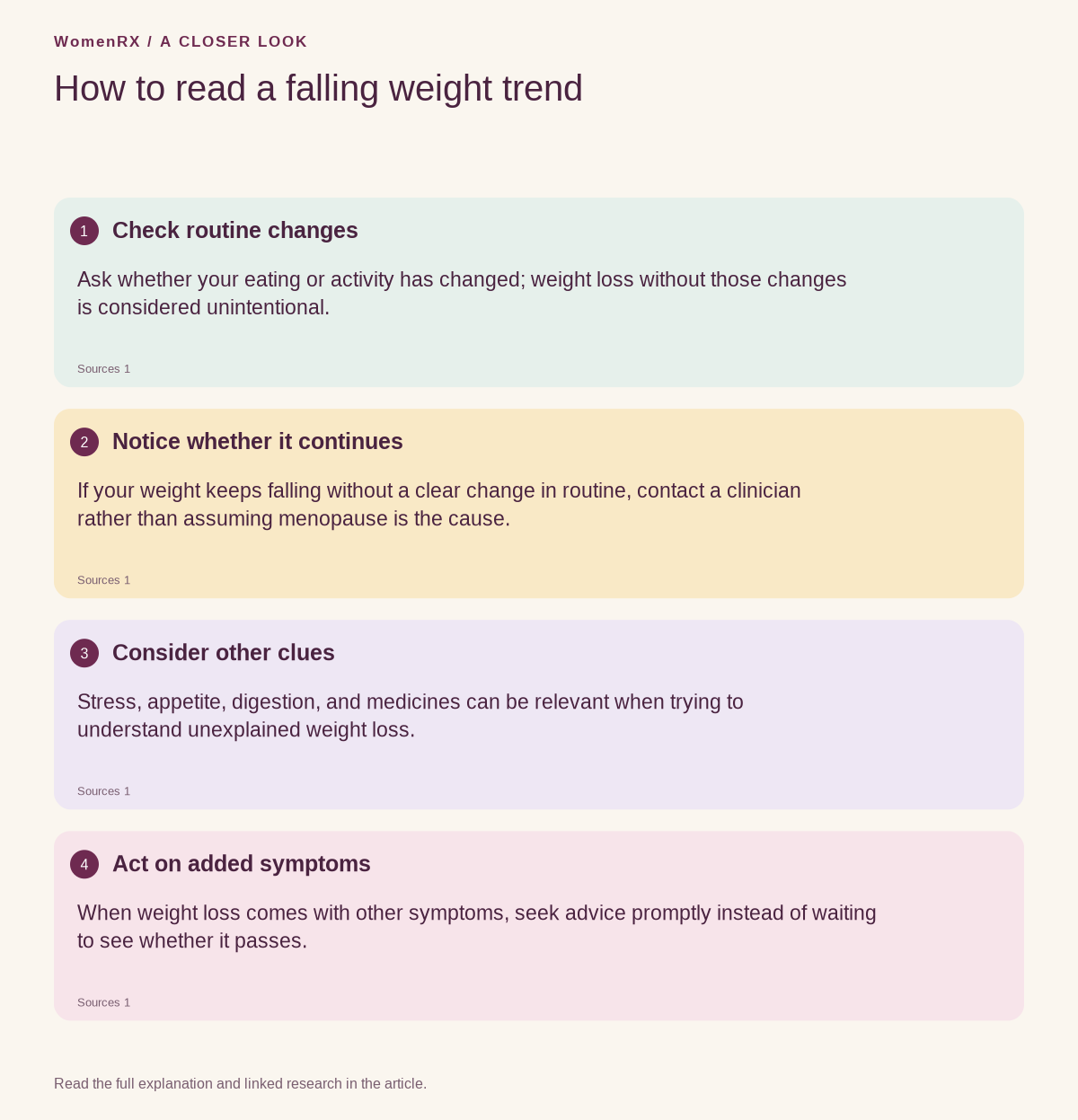
How to read a falling weight trend
Check routine changes: Ask whether your eating or activity has changed; weight loss without those changes is considered unintentional.1
Notice whether it continues: If your weight keeps falling without a clear change in routine, contact a clinician rather than assuming menopause is the cause.1
Consider other clues: Stress, appetite, digestion, and medicines can be relevant when trying to understand unexplained weight loss.1
Act on added symptoms: When weight loss comes with other symptoms, seek advice promptly instead of waiting to see whether it passes.1
Read the figure as text
Use the pattern and its context to distinguish a change with an apparent explanation from continuing unexplained loss that merits assessment.- Check routine changes: Ask whether your eating or activity has changed; weight loss without those changes is considered unintentional.1
- Notice whether it continues: If your weight keeps falling without a clear change in routine, contact a clinician rather than assuming menopause is the cause.1
- Consider other clues: Stress, appetite, digestion, and medicines can be relevant when trying to understand unexplained weight loss.1
- Act on added symptoms: When weight loss comes with other symptoms, seek advice promptly instead of waiting to see whether it passes.1
More questions, answered
Is there a specific amount of weight loss that means I should seek care?
The guidance cited here doesn’t set a single weight-loss number. It advises getting assessed if you keep losing weight without changing your diet or activity, and seeking advice promptly when weight loss occurs with other symptoms. 1
Sources you can check
- Unintentional weight loss - NHSAccessed 2026-09-25Return to first citation
- Menopause | Menopause Symptoms | MedlinePlusAccessed 2026-09-25Return to first citation
- Changes in body composition and weight during the menopause transition.Greendale GA, Sternfeld B, Huang M, Han W, Karvonen-Gutierrez C, Ruppert K, Cauley JA, Finkelstein JS, Jiang SF, Karlamangla AS. · JCI insight · 2019Return to first citation