Menopause and Weight Changes: What’s Actually Linked?
Midlife weight gain isn’t caused by menopause alone, but the transition can shift where fat is stored and how much lean tissue you carry.
Weight often changes with age, and menopause isn’t the only reason. The transition is also linked with a shift toward more abdominal fat and less lean mass, which can happen even when the scale changes little. Look at weight and waist trends together. A sudden, unexplained change is different from a gradual midlife shift and is worth discussing with a clinician. 1 2 4
The scale and your shape tell different stories
A number on the scale combines fat, muscle, bone, and water. It can’t show which of those changed, or where body fat is stored. Waist size can add useful context: more fat around the abdomen than the hips is associated with higher risk of heart disease and type 2 diabetes. 1
That distinction matters around menopause. A 2026 review describes midlife weight gain as driven primarily by age-related changes, while menopause contributes to less favorable body composition and a shift toward central fat. So a change around your final period may be related to menopause, aging, or both, rather than having one simple cause. 4
What may change across the transition
The clearest reported menopause-related pattern is about fat distribution and lean mass, not a guaranteed jump in total weight. In a retrospective, cross-sectional study of 325 women, postmenopausal participants were reported to have lower measured lean mass and greater central adiposity overall than premenopausal participants. But the reported patterns varied by weight category: in the obesity subgroup, postmenopausal participants had lower visceral fat area and body-fat percentage than premenopausal participants. Because the researchers compared existing records at one point in time, the study can show associations, but it can’t establish that menopause itself caused those differences. 2
The transition doesn’t look the same for everyone. Your scale may rise, stay similar, or fluctuate; changes in waist size or body composition may not match the number on the scale. Weight also reflects several tissues and water, so the number alone can’t identify what has changed. 1 2
A practical way to sort out a change
If your weight or waist size is changing, these questions can help you describe what’s happening without assuming menopause explains it all:
- What changed, and how quickly? Is the scale moving gradually over months or years, or was the change sudden? Has your waist changed even if your weight has not? The two measurements tell different parts of the story. 1 4
- When did it begin? Was it during the transition, after your periods stopped, or at another time? Timing is useful context, but it can’t prove what caused the change. 2 4
- What else changed around then? Consider shifts in eating habits, activity, sleep, or mood. Aging, hormonal changes, and lifestyle factors can overlap in midlife; noticing a change in one of these areas is a starting point for a conversation, not a diagnosis. 4
- Is there another health concern? If the weight change is unexpected, mention any other new symptoms or changes in your health history. A sudden, unexplained gain or loss can signal a medical problem and is worth discussing rather than attributing it to menopause. 1
You don’t need a perfect record. A brief account of the weight or waist change, when it began, and what else was happening at the time gives a clinician more to work with than one scale reading. Your broader health history also matters when assessing weight and health risk. 1
What you can do without chasing one number
If you want support with weight or waist changes, start with a plan that considers overall health and body composition, not just scale loss. A recent review describes resistance training and a Mediterranean-style eating pattern as foundational approaches to midlife weight management. 4
Hormone therapy is not a weight-loss treatment. A 2026 expert statement says the possibility that hormone therapy might enhance weight loss with semaglutide is still a hypothesis, and it should not be a reason to start hormone therapy. Decisions about hormone therapy should be based on its appropriate indications, not on weight loss. 3
The useful distinction is this: a gradual midlife shift can reflect both aging and menopause-related changes in fat distribution, while a sudden or unexplained change deserves a closer look. Neither pattern can be understood from the scale alone.
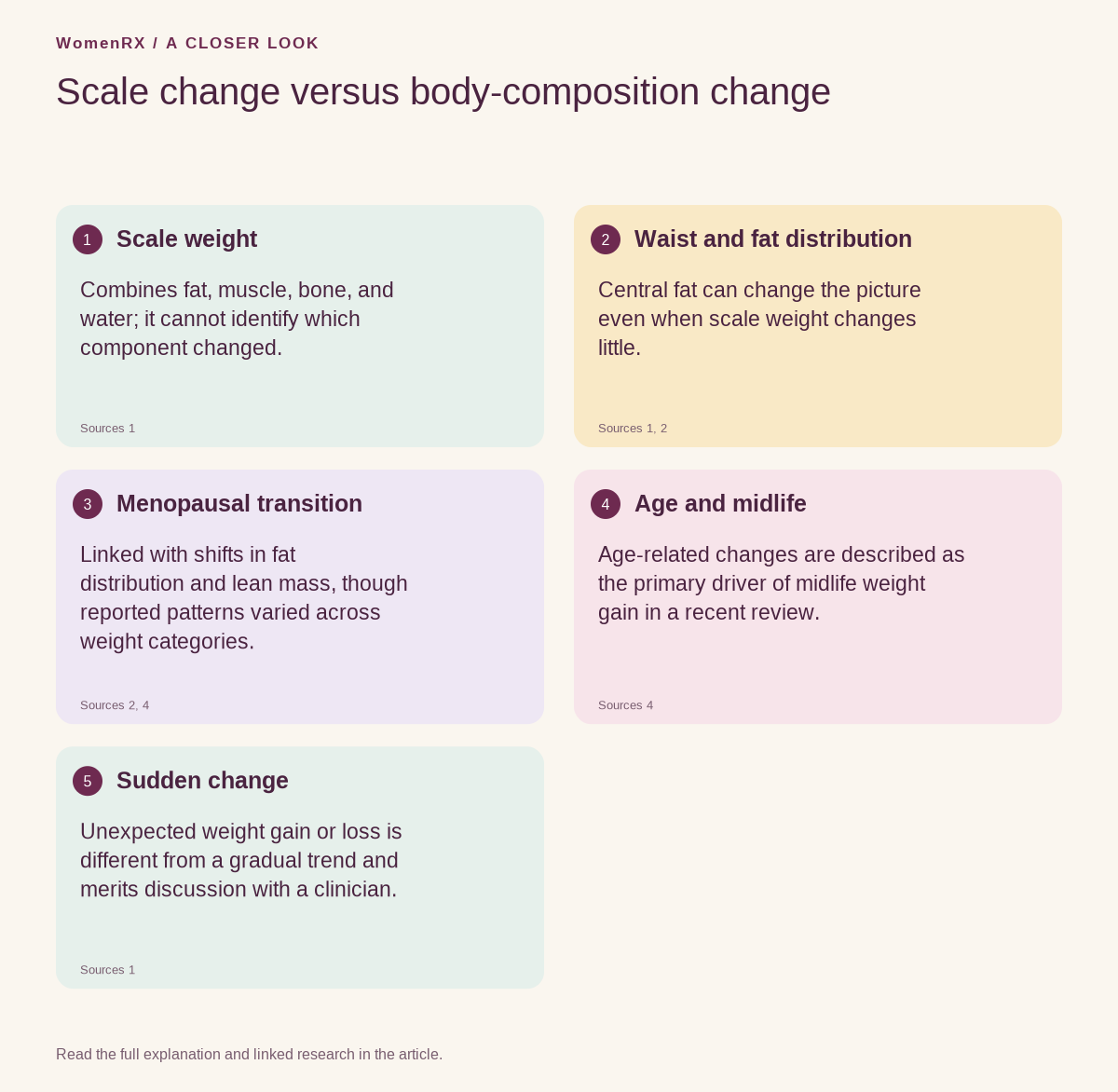
Scale change versus body-composition change
Scale weight: Combines fat, muscle, bone, and water; it cannot identify which component changed.1
Waist and fat distribution: Central fat can change the picture even when scale weight changes little.12
Menopausal transition: Linked with shifts in fat distribution and lean mass, though reported patterns varied across weight categories.24
Age and midlife: Age-related changes are described as the primary driver of midlife weight gain in a recent review.4
Sudden change: Unexpected weight gain or loss is different from a gradual trend and merits discussion with a clinician.1
Read the figure as text
Menopause-related changes can show up in fat distribution and lean mass, while age also contributes to midlife weight trends. Comparing these patterns helps avoid treating the scale as the whole story.- Scale weight: Combines fat, muscle, bone, and water; it cannot identify which component changed.1
- Waist and fat distribution: Central fat can change the picture even when scale weight changes little.12
- Menopausal transition: Linked with shifts in fat distribution and lean mass, though reported patterns varied across weight categories.24
- Age and midlife: Age-related changes are described as the primary driver of midlife weight gain in a recent review.4
- Sudden change: Unexpected weight gain or loss is different from a gradual trend and merits discussion with a clinician.1
More questions, answered
Can menopause change my waist even if my weight stays similar?
It can. Menopause-related body-composition changes may involve more central fat and less lean mass, so the scale may not tell the whole story. Study findings vary across weight categories, and cross-sectional research shows an association, not proof that menopause caused the change. 1 2
Should I consider hormone therapy to lose weight?
No. Hormone therapy should not be started to promote weight loss. An expert statement describes any added weight-loss effect alongside semaglutide as a hypothesis, not a reason to use hormone therapy. 3
Sources you can check
- Body Weight: MedlinePlusAccessed 2026-09-25Return to first citation
- The Impact of the Menopausal Transition on Body Composition and Abdominal Fat Redistribution.Szeliga A, Chedraui P, Meczekalski B. · Journal of clinical medicine · 2026Return to first citation
- Incretin-based therapies in peri- and postmenopausal women with obesity: an expert position statement from the Spanish Menopause Society.Sánchez-Prieto M, Romero-Domínguez M, Orozco R, Lilue M, Lubián-López DM, González SP, Nieto A, Coronado P, Sánchez-Borrego R, Cano A, Castelo-Branco C, Palacios S, Young Investiga... · Maturitas · 2026Return to first citation
- Midlife weight gain: challenges and solutions.Hung S, Adams KE. · Current opinion in obstetrics & gynecology · 2026Return to first citation