Is Body Weight Linked to Recurrent UTIs?
Obesity has been linked with recurrent UTIs in one selected group of women, but the finding doesn’t show that weight causes repeat infections.
Obesity was more common among hospitalized premenopausal women with recurrent UTIs in one study, but that doesn’t establish cause and effect. A larger study linked obesity to a small increase in a separate, record-based measure of antibiotic treatment failure. Neither study establishes a relationship across body sizes or shows that weight loss prevents repeated infections. 2 3
What the studies actually found
The evidence points to a possible association, not a proven cause. In a retrospective case-control study of 372 hospitalized premenopausal women with a UTI, obesity was more common among the 186 women with recurrent UTIs than among the 186 controls. The study did not establish that obesity caused recurrence, and its findings may not apply to women who weren’t hospitalized or to women who are pregnant or postmenopausal. 3
A much larger US study looked at a different question: whether records showed antibiotic treatment failure after an episode of uncomplicated UTI. Among 376,004 female outpatients, obesity was associated with a slightly higher risk of this outcome (adjusted risk ratio 1.06, 95% confidence interval 1.04-1.08). The study counted a new or repeat oral antibiotic prescription, IV antibiotics, or a new acute UTI diagnosis within 28 days of the initial prescription as treatment failure. Those recorded events don’t necessarily show that symptoms failed to respond. Nor does this result show that obesity causes recurrent UTIs: the study’s treatment-failure measure and a history of separate repeat infections are different outcomes. 2
Together, these studies don’t make obesity a strong or settled explanation for recurrent infections, or establish a broader relationship across body sizes. They also don’t show that losing weight prevents UTIs, so weight loss shouldn’t be presented as a UTI treatment based on this evidence.
First check what “recurrent” means
NHS guidance recommends a clinical review if you’ve had two UTIs in six months or three in a year. Symptoms that return after treatment also deserve review. 1
It can help to ask whether each episode was diagnosed as a UTI and whether symptoms cleared between episodes. These questions distinguish a pattern of separate infections from symptoms that persist or return after treatment. Neither study establishes how best to confirm every episode, so a clinician can review the history and decide what assessment makes sense.
Put weight in context, not in the driver’s seat
The women’s recurrence study was limited to premenopausal patients who had been hospitalized. It therefore can’t tell us whether the same association applies to pregnancy, postmenopause, or women with less severe infections treated outside the hospital. 3
The large US study included female patients aged 12 and older, but it examined a record-based treatment-failure outcome, not recurrence, and its result shouldn’t be used to fill that evidence gap. 2
For a review of repeated symptoms, more useful questions than “Is my weight causing this?” include: How many episodes have I had, over what period? Did symptoms fully resolve between them? Were the episodes assessed as UTIs? Could anything about my health or circumstances change how these episodes should be evaluated? These questions keep the focus on the pattern and the right clinical context without assuming weight is to blame.
If you’ve had two UTIs in six months, three in a year, or symptoms that return after treatment, arrange a clinical review. The frequency itself is a reason to discuss the pattern, regardless of your body size. 1
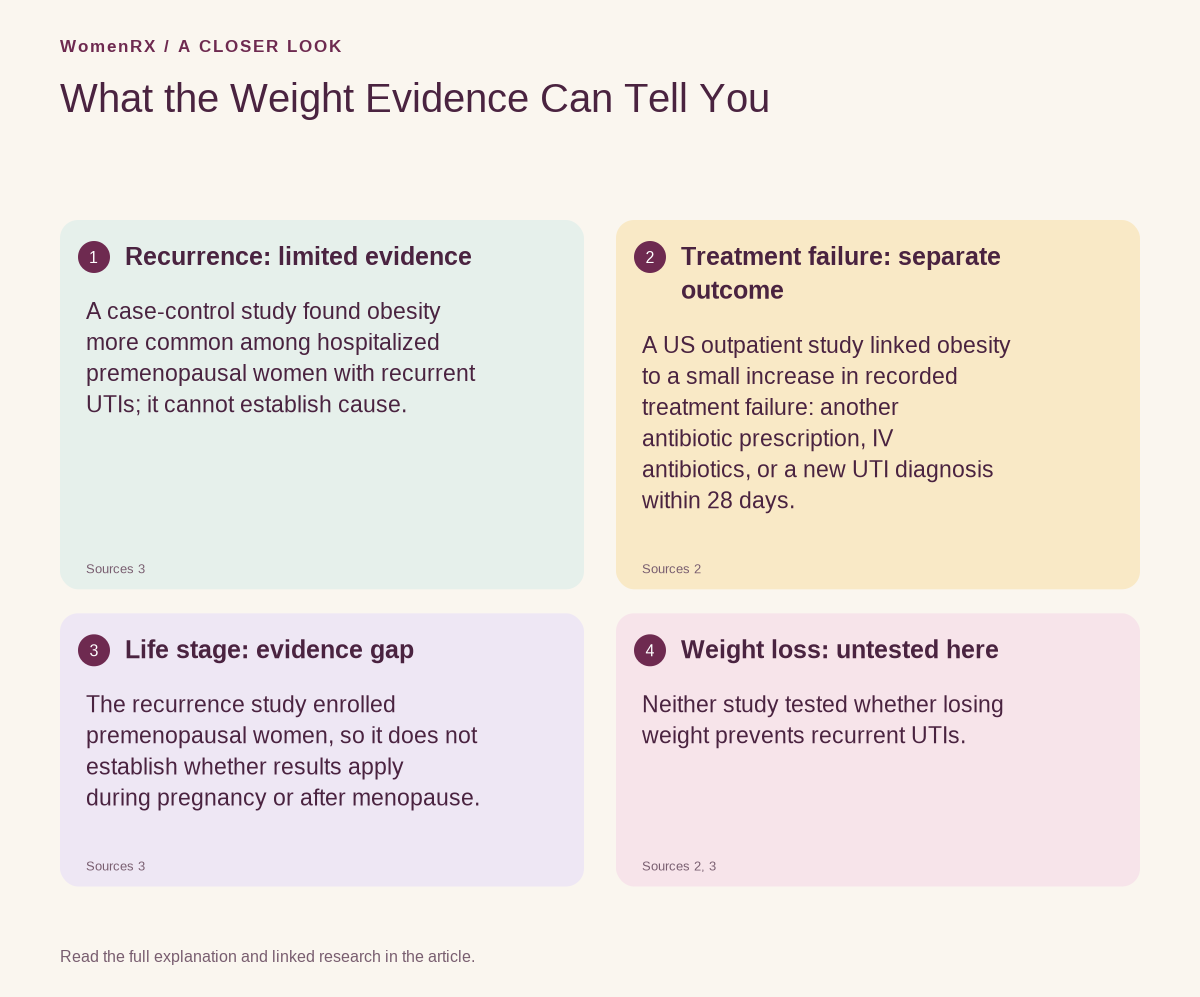
What the Weight Evidence Can Tell You
Recurrence: limited evidence: A case-control study found obesity more common among hospitalized premenopausal women with recurrent UTIs; it cannot establish cause.3
Treatment failure: separate outcome: A US outpatient study linked obesity to a small increase in recorded treatment failure: another antibiotic prescription, IV antibiotics, or a new UTI diagnosis within 28 days.2
Life stage: evidence gap: The recurrence study enrolled premenopausal women, so it does not establish whether results apply during pregnancy or after menopause.3
Weight loss: untested here: Neither study tested whether losing weight prevents recurrent UTIs.23
Read the figure as text
These findings address different outcomes and populations, so they shouldn’t be treated as proof that obesity causes recurrent UTIs.- Recurrence: limited evidence: A case-control study found obesity more common among hospitalized premenopausal women with recurrent UTIs; it cannot establish cause.3
- Treatment failure: separate outcome: A US outpatient study linked obesity to a small increase in recorded treatment failure: another antibiotic prescription, IV antibiotics, or a new UTI diagnosis within 28 days.2
- Life stage: evidence gap: The recurrence study enrolled premenopausal women, so it does not establish whether results apply during pregnancy or after menopause.3
- Weight loss: untested here: Neither study tested whether losing weight prevents recurrent UTIs.23
More questions, answered
Does this mean I should lose weight to prevent UTIs?
These studies don’t show that weight loss prevents recurrent UTIs. One observed an association with obesity in a selected group of hospitalized premenopausal women; the larger study examined recorded events after antibiotic treatment, not prevention of repeat infections. 2 3
Sources you can check
- Urinary tract infections (UTIs) - NHSAccessed 2026-09-25Return to first citation
- Risk Factors for Empiric Treatment Failure in US Female Outpatients with Uncomplicated Urinary Tract Infection: an Observational Study.Fromer DL, Luck ME, Cheng WY, Mahendran M, da Costa WL, Pinaire M, Duh MS, Preib MT, Ellis JJ. · Journal of general internal medicine · 2025Return to first citation
- Non-alcoholic Fatty Liver Disease is Associated with Recurrent Urinary Tract Infection in Premenopausal Women Independent of Metabolic Syndrome.Nseir W, Amara A, Farah R, Ahmad HS, Mograbi J, Mahamid M. · The Israel Medical Association journal : IMAJ · 2019Return to first citation