Is Body Weight Linked to Interstitial Cystitis Symptoms?
A few studies report BMI differences between people with bladder pain syndrome and comparison groups, but they don’t show that weight causes worse symptoms.
The research doesn’t establish body weight as a cause of interstitial cystitis/bladder pain syndrome (IC/BPS), or show that losing weight improves it. Studies reported lower BMI measures in women with IC/BPS than in women with overactive bladder, but those group comparisons don’t tell us whether weight predicts symptom severity among women with IC/BPS. They also can’t explain an individual person’s pain. 4 5
What the comparisons can tell you
IC/BPS involves bladder or pelvic pain, often alongside urinary urgency or frequency. These symptoms can overlap with other conditions, so a comparison between groups can offer clues, but it doesn’t answer every question about weight and symptoms. 3 4
In one retrospective study, researchers compared 55 women with interstitial cystitis with 171 women with overactive bladder. The women with IC had lower BMI, while reported urinary symptom severity was higher than in one overactive-bladder subgroup and similar to another. The study didn’t show that BMI explained those symptom differences, or test whether women with IC and higher BMI had more severe symptoms than women with IC and lower BMI. 4
A study of 109 female IC/BPS outpatients also reported a lower BMI ratio in the IC/BPS group than in an overactive-bladder comparison group. It identified caffeine intake and constipation as factors that might relate to quality of life, but the reported findings don’t establish BMI as a driver of symptoms. 5
These are comparisons between groups, not proof that weight causes bladder pain. They also don’t tell you whether weight change improves symptoms. BMI itself is a limited measure: it doesn’t distinguish body fat from muscle or bone. 1
Prevalence, severity, and treatment response are different questions
A difference in BMI between two groups is not the same as evidence that body weight affects how severe IC/BPS feels. And neither finding tells us whether weight change alters the chance of having IC/BPS or changes response to treatment.
For example, a study of women receiving bladder instillation treatment reported participants’ average BMI and identified pretreatment urinary measures and bladder capacity associated with treatment failure. Its reported results don’t establish BMI as a predictor of treatment response. 6 The studies summarized here therefore leave the key personal question open: whether a particular woman’s weight is related to her own symptom pattern.
Look at what changed alongside your symptoms
If your bladder pain or urgency shifts around the same time as your weight, the timing may be worth noticing, but it can’t by itself identify a cause. Consider the broader pattern:
- Did pain, urgency, and frequency change together, or did one symptom shift on its own?
- Did constipation or caffeine intake change at the same time? These were related to quality of life in one study, though that doesn’t prove either explains your symptoms. 5
- Are other overlapping pain conditions part of the picture? In women with IC/BPS, research has examined overlapping chronic pain conditions as a distinct feature, rather than treating BMI as an explanation for them. 2
- Did the symptoms change even when your weight stayed about the same?
Those distinctions can help make sense of a change without turning the scale into a diagnosis. Weight management may matter for other health reasons, but these studies don’t support treating weight loss as an established IC/BPS therapy.
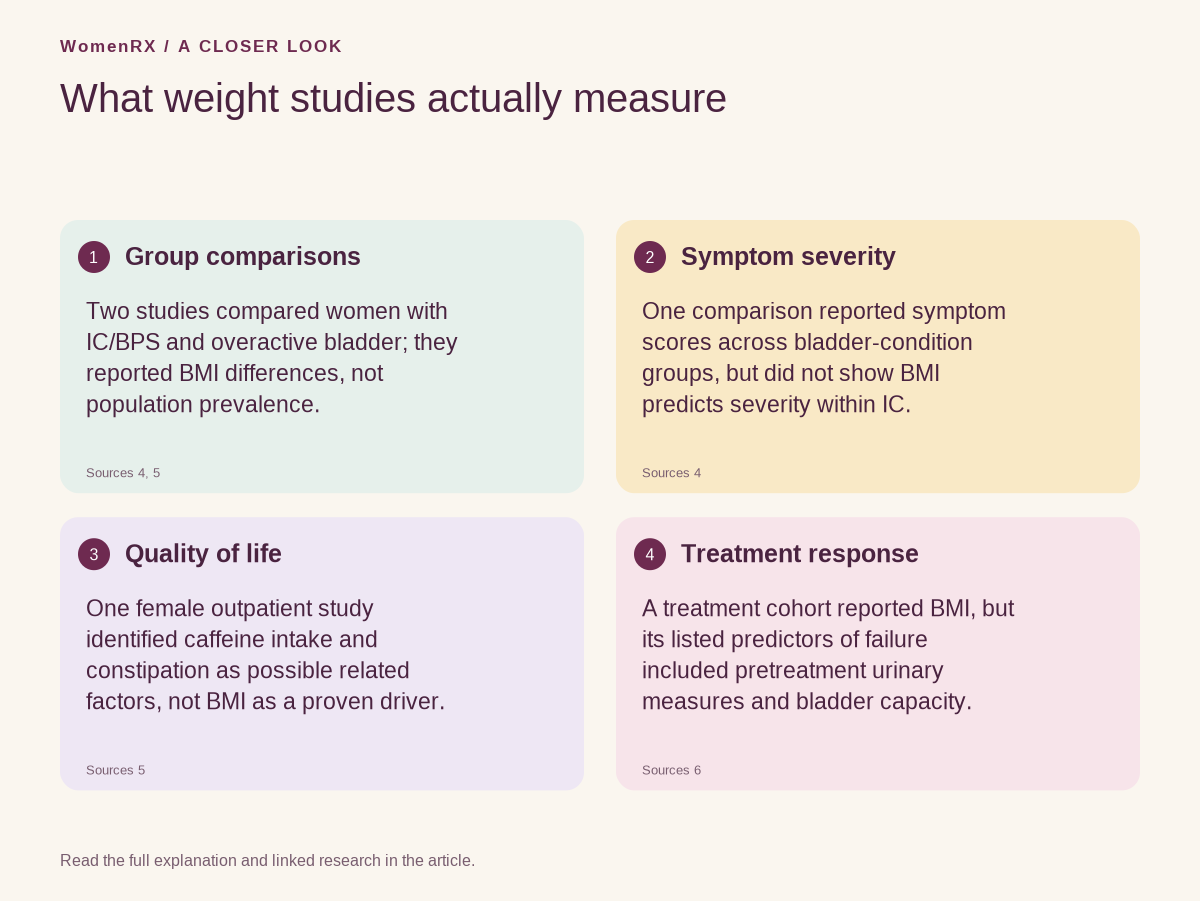
What weight studies actually measure
Group comparisons: Two studies compared women with IC/BPS and overactive bladder; they reported BMI differences, not population prevalence.45
Symptom severity: One comparison reported symptom scores across bladder-condition groups, but did not show BMI predicts severity within IC.4
Quality of life: One female outpatient study identified caffeine intake and constipation as possible related factors, not BMI as a proven driver.5
Treatment response: A treatment cohort reported BMI, but its listed predictors of failure included pretreatment urinary measures and bladder capacity.6
Read the figure as text
These findings answer different questions. A group BMI difference doesn’t establish symptom severity or treatment response.- Group comparisons: Two studies compared women with IC/BPS and overactive bladder; they reported BMI differences, not population prevalence.45
- Symptom severity: One comparison reported symptom scores across bladder-condition groups, but did not show BMI predicts severity within IC.4
- Quality of life: One female outpatient study identified caffeine intake and constipation as possible related factors, not BMI as a proven driver.5
- Treatment response: A treatment cohort reported BMI, but its listed predictors of failure included pretreatment urinary measures and bladder capacity.6
More questions, answered
Does a higher BMI mean my bladder pain is caused by my weight?
No. BMI alone can’t identify the cause of bladder pain, and these studies don’t show that BMI explains symptom severity in an individual woman. 1 4
Should I lose weight to improve IC/BPS symptoms?
These findings don’t show that weight loss improves IC/BPS. If you’re considering weight change for other health reasons, keep that decision separate from any promise of bladder-symptom relief.
Sources you can check
- Body Weight: MedlinePlusAccessed 2026-09-25Return to first citation
- Stimulated whole-blood cytokine/chemokine responses are associated with interstitial cystitis/bladder pain syndrome phenotypes and features of nociplastic pain: a multidisciplinary approach to the study of chronic pelvic pain research network study.Schrepf A, Kaplan C, Harris RE, Williams DA, Clauw DJ, As-Sanie S, Till S, Clemens JQ, Rodriguez LV, Van Bokhoven A, Landis R, Gallop R, Bradley C, Naliboff B, Pontari M, O'Donnell... · Pain · 2023Return to first citation
- Early and recent exposure to adversity, TLR-4 stimulated inflammation, and diurnal cortisol in women with interstitial cystitis/bladder pain syndrome: A MAPP research network study.Lutgendorf SK, Zia S, Luo Y, O'Donnell M, van Bokhoven A, Bradley CS, Gallup R, Pierce J, Taple BJ, Naliboff BD, Quentin Clemens J, Kreder KJ, Schrepf A. · Brain, behavior, and immunity · 2023Return to first citation
- Comparison of urodynamic results and quality of life between women with interstitial cystitis and overactive bladder.Hsu CC, Liang CC, Chang SD, Chien CW, Hsieh WC. · Taiwanese journal of obstetrics & gynecology · 2020Return to first citation
- [Quality of life and related factors in patients with interstitial cystitis/bladder pain syndrome].Wang JW, Liu JC, Meng LF, Zhang W, Liu XD, Zhang YG. · Beijing da xue xue bao. Yi xue ban = Journal of Peking University. Health sciences · 2021Return to first citation
- Long-term outcomes of intravesical dimethyl sulfoxide/heparin/hydrocortisone therapy for interstitial cystitis/bladder pain syndrome.Lim YN, Dwyer P, Murray C, Karmakar D, Rosamilia A, Thomas E. · International urogynecology journal · 2017Return to first citation