Bladder Pain and Urgency: Could It Be Interstitial Cystitis?
Pain that changes as your bladder fills is a useful clue, but infection and other causes need attention too.
Interstitial cystitis, also called bladder pain syndrome (IC/BPS), may be considered when bladder-related pain or pressure keeps returning alongside urinary urgency or frequency and another cause hasn’t been identified. Discomfort that grows as the bladder fills and eases after you pee is a useful clue, not a diagnosis. Evaluation starts with your symptom pattern and checking for other causes, including a urinary tract infection (UTI). 34
The clue is pain, not urgency alone
Needing to pee often can be exhausting, but frequency by itself doesn’t tell you why it’s happening. IC/BPS describes bladder-related pain, pressure, or discomfort together with urinary symptoms when infection or another identifiable cause does not explain them. The pain may be felt in the bladder area, lower belly, or back. Some people notice discomfort as the bladder fills after drinking and some relief after they pee. Others feel an urge to go even when the bladder seems empty. 34
That filling-and-emptying pattern gives a clinician something more specific to investigate than “I’m going all the time.” It still isn’t a home test for IC/BPS. Tell them where you feel pain, whether peeing changes it, and whether the symptoms are steady, episodic, or getting worse. Those details help describe pain that can otherwise be hard to pin down. 14
How an evaluation separates possibilities
A clinician will ask about your symptoms and consider conditions that can look similar. A urine test may be part of checking for a UTI. There’s no single test that establishes IC/BPS; depending on the symptoms, further tests may be used to investigate other causes or examine the bladder. Cystoscopy, which uses a camera to look inside the bladder, is not required for every IC/BPS diagnosis under a commonly used US clinical framework. It can be useful when a clinician needs to investigate a particular concern, including a suspected Hunner lesion, a distinct bladder finding. 43
A UTI deserves particular attention because it can overlap with bladder pain and urinary frequency. Cloudy, bad-smelling, or reddish urine and pain in the back or side below the ribs are clues worth reporting; a urine test can help assess whether an infection is present. Symptoms alone may not settle the question, and a negative test doesn’t automatically prove IC/BPS. If symptoms persist or change, the result needs to be considered alongside the full history. Antibiotics treat a bacterial infection, not an IC/BPS diagnosis in itself. 653
Don’t wait for a routine bladder-pain appointment if you see blood in your urine or have bladder, lower-belly, or back pain with a high temperature or chills. Those symptoms need prompt medical assessment because infection or another cause may need attention. 4
Pelvic pain can have more than one pattern
If you have periods, note whether the pain starts just before bleeding, peaks during it, or occurs throughout the month. Period cramps commonly affect the lower belly and can spread to the back and thighs. More painful periods can also have causes such as endometriosis, adenomyosis, fibroids, or pelvic inflammatory disease. That doesn’t rule bladder pain in or out; it means the timing and location of pain matter when deciding what to investigate. 24
Also mention pain with penetration or another ongoing pelvic or pain condition if it applies to you. Pain with sex can occur with bladder pain syndrome, while the cause of persistent pelvic pain may not be limited to one organ. You don’t need to decide which condition you have before describing all the symptoms. 43
A short record can make the pattern clearer
Before an appointment, jot down what happens on days that feel typical and days that feel worse. This isn’t a diagnostic score, and you don’t need a perfect log. The useful question is whether pain and the urge to pee move together, and what else changes when they do. 14
- Filling and relief: Where is the pain or pressure? Does it build before you pee, ease afterward, or stay the same? 4
- Trips to the bathroom: Note when you pee and whether the urge arrives despite feeling that your bladder is empty. 4
- Drinks and symptoms: Record what you drank and whether discomfort followed as your bladder filled. A possible pattern is more useful than assuming every drink is a trigger. 4
- Other urinary clues: Record any change in urine appearance or smell, or pain in your back or side below the ribs. 6
- Pelvic context: If relevant, mark period timing and pain with sex, alongside symptoms that occur outside those situations. 24
Bring any previous urine-test results you have, and explain whether your current symptoms feel like earlier episodes or different from them. The record helps tell the story; it doesn’t replace testing when infection or another cause is possible. 45
What happens if IC/BPS is the likely explanation?
Treatment is individualized because symptoms and responses vary. Options described in clinical references include behavioral approaches, help managing persistent pain, medicines, treatments placed into the bladder, and procedures for selected cases. Bladder retraining may be one part of care; amitriptyline is among medicines used for pain symptoms. A clinician can weigh options against the symptom that most disrupts your day and revisit the plan if it isn’t helping. 34
The first useful next move isn’t to find one perfect treatment. It’s to establish whether infection or another condition needs treatment now, then describe the bladder and pelvic pain pattern clearly enough to choose a sensible next step. 346
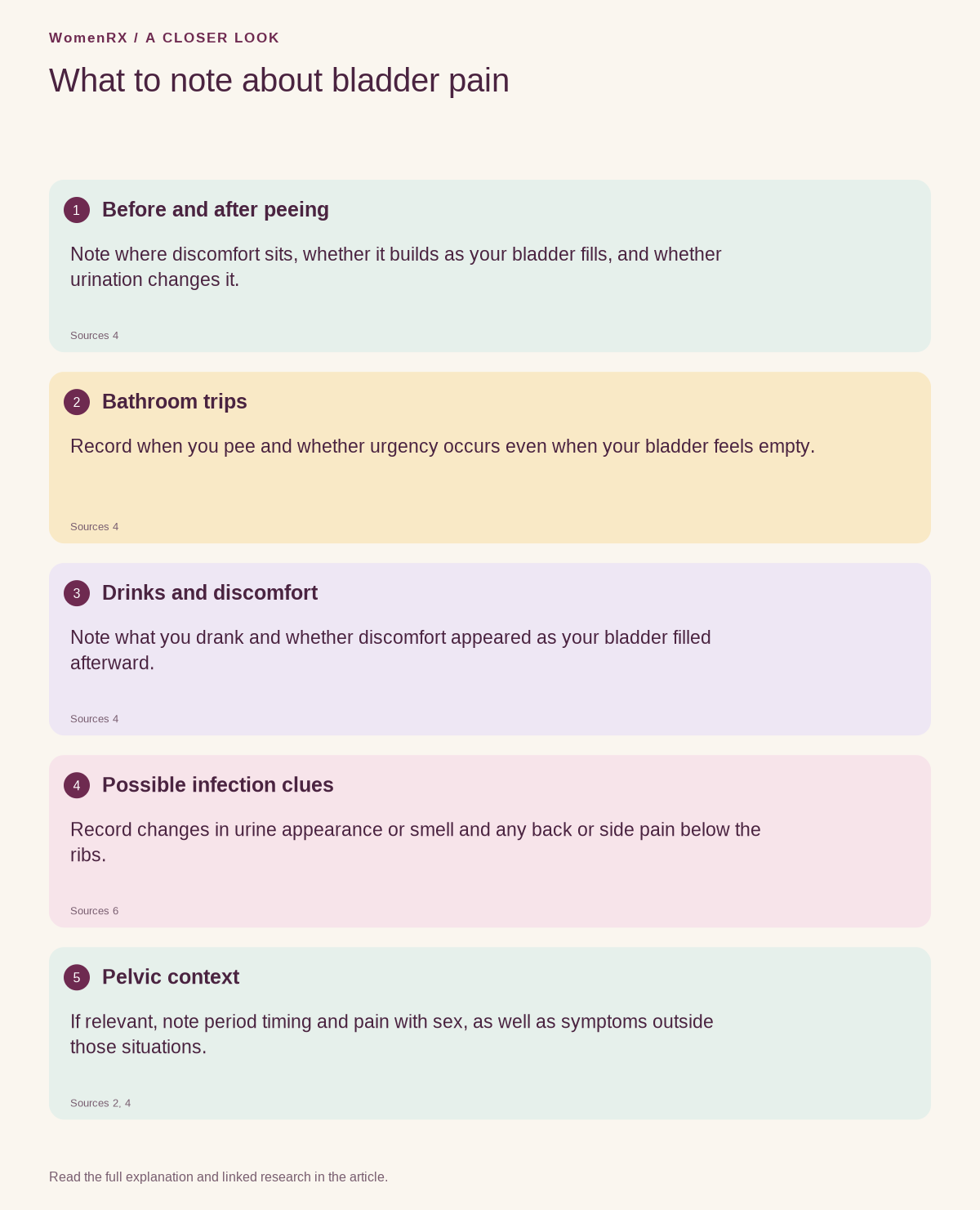
What to note about bladder pain
Before and after peeing: Note where discomfort sits, whether it builds as your bladder fills, and whether urination changes it.4
Bathroom trips: Record when you pee and whether urgency occurs even when your bladder feels empty.4
Drinks and discomfort: Note what you drank and whether discomfort appeared as your bladder filled afterward.4
Possible infection clues: Record changes in urine appearance or smell and any back or side pain below the ribs.6
Pelvic context: If relevant, note period timing and pain with sex, as well as symptoms outside those situations.24
Read the figure as text
A symptom record can show how pain, urination, and other clues fit together; it is not a diagnostic score.- Before and after peeing: Note where discomfort sits, whether it builds as your bladder fills, and whether urination changes it.4
- Bathroom trips: Record when you pee and whether urgency occurs even when your bladder feels empty.4
- Drinks and discomfort: Note what you drank and whether discomfort appeared as your bladder filled afterward.4
- Possible infection clues: Record changes in urine appearance or smell and any back or side pain below the ribs.6
- Pelvic context: If relevant, note period timing and pain with sex, as well as symptoms outside those situations.24
More questions, answered
Does a normal urine test mean I have IC/BPS?
No. IC/BPS is assessed from the symptom pattern after other identifiable causes are considered; there’s no single confirming test. If symptoms continue, discuss the result in the context of your history rather than treating one test as the whole answer. 345
Will I need a cystoscopy?
Not necessarily. Cystoscopy may help investigate particular concerns or identify a Hunner lesion, but it isn’t required for every diagnosis under a commonly used US clinical framework. 34
Sources you can check
- Pain | MedlinePlusAccessed 2026-09-25Return to first citation
- Period pain - NHSAccessed 2026-09-25Return to first citation
- Interstitial Cystitis/Bladder Pain Syndrome: A Narrative Review of Nomenclature, Epidemiology, Pathophysiology, Diagnosis, and Management.Priporeanu T, Petre I, Dragomir RE, Stoica RI, Grigore N. · Cureus · 2026Return to first citation
- Bladder pain syndrome (BPS) - NHSAccessed 2026-09-25Return to first citation
- Urinary tract infections (UTIs) - NHSAccessed 2026-09-25Return to first citation
- Urinary Tract Infections | UTI | UTI Symptoms | MedlinePlusAccessed 2026-09-25Return to first citation