Interstitial Cystitis Supplements: What the Evidence Says
Some people report bladder-symptom relief, but current findings don’t establish a best supplement or show that supplements change the condition.
There’s no well-supported “best” supplement for interstitial cystitis/bladder pain syndrome (IC/BPS). A survey found only a trend toward symptom improvement with calcium glycerophosphate and baking soda, while an uncontrolled study reported improvement with a multi-ingredient product. Neither establishes that a supplement caused relief or changed the condition. First make sure other causes, including infection, have been considered. 1 3 4
Relief is not the same as treating the condition
If bladder pain, urgency, or frequent urination has you looking for a supplement, the most useful answer is a cautious one: the evidence doesn’t identify a clear winner. Some people with IC/BPS report that particular foods or products affect their symptoms. That’s different from showing that a supplement treats the underlying condition, prevents it from progressing, or works reliably for other people.
IC/BPS is especially relevant in women’s care: a clinical review described most affected patients as women. Still, bladder pain, urgency, or frequency alone doesn’t confirm IC/BPS. Other causes, including infection, need consideration. 3
One web-based questionnaire collected responses from 598 members of an interstitial cystitis organization. Most of the 344 foods, drinks, supplements, and other items asked about were reported to have no effect. Calcium glycerophosphate and sodium bicarbonate showed only a trend toward symptom improvement. Because this was a self-reported survey, it can point to experiences worth discussing, but it can’t establish that either product caused relief. 1
A separate study looked at CystoProtek, a product with several ingredients, in 252 people with symptoms that had not improved with other treatments. Participants reported lower visual analogue symptom scores after taking it, but the study had no control group. Without a comparison group, it’s not possible to separate a product effect from other influences on symptoms, and the combination of ingredients makes it hard to tell which ingredient might matter. The study measured symptoms, not whether the condition itself changed. 4
A personal trigger is not a proven treatment
Dietary sensitivities can be individual. In a separate study, researchers tested a shortened questionnaire about foods, drinks, and supplements that participants associated with IC/BPS symptoms. That work supports using a structured history to identify possible personal triggers; it doesn’t show that a supplement reduces symptoms. 2
So if a product seems to help you, that experience matters, but it isn’t proof that it will help someone else or that it has changed the course of IC/BPS. Be wary of claims that a supplement “repairs” the bladder or cures the condition when this evidence measures reported symptoms instead.
Check the diagnosis and the label before trying one
Bladder pain and urinary symptoms aren’t a diagnosis by themselves. A clinical review describes IC/BPS as a condition with symptoms such as pelvic or bladder-area pain, urgency, and frequency, and emphasizes that other causes, including infection, should be excluded. That distinction matters before treating symptoms as IC/BPS with a supplement. 3
If you’re considering a product, bring its full ingredient label and your medication list to a prescriber or pharmacist. Ask what evidence supports the specific ingredient for your symptom, whether its ingredients are appropriate with your medicines and health conditions, and what would count as a reason to stop. The studies summarized here don’t establish ingredient-specific safety or interactions, so don’t treat a symptom-relief claim as a safety guarantee.
A simple way to make the conversation useful is to name the symptom you hope to change, such as pain or urgency, and ask whether there’s evidence for that outcome. Also ask whether the product is being proposed for short-term symptom relief or for changing the condition. Those are different claims, and the available supplement findings support neither as a dependable result.
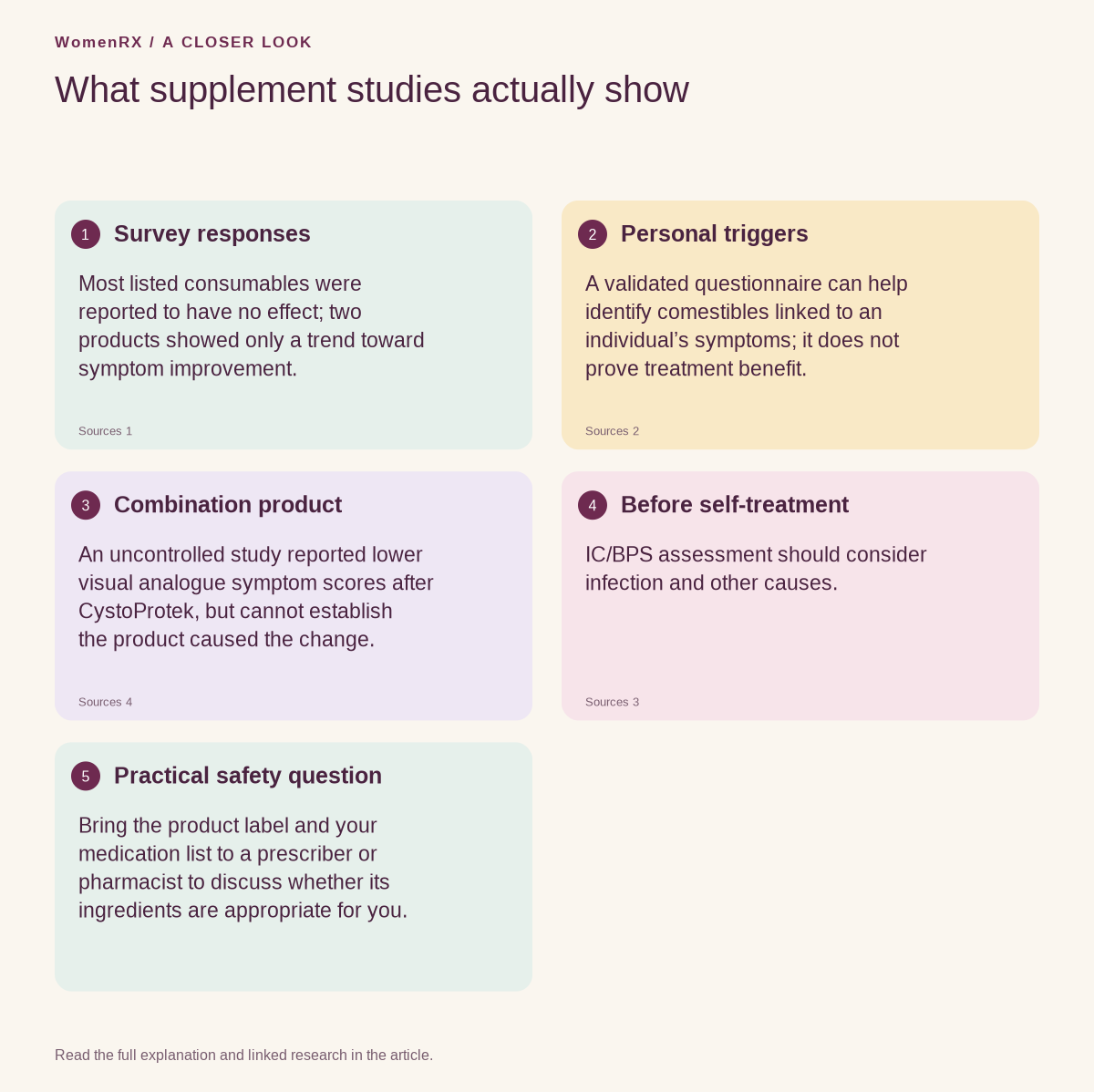
What supplement studies actually show
Survey responses: Most listed consumables were reported to have no effect; two products showed only a trend toward symptom improvement.1
Personal triggers: A validated questionnaire can help identify comestibles linked to an individual’s symptoms; it does not prove treatment benefit.2
Combination product: An uncontrolled study reported lower visual analogue symptom scores after CystoProtek, but cannot establish the product caused the change.4
Before self-treatment: IC/BPS assessment should consider infection and other causes.3
Practical safety question: Bring the product label and your medication list to a prescriber or pharmacist to discuss whether its ingredients are appropriate for you.
Read the figure as text
These findings differ in what they can tell you: a survey records reported sensitivities, while an uncontrolled study records before-and-after symptoms.- Survey responses: Most listed consumables were reported to have no effect; two products showed only a trend toward symptom improvement.1
- Personal triggers: A validated questionnaire can help identify comestibles linked to an individual’s symptoms; it does not prove treatment benefit.2
- Combination product: An uncontrolled study reported lower visual analogue symptom scores after CystoProtek, but cannot establish the product caused the change.4
- Before self-treatment: IC/BPS assessment should consider infection and other causes.3
- Practical safety question: Bring the product label and your medication list to a prescriber or pharmacist to discuss whether its ingredients are appropriate for you.
More questions, answered
Does a supplement cure interstitial cystitis?
These studies don’t show that a supplement cures IC/BPS or changes its course. The reported outcomes were symptom reports, and the multi-ingredient study had no control group. 1 4
Sources you can check
- Dietary consumption triggers in interstitial cystitis/bladder pain syndrome patients.Bassaly R, Downes K, Hart S. · Female pelvic medicine & reconstructive surgery · 2011Return to first citation
- Statistical validation of the shorter-moldwin food sensitivity questionnaire for patients with interstitial cystitis/bladder pain syndrome.Shorter B, Ackerman M, Varvara M, Moldwin RM. · The Journal of urology · 2014Return to first citation
- Interstitial cystitis/painful bladder syndrome.French LM, Bhambore N. · American family physician · 2011Return to first citation
- Treatment of refractory interstitial cystitis/painful bladder syndrome with CystoProtek--an oral multi-agent natural supplement.Theoharides TC, Kempuraj D, Vakali S, Sant GR. · The Canadian journal of urology · 2008Return to first citation