Could Bladder Pain and Urgency Be Interstitial Cystitis?
Bladder pain that keeps returning alongside urgency deserves a closer look, even when a urine test hasn’t shown an infection.
Bladder pressure or pain that builds before you pee and eases briefly afterward can be a clue to interstitial cystitis, also called bladder pain syndrome. Frequent trips to the bathroom and urgency can occur too. These symptoms overlap with other conditions, so diagnosis involves checking for infection and other causes. 1415
The clue is pain alongside the urge to go
You might feel pressure low in your belly and need to pee again soon after leaving the bathroom. IC/BPS is one possible explanation when bladder-related pain, pressure, or discomfort occurs with a urinary symptom such as urgency or frequency, and infection or another identifiable cause doesn’t explain it. Symptoms can vary, and pain may also be felt in the lower belly or back. 611
One useful detail is what happens before and after you pee. IC can cause pain that grows as your bladder fills and improves for a while after you empty it. Symptoms can settle and return; they do not have to feel identical every day. Menstruation can also trigger a flare in some people. 14
Frequency or urgency on its own isn’t the same pattern. Overactive bladder can also cause urinary symptoms, while pain or discomfort related to the bladder is central to the IC/BPS definition. These conditions can’t be reliably sorted out from one symptom alone. 156
Persistent symptoms deserve an explanation. There is no need to wait for them to reach a particular anniversary before describing the pattern.
What happens after a negative urine test?
Urine testing helps check for a urinary tract infection (UTI), which calls for a different approach. A clinician will also ask about where you feel the discomfort, how often you urinate, whether symptoms come and go, and what else happens alongside them. The question isn’t simply whether a test was negative. It’s whether the whole pattern fits IC/BPS better than another cause. 61113
That distinction matters because pelvic pain can come from the urinary tract, reproductive organs, bowel, or muscles, and more than one cause can be present. Pain with sex is worth mentioning too: it can occur with IC/BPS, but it doesn’t identify the cause by itself. 1112
If you have periods, pain that starts just before or during a period may point the evaluation toward period pain or another pelvic cause rather than bladder pain alone. Heavier or irregular periods, bleeding between periods, or pain when peeing can also shape what needs investigating. 312
A pelvic examination may help assess the pelvic floor muscles. A bladder diary can add practical detail by recording what you drink and how much urine you pass. Together with urine tests, these observations help distinguish similar-looking problems. 15
When might more testing help?
There’s no single confirmatory test for bladder pain syndrome. A urine test may be part of the initial workup; further tests depend on the symptoms and what the first evaluation finds. Cystoscopy uses a small camera to look inside the bladder, but the AUA/SUFU framework does not require it for every IC/BPS diagnosis. It may be considered when a specialist suspects a particular bladder finding called a Hunner lesion. 611
If symptoms are severe, keep returning, or remain unexplained, a clinician may involve a urologist. That’s an opportunity to examine the pattern more closely, not a sign that IC/BPS has already been confirmed. 611
Don’t assume a new warning sign is part of IC/BPS. Blood in your urine, or bladder, lower-belly, or back pain with a high temperature or chills, needs urgent medical advice. Pain with fever or chills could be a sign of infection. 11
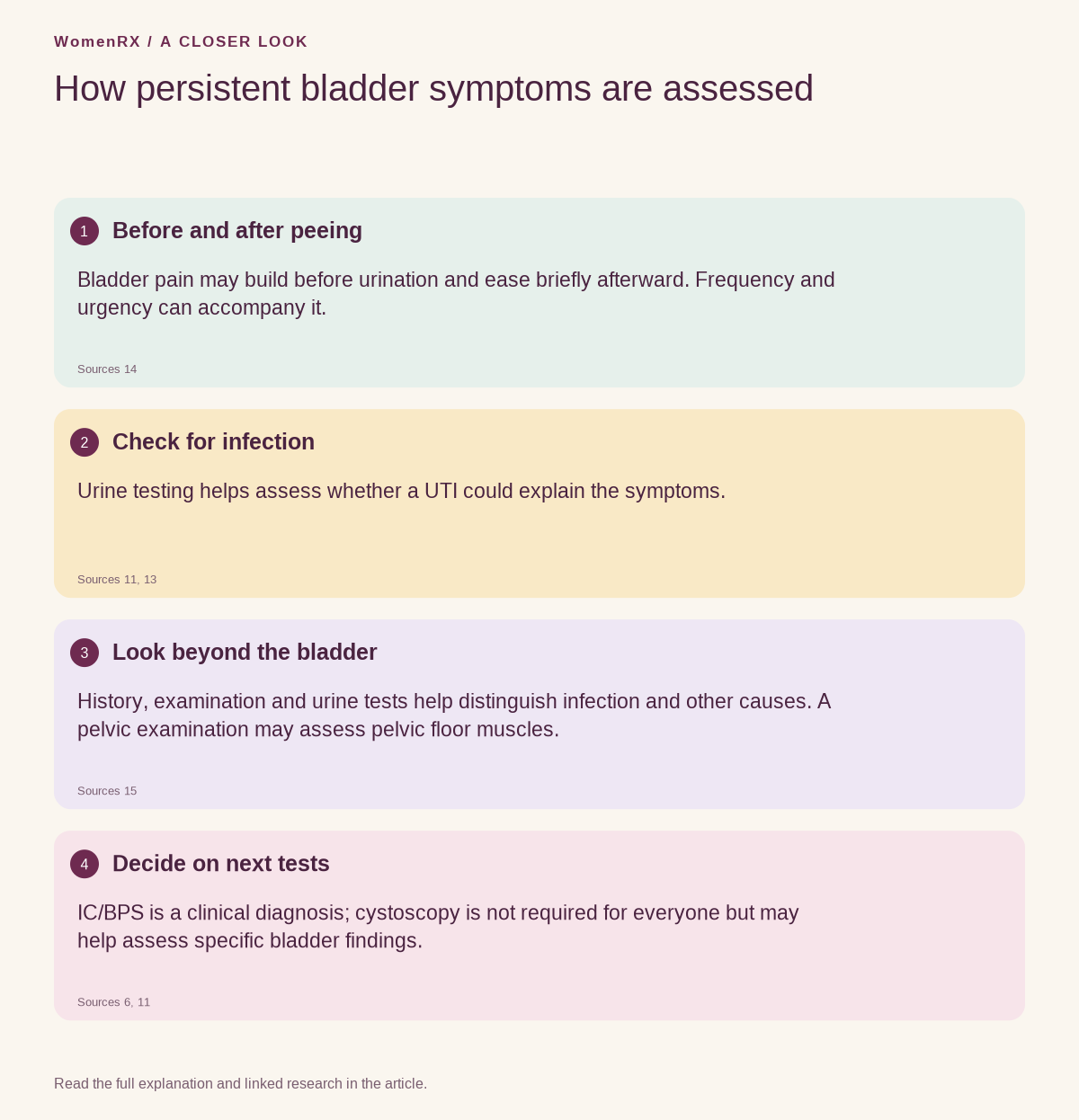
How persistent bladder symptoms are assessed
Before and after peeing: Bladder pain may build before urination and ease briefly afterward. Frequency and urgency can accompany it.14
Check for infection: Urine testing helps assess whether a UTI could explain the symptoms.1113
Look beyond the bladder: History, examination and urine tests help distinguish infection and other causes. A pelvic examination may assess pelvic floor muscles.15
Decide on next tests: IC/BPS is a clinical diagnosis; cystoscopy is not required for everyone but may help assess specific bladder findings.611
Read the figure as text
The path depends on the combination of symptoms and what testing finds, not on a single negative result.- Before and after peeing: Bladder pain may build before urination and ease briefly afterward. Frequency and urgency can accompany it.14
- Check for infection: Urine testing helps assess whether a UTI could explain the symptoms.1113
- Look beyond the bladder: History, examination and urine tests help distinguish infection and other causes. A pelvic examination may assess pelvic floor muscles.15
- Decide on next tests: IC/BPS is a clinical diagnosis; cystoscopy is not required for everyone but may help assess specific bladder findings.611
Can I have IC/BPS if my urine culture is negative?
Yes. IC/BPS is considered when bladder-related pain or pressure and urinary symptoms persist without infection or another identifiable explanation. A negative culture helps address the infection question, but it cannot confirm IC/BPS by itself. 611
Will I need a cystoscopy?
Not necessarily. There’s no single test that diagnoses IC/BPS, and the AUA/SUFU framework does not require cystoscopy for every person. A specialist may use it when looking for specific bladder findings, including Hunner lesions. 611
Sources you can check
- Urine and Urination | Urine | MedlinePlusAccessed 2026-09-25Return to first citation
- Period pain - NHSAccessed 2026-09-25Return to first citation
- The urinary microbiome, overactive bladder and bladder pain syndrome/interstitial cystitis - mechanisms, diagnostics and therapeutic opportunities.Spazzapan M, Raison N, Steves C, Sahai A. · Nature reviews. Urology · 2026Return to first citation
- Interstitial Cystitis/Bladder Pain Syndrome: A Narrative Review of Nomenclature, Epidemiology, Pathophysiology, Diagnosis, and Management.Priporeanu T, Petre I, Dragomir RE, Stoica RI, Grigore N. · Cureus · 2026Return to first citation
- Bladder pain syndrome (BPS) - NHSAccessed 2026-09-25Return to first citation
- Pelvic Pain | Chronic Pelvic Pain | MedlinePlusAccessed 2026-09-25Return to first citation
- Urinary Tract Infections | UTI | UTI Symptoms | MedlinePlusAccessed 2026-09-25Return to first citation
- Symptoms & Causes of Interstitial Cystitis - NIDDKAccessed 2026-09-26Return to first citation
- Diagnosis of Interstitial Cystitis - NIDDKAccessed 2026-09-26Return to first citation