Could Your Symptoms Be Hypothyroidism? Here’s What Tests Clarify
Fatigue or feeling cold can raise the question, but thyroid blood tests help separate a possible cause from symptoms alone.
Persistent fatigue, feeling unusually cold, weight gain, or trouble concentrating can occur with hypothyroidism, but none confirms it. A TSH blood test is usually the first step when thyroid dysfunction is suspected; free T4 helps interpret an abnormal result. A mildly elevated TSH with normal free T4 may need follow-up rather than an immediate conclusion, since it can return to normal. 147
Symptoms are a reason to look closer, not a diagnosis
If you’re tired despite making room for sleep, reaching for a sweater when others are comfortable, or finding it harder to concentrate, it’s reasonable to wonder about your thyroid. Fatigue, cold intolerance, weight gain, and cognitive slowing can occur with hypothyroidism. They’re also nonspecific, so even several of them together can’t tell you whether your thyroid is the cause. 4
Constipation is another change worth mentioning during an assessment, particularly if it’s new for you. But bowel habits can change for other reasons, including medicines. If constipation is the main thing bothering you, asking whether a medicine could be contributing is useful whether or not thyroid testing is needed. 3
What matters is the change from your usual health and how much it’s affecting daily life. For example, feeling cold once on a chilly day tells you little. Persistently feeling cold alongside fatigue that’s disrupting work or home life gives a clinician more reason to consider thyroid testing as part of a broader assessment. Symptoms help start the conversation; the blood results help answer the thyroid question. 14
What TSH and free T4 tell you together
Your thyroid makes hormones involved in how your body uses energy, including functions related to digestion, heart rate, weight, and mood. TSH, or thyroid-stimulating hormone, is usually the first blood test ordered to check thyroid function. Free T4 measures a form of thyroxine, a thyroid hormone, and adds context when TSH is abnormal. 16
For suspected primary hypothyroidism, meaning the problem is at the thyroid gland, a high TSH points toward an underactive thyroid. The free T4 result helps distinguish two different findings:
- High TSH with low free T4 supports overt primary hypothyroidism. 56
- High TSH with free T4 still in the normal range is called subclinical hypothyroidism. It’s a blood-test pattern, not proof that it explains every symptom. 47
That distinction matters because an elevated TSH does not always mean you need thyroid treatment right away. In subclinical hypothyroidism, TSH can return to normal without treatment, and decisions depend on the result and clinical circumstances rather than symptoms alone. A clinician may consider a repeat test to see whether an elevation persists; there isn’t one repeat-testing interval that fits every situation described here. 47
A TSH result within the laboratory’s reference range makes primary hypothyroidism less likely, but it doesn’t explain away persistent symptoms. TSH-centered testing is designed chiefly for dysfunction at the thyroid gland. If the clinical picture points elsewhere, the next question is what else could account for the change, not whether your symptoms are real. 6
When other thyroid tests add something
Thyroid antibody tests can help investigate an autoimmune thyroid disorder. They answer a different question from TSH and free T4: they may help identify a cause, while hormone tests show how the thyroid is functioning. Thyroid imaging is not the routine first step for fatigue or feeling cold; it has other uses, such as assessing a thyroid lump. 1
If you already have a test result, it’s worth looking at the actual TSH and free T4 values and the laboratory reference ranges rather than relying on a single “normal” or “abnormal” label. In particular, a slightly high TSH with normal free T4 is a different finding from a high TSH with low free T4. 47
Pregnancy and the months after birth change the context
If you’re pregnant or planning pregnancy, say so when discussing symptoms or thyroid results. Pregnancy is a distinct clinical context for thyroid testing and decisions; guidance addressing primary hypothyroidism considers it separately from testing in other adults. That makes it especially unhelpful to interpret a result in isolation or apply a treatment rule from a general adult article. 6
After birth, physical and emotional changes can make symptoms harder to sort out. The postpartum period also doesn’t rule out a thyroid problem: postpartum thyroiditis is a recognized condition, although reports of individual cases can’t tell us how likely it is for any one person. If symptoms are persistent or worsening, mention that you’ve recently given birth when discussing whether thyroid tests or another assessment would help. 25
The useful next move is not to count symptoms until they add up to a supposed diagnosis. It’s to describe what has changed, consider other possible contributors, and use TSH and, when indicated, free T4 to find out whether the thyroid is part of the picture. 136
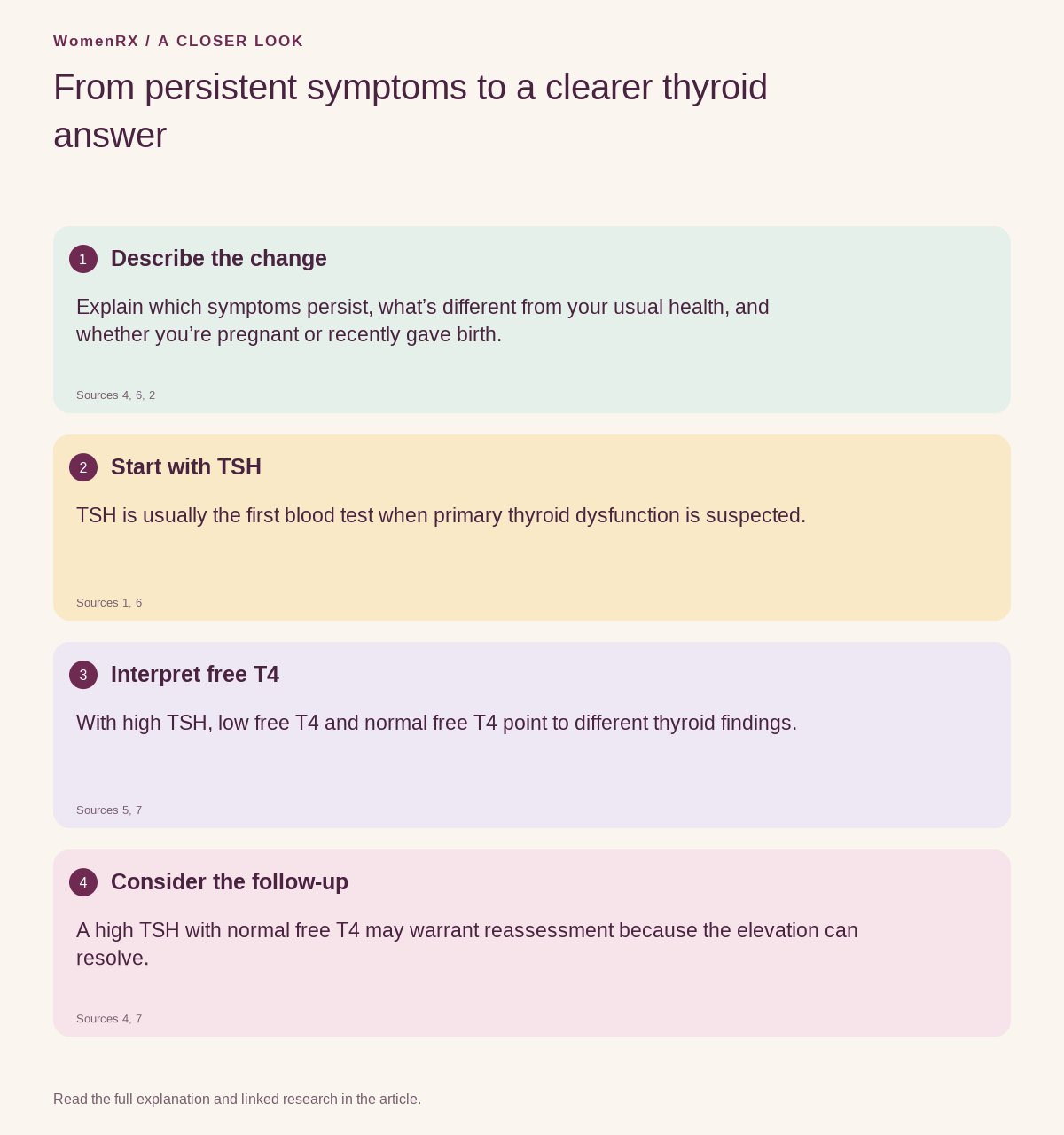
From persistent symptoms to a clearer thyroid answer
Describe the change: Explain which symptoms persist, what’s different from your usual health, and whether you’re pregnant or recently gave birth.462
Start with TSH: TSH is usually the first blood test when primary thyroid dysfunction is suspected.16
Interpret free T4: With high TSH, low free T4 and normal free T4 point to different thyroid findings.57
Consider the follow-up: A high TSH with normal free T4 may warrant reassessment because the elevation can resolve.47
Read the figure as text
Symptoms start the assessment; blood tests help distinguish thyroid findings that may need different follow-up.- Describe the change: Explain which symptoms persist, what’s different from your usual health, and whether you’re pregnant or recently gave birth.462
- Start with TSH: TSH is usually the first blood test when primary thyroid dysfunction is suspected.16
- Interpret free T4: With high TSH, low free T4 and normal free T4 point to different thyroid findings.57
- Consider the follow-up: A high TSH with normal free T4 may warrant reassessment because the elevation can resolve.47
More questions, answered
Does a high TSH always mean I have hypothyroidism?
It suggests that thyroid function needs interpretation, but free T4 changes what the result means. High TSH with normal free T4 is called subclinical hypothyroidism; an elevated TSH in that pattern can sometimes return to normal without treatment. 47
Do I need a thyroid ultrasound for these symptoms?
Usually the first thyroid check is a blood test for TSH. Ultrasound has a different role, including checking thyroid nodules or lumps; it doesn’t replace blood tests for assessing thyroid function. 1
Sources you can check
- Thyroid Tests: MedlinePlusAccessed 2026-09-25Return to first citation
- Postpartum Care: MedlinePlusAccessed 2026-09-25Return to first citation
- Constipation | MedlinePlusAccessed 2026-09-25Return to first citation
- Gray-zone decisions in subclinical hypothyroidism: a qualitative analysis of ChatGPT responses.Vuraloglu E. · BMC endocrine disorders · 2026Return to first citation
- Systematic review of COVID-19 and autoimmune thyroiditis.Tutal E, Ozaras R, Leblebicioglu H. · Travel medicine and infectious disease · 2022Return to first citation
- Thyroid testing in primary hypothyroidism1994Return to first citation
- Is subclinical hypothyroidism associated with cardiovascular disease in the elderly?Yamamoto K, Nakano Y, Soejima Y, Suyama A, Oguni K, Hasegawa K, Otsuka F. · Endocrine connections · 2025Return to first citation