Hashimoto’s or Perimenopause? What Thyroid Tests Can Clarify
Fatigue, mood changes, and disrupted sleep can be hard to sort out in midlife, but thyroid tests answer a different question than symptoms alone.
New symptoms during perimenopause don’t tell you by themselves whether your thyroid is underactive. Hashimoto’s is an autoimmune condition that can cause hypothyroidism, while symptoms of thyroid disease may be mistaken for menopausal symptoms. A TSH blood test is usually the first check of thyroid function; other tests can help clarify the result or investigate its cause. 134
Two questions that often get mixed together
If you’re tired, sleeping differently, feeling unlike yourself, or noticing changes in how you handle temperature, it’s reasonable to wonder whether perimenopause explains it. It’s also reasonable to ask about your thyroid. The tricky part is that a symptom can be real and disruptive without pointing to one cause. A review of thyroid disease in perimenopausal and postmenopausal women notes that thyroid symptoms can be subtle and attributed to menopause. 4
Start by separating what your thyroid is doing from why it might be doing it. Hypothyroidism means the thyroid isn’t making enough hormone to meet your body’s needs. Hashimoto’s is an autoimmune condition that can cause hypothyroidism. Thyroid hormones affect energy use, heart rate, digestion, weight, and mood, so a change in thyroid function can be felt in more than one part of daily life. 1
That distinction matters at an appointment. “Could this be my Hashimoto’s?” might mean “Has my thyroid function changed?” or “Do I have an autoimmune thyroid condition?” Those questions call for different information.
What a blood test adds that a symptom list can’t
TSH, or thyroid-stimulating hormone, is usually the first blood test ordered to check thyroid function. Tests for thyroid hormones, including T4, provide more information about hormone levels. Thyroid antibody tests look for markers that may help identify an autoimmune thyroid disorder. In other words, a thyroid function test addresses whether the gland is working as expected; an antibody test addresses a possible cause. 3
This doesn’t mean every symptom requires every thyroid test. It means you can ask a more precise question: “Given these new symptoms and my history, would checking my thyroid function help, and what would the result tell us?” If you already have a Hashimoto’s diagnosis, ask whether your current thyroid function has been checked rather than assuming the diagnosis explains every new symptom. Hashimoto’s identifies a cause of thyroid disease, while blood tests assess thyroid function. 13
Test results also need interpretation in context. A review focused on perimenopause and postmenopause advises care in interpreting thyroid function tests because thyroid hormone and TSH patterns can change with age and this life stage. That is a reason to discuss an unexpected result, not to dismiss it or assign symptoms to menopause without checking. The review also notes that there is no consensus on screening all postmenopausal women; that broad screening question is different from assessing your new symptoms. 4
If you already take levothyroxine
Tell the person assessing your symptoms that you take it and when your thyroid levels were last checked. Levothyroxine replaces thyroid hormone for an underactive thyroid, and blood tests are used to check whether the amount prescribed is right for you. Problems sleeping can occur when the dose isn’t right, so a new sleep problem isn’t automatically evidence that perimenopause is the only change. Don’t change or stop the medicine based on symptoms alone. 12
Make the appointment about the change you’ve noticed
You don’t need to arrive with a self-diagnosis. A useful description is more specific than “I feel hormonal.” For example: “My sleep changed this spring, I’m more tired during the day, and I’ve noticed these other changes too. Could thyroid function be part of this?” If you have a family history of thyroid disease, mention it; MedlinePlus lists it among factors associated with a higher risk of hypothyroidism. 1
The goal isn’t to choose between perimenopause and Hashimoto’s before you’re seen. It’s to make sure a familiar label doesn’t hide a change worth assessing. Thyroid tests can clarify thyroid function and sometimes its cause. They cannot, on their own, explain every symptom you’re experiencing. 134
What each clue can tell you
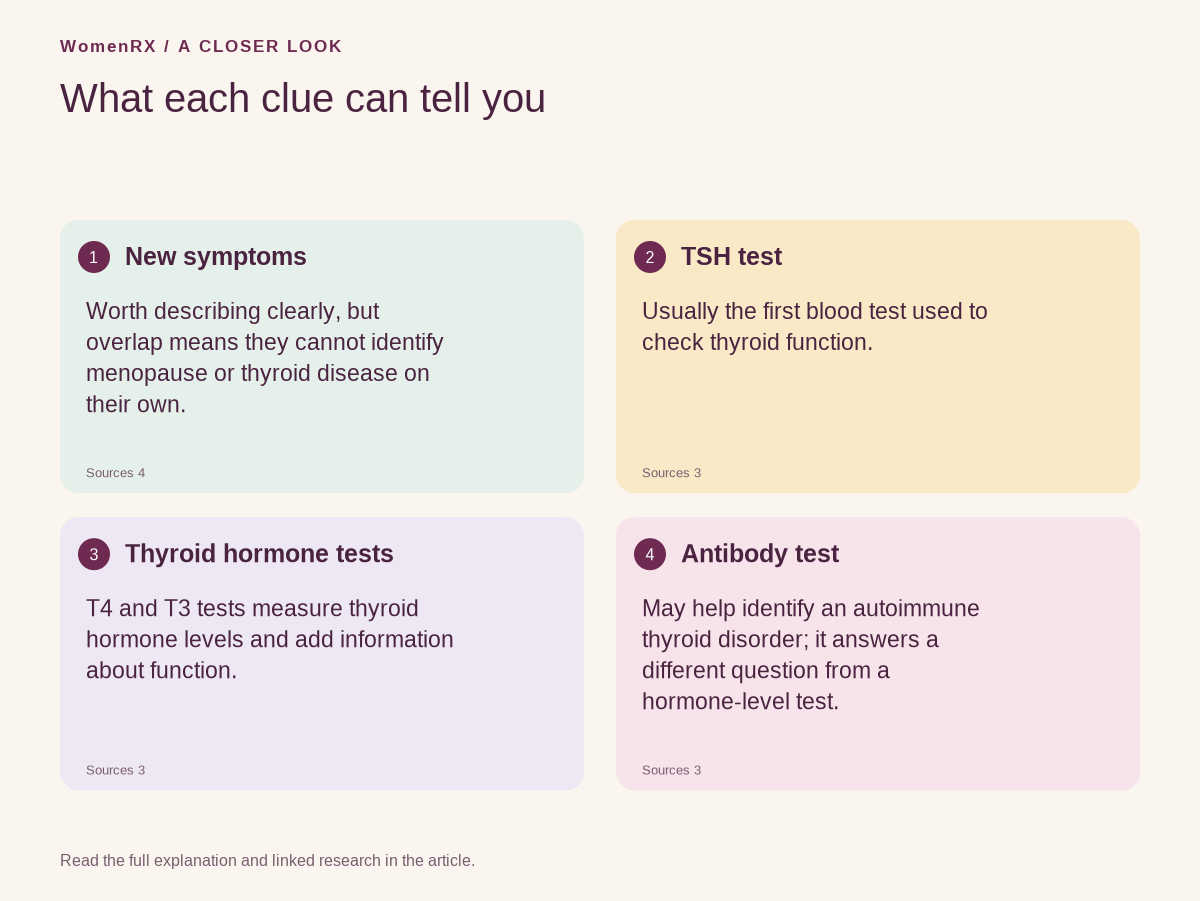
New symptoms: Worth describing clearly, but overlap means they cannot identify menopause or thyroid disease on their own.4
TSH test: Usually the first blood test used to check thyroid function.3
Thyroid hormone tests: T4 and T3 tests measure thyroid hormone levels and add information about function.3
Antibody test: May help identify an autoimmune thyroid disorder; it answers a different question from a hormone-level test.3
Read the figure as text
Symptoms, function tests, and antibody tests contribute different pieces of the picture; none should be treated as a stand-alone verdict.- New symptoms: Worth describing clearly, but overlap means they cannot identify menopause or thyroid disease on their own.4
- TSH test: Usually the first blood test used to check thyroid function.3
- Thyroid hormone tests: T4 and T3 tests measure thyroid hormone levels and add information about function.3
- Antibody test: May help identify an autoimmune thyroid disorder; it answers a different question from a hormone-level test.3
More questions, answered
Does a thyroid antibody test show whether my thyroid is underactive?
Not by itself. Antibody tests look for markers that may help identify an autoimmune thyroid disorder. Tests such as TSH and T4 assess thyroid function, which is the separate question of how your thyroid is working. 3
Sources you can check
- Hypothyroidism | Hashimoto's Disease | MedlinePlusAccessed 2026-09-25Return to first citation
- Levothyroxine: a medicine for an underactive thyroid (hypothyroidism) - NHSAccessed 2026-09-25Return to first citation
- Thyroid Tests: MedlinePlusAccessed 2026-09-25Return to first citation
- Thyroid disease in the perimenopause and postmenopause period.Uygur MM, Yoldemir T, Yavuz DG. · Climacteric : the journal of the International Menopause Society · 2018Return to first citation