Hashimoto’s Claims: What Tests and Treatment Really Show
A positive thyroid antibody test and an abnormal thyroid function test answer different questions.
Thyroid antibodies can help identify an autoimmune cause, while TSH and thyroid hormone tests show how well the thyroid is working. A positive antibody result alone doesn’t tell you whether hormone levels are low or whether treatment is needed. Levothyroxine replaces thyroid hormone when it’s prescribed for hypothyroidism; it isn’t a treatment aimed at lowering antibody numbers. 1 3
Two kinds of thyroid tests, two different answers
Hashimoto’s is an autoimmune condition involving the thyroid. Tests for thyroid antibodies, including thyroid peroxidase antibodies (TPOAb) and thyroglobulin antibodies (TgAb), can help identify that autoimmune pattern. TSH and thyroid hormone tests, such as free T4, assess thyroid function instead. Those results are related, but they aren’t interchangeable. 1 4
That distinction helps make sense of a common confusing result: someone can have thyroid antibodies without the test results showing low thyroid function. An antibody result is a marker that can help explain the cause of thyroid disease; it isn’t itself a measurement of how much thyroid hormone the body has available. Interpreting a result depends on the full test picture and clinical context. 1 4
Ultrasound answers another question. It can show the thyroid’s size, appearance, and nodules, but it doesn’t replace blood tests of thyroid function. In a study of 149 people already diagnosed with Hashimoto’s, ultrasound features and antibody or hormone results showed some associations. That kind of correlation doesn’t mean an ultrasound finding or antibody level can stand in for a function test. 1 5
Check a treatment claim by asking what it changes
Levothyroxine is used to replace thyroid hormone in hypothyroidism associated with Hashimoto’s. Its purpose is not to erase the autoimmune process or to make antibody results negative. A review of acupuncture and moxibustion studies describes this distinction: levothyroxine can improve thyroid function without necessarily lowering thyroid antibody concentrations. 3
So, if a treatment is promoted because it “lowers antibodies,” ask whether it also improved thyroid function, symptoms, or another outcome that matters to patients. A change in a lab marker alone doesn’t establish that someone feels better or needs less hormone replacement. The acupuncture and moxibustion review found possible changes in some lab markers, but also reported methodological weaknesses, heterogeneity, and publication bias; it did not support reliable clinical recommendations. 3
There’s a practical medication detail worth checking, too. Calcium and iron products can reduce levothyroxine absorption. The cited US prescribing information advises separating them from that levothyroxine product by at least four hours. Biotin can also interfere with some thyroid blood tests and produce misleading results; tell the person arranging your test about biotin-containing supplements and follow their instructions before testing. 2
Supplements and diet need more than a testimonial
Selenium is often discussed in relation to Hashimoto’s, but whether taking it improves thyroid function remains uncertain. One retrospective study followed 60 people with Hashimoto’s who were selenium-deficient and received supplementation for six months. Selenium levels rose, but the study found no significant changes in TSH, free T3, or free T4; antibody levels increased. Because this was a retrospective study in a selected group, it can’t establish what selenium would do for everyone with Hashimoto’s. 6
For any diet or supplement claim, check what was actually measured. A change in antibodies isn’t the same as better thyroid function, fewer symptoms, or a meaningful health outcome. A testimonial can describe one person’s experience, but it can’t show that a diet or supplement caused the change or that others will benefit.
A quick way to sort a claim
When advice about Hashimoto’s sounds certain, ask three questions: Is this about antibodies, thyroid function, or symptoms? Was the result measured in people with Hashimoto’s, and was the study designed to test cause and effect? Did the research measure an outcome that matters to daily life, or only a lab marker?
Those questions can help you separate a useful clue from a treatment conclusion. For example, a positive antibody test may help explain why thyroid disease is autoimmune, while TSH and thyroid hormone tests help show whether thyroid function is affected. Keeping those answers separate makes it easier to discuss what a result means for your own care. 1 4
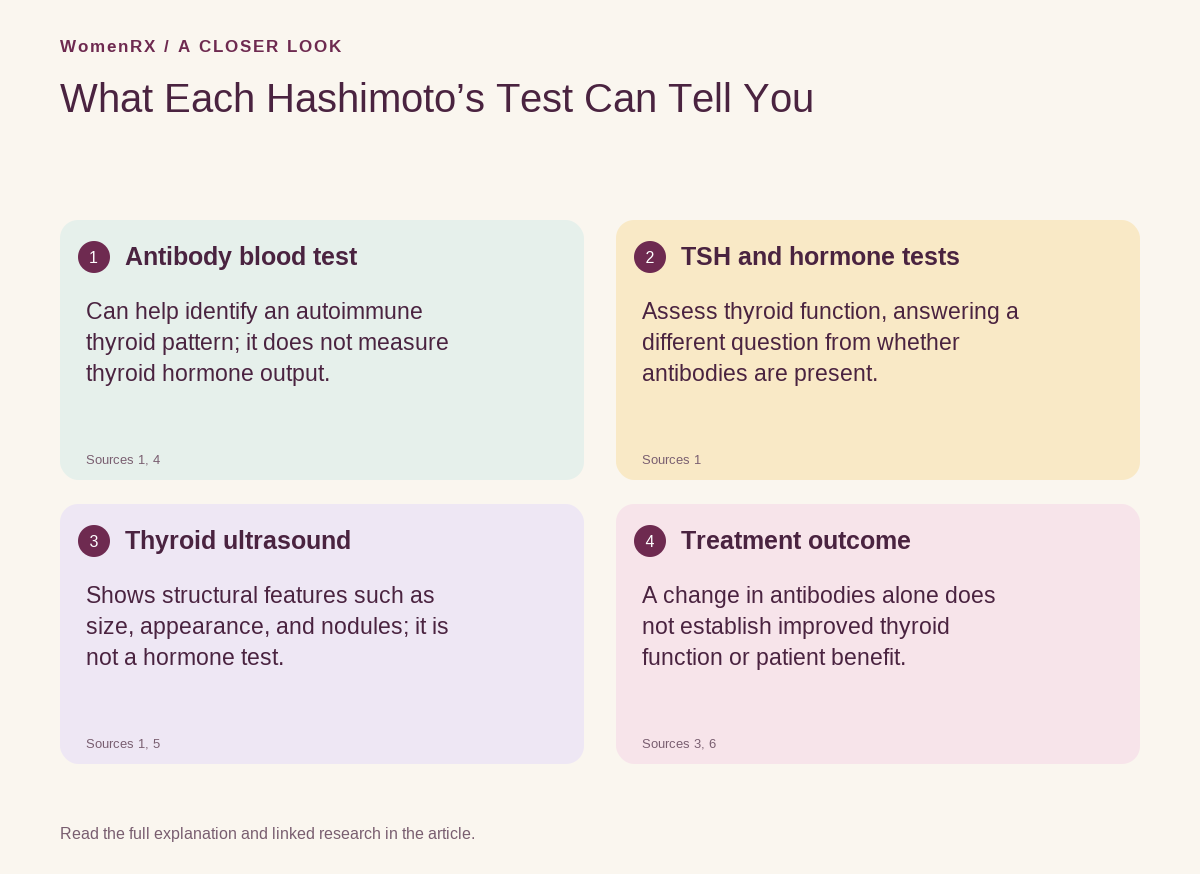
What Each Hashimoto’s Test Can Tell You
Antibody blood test: Can help identify an autoimmune thyroid pattern; it does not measure thyroid hormone output.14
TSH and hormone tests: Assess thyroid function, answering a different question from whether antibodies are present.1
Thyroid ultrasound: Shows structural features such as size, appearance, and nodules; it is not a hormone test.15
Treatment outcome: A change in antibodies alone does not establish improved thyroid function or patient benefit.36
Read the figure as text
Separate clues about autoimmunity, thyroid function, and structure before judging what a result means.- Antibody blood test: Can help identify an autoimmune thyroid pattern; it does not measure thyroid hormone output.14
- TSH and hormone tests: Assess thyroid function, answering a different question from whether antibodies are present.1
- Thyroid ultrasound: Shows structural features such as size, appearance, and nodules; it is not a hormone test.15
- Treatment outcome: A change in antibodies alone does not establish improved thyroid function or patient benefit.36
More questions, answered
Can an antibody result show how well my thyroid is working?
No. Antibody tests can help identify an autoimmune thyroid condition. TSH and thyroid hormone tests assess thyroid function, so the results answer different questions. 1
Can biotin affect thyroid blood tests?
Yes. Biotin can interfere with some tests for TSH and thyroid hormones and lead to misleading results. Tell the person arranging your test if you take biotin or a supplement that contains it, and follow their instructions before testing. 2
Sources you can check
- Thyroid Tests: MedlinePlusAccessed 2026-09-25Return to first citation
- LEVOTHYROXINE SODIUM TABLET [CARDINAL HEALTH 107, LLC] | US prescribing information and patient instructionsAccessed 2026-09-25Return to first citation
- A systematic review, meta-analysis, and trial sequential analysis of the effect of acupuncture and moxibustion cake on thyroid function in patients with Hashimoto thyroiditis.Haitao R, Gaokai L, Chunxia L, Hongchen X, Zongjiao W. · Medicine · 2026Return to first citation
- Thyroid function, autoimmunity, thyroid volume, and metabolic profile in people with Hashimoto thyroiditis.Couto B, Neves C, Neves JS, Delgado L. · BMC endocrine disorders · 2024Return to first citation
- Comparison of Thyroid Gland Sonography Index with Serum Antithyroid Peroxidase, Antithyroglobulin, and Thyroid Function Tests in Patients with Hashimoto Thyroiditis.Eftekharian F, Ranjbar Omrani G, Dabbaghmanesh MH, Sahraei R, Behnam MA, Bakhshayeshkaram M, Dabbaghmanesh MM. · Galen medical journal · 2024Return to first citation
- The Impact of Selenium Deficiency and Supplementation on Hashimoto's Thyroiditis: A Clinical Evaluation.Acik H, Aydin Y. · Endocrine, metabolic & immune disorders drug targets · 2026Return to first citation