How Hashimoto’s Is Diagnosed, and What Your Tests Mean
Thyroid antibodies can point to Hashimoto’s, while TSH and free T4 show whether your thyroid function is affected.
Clinicians usually start with TSH, then use thyroid hormone testing, often free T4, to understand how well your thyroid is working. Thyroid peroxidase (TPO) and thyroglobulin (Tg) antibodies can help identify an autoimmune cause such as Hashimoto’s. A positive antibody result doesn’t, by itself, show that you currently have hypothyroidism or need medication. 13
Two questions, two kinds of tests
If you’ve been told your thyroid antibodies are positive, the next question is often, “Does that mean my thyroid isn’t working?” Not necessarily. An antibody test looks for evidence of thyroid autoimmunity. Thyroid function tests look at hormone activity. Clinicians read them together. One study defined Hashimoto’s using both thyroid antibodies and ultrasound findings. 4 Separately, in a prospective study of pregnant women, some participants had positive TPO or Tg antibodies while their thyroid function was classified as normal. 3
TSH, or thyroid-stimulating hormone, is usually the first thyroid blood test. Free T4 measures an available form of thyroid hormone. Looking at both helps distinguish an elevated TSH with free T4 still in the normal range from an elevated TSH with low free T4. Those are different patterns of thyroid function, even when antibodies are positive in both cases. 134
What a positive antibody result adds
TPO and Tg antibodies can help identify autoimmune thyroid disease as the reason behind an abnormal thyroid test. They don’t measure how much hormone your thyroid is making. That’s why a report marked “positive” deserves a look at the accompanying TSH and free T4 results, rather than an assumption that you need thyroid hormone treatment. 13
For example, positive antibodies with normal thyroid function tests can point to autoimmunity without showing current hypothyroidism. Elevated TSH with normal free T4 describes a milder pattern of impaired thyroid function, often called subclinical hypothyroidism. Elevated TSH with low free T4 indicates a clearer loss of thyroid hormone function. These examples explain what the tests contribute; they aren’t a way to diagnose yourself from one lab value. The laboratory’s reference ranges and your clinical circumstances also matter. 34
Thyroid imaging tests include ultrasound, which is distinct from blood tests. One study defined Hashimoto’s using both antibodies and ultrasound findings, but that research definition doesn’t mean everyone with a positive antibody result needs an ultrasound. 14
If pregnancy is part of the picture
Tell the clinician interpreting your results if you’re pregnant or planning a pregnancy. Pregnancy studies assess thyroid function using TSH and free T4, and US prescribing information for levothyroxine calls for pregnancy-specific TSH assessment in people being treated for hypothyroidism. If you already take levothyroxine, pregnancy is a reason to discuss your thyroid results and treatment plan promptly rather than judging them by an old result. 23
After delivery, the distinction between antibodies and function still holds. If you were taking levothyroxine for hypothyroidism before pregnancy, your postpartum thyroid testing and medication plan need review; US prescribing information specifically describes checking TSH after delivery in that situation. 12
The most useful way to read a thyroid report is in pairs: What do TSH and free T4 say about function right now? What do the antibodies add about the likely cause? Keeping those questions separate makes a positive antibody result much less confusing. 13
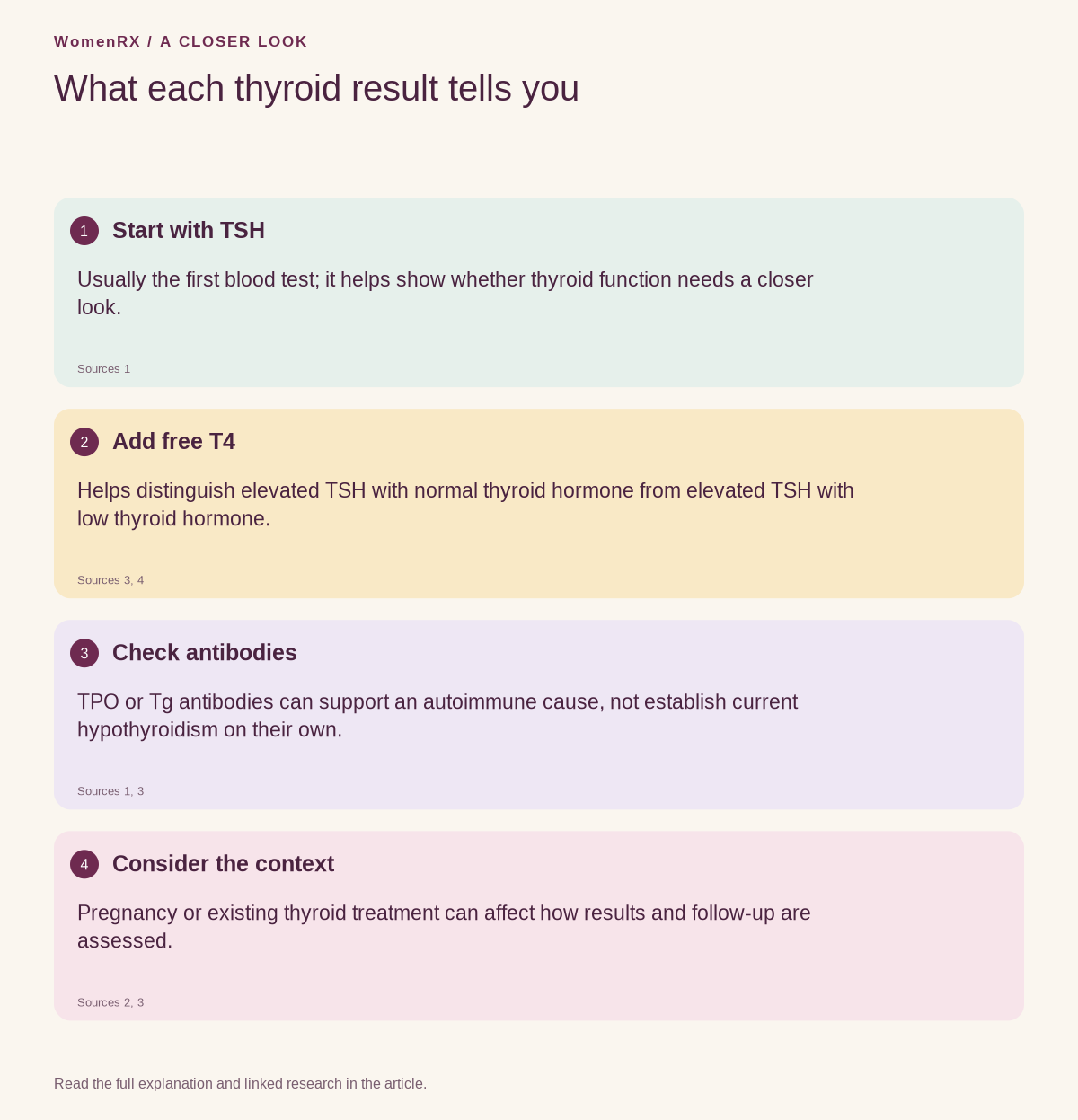
What each thyroid result tells you
Start with TSH: Usually the first blood test; it helps show whether thyroid function needs a closer look.1
Add free T4: Helps distinguish elevated TSH with normal thyroid hormone from elevated TSH with low thyroid hormone.34
Check antibodies: TPO or Tg antibodies can support an autoimmune cause, not establish current hypothyroidism on their own.13
Consider the context: Pregnancy or existing thyroid treatment can affect how results and follow-up are assessed.23
Read the figure as text
Read thyroid function and autoimmune markers as related but separate pieces of the assessment.- Start with TSH: Usually the first blood test; it helps show whether thyroid function needs a closer look.1
- Add free T4: Helps distinguish elevated TSH with normal thyroid hormone from elevated TSH with low thyroid hormone.34
- Check antibodies: TPO or Tg antibodies can support an autoimmune cause, not establish current hypothyroidism on their own.13
- Consider the context: Pregnancy or existing thyroid treatment can affect how results and follow-up are assessed.23
More questions, answered
Does a higher antibody number mean worse hypothyroidism?
An antibody result helps identify autoimmunity; TSH and thyroid hormone tests assess function. Don’t use the antibody number alone to judge how much thyroid hormone your body has available. 13
Can supplements affect thyroid test results?
Biotin can interfere with some laboratory tests for TSH and thyroid hormones and produce misleading results. If you take a biotin-containing supplement, tell the clinician interpreting your tests. 2
Sources you can check
- Thyroid Tests: MedlinePlusAccessed 2026-09-25Return to first citation
- LEVOTHYROXINE SODIUM TABLET [CARDINAL HEALTH 107, LLC] | US prescribing information and patient instructionsAccessed 2026-09-25Return to first citation
- Impact of maternal thyroid dysfunction on fetal and maternal outcomes in pregnancy: a prospective cohort study.Vamja R, M Y, Patel M, Vala V, Ramachandran A, Surati B, Nagda J. · Clinical diabetes and endocrinology · 2024Return to first citation
- Using Hashimoto thyroiditis as gold standard to determine the upper limit value of thyroid stimulating hormone in a Chinese cohort.Li Y, Chen DN, Cui J, Xin Z, Yang GR, Niu MJ, Yang JK. · BMC endocrine disorders · 2016Return to first citation