How IBS Is Diagnosed: Symptoms, Tests, and Warning Signs
IBS is usually identified from a recurring pattern of abdominal pain and bowel changes, with focused tests considered when they could help check for another cause.
There is no single test that confirms IBS. Clinicians can make a positive diagnosis when symptoms fit the Rome IV pattern: recurring abdominal pain linked to bowel movements or changes in stool frequency or form, with symptoms beginning at least six months earlier. A focused history and selective tests, such as blood testing for celiac disease or stool testing for infection or inflammation, help assess other possibilities. 1 6
The pattern clinicians look for
IBS can involve abdominal pain or cramping, bloating, and changes in bowel habits, including constipation, diarrhea, or both at different times. Symptoms often come and go. 3 4
Rome IV gives clinicians a more specific symptom framework for adults: abdominal pain, on average, at least one day a week during the past three months, associated with at least two of these: pain related to a bowel movement, a change in how often you have a bowel movement, or a change in stool form. Symptoms must have started at least six months before diagnosis. 6
These criteria help identify a recognizable pattern; they are not a home test or a guarantee that no other condition is present. A positive IBS diagnosis combines the symptom pattern with clinical assessment, rather than requiring every possible disease to be ruled out first. 5 6
What the assessment may include
A clinician will usually ask what the pain and bowel changes are like, how long they have been happening, and whether they come and go or seem connected to particular situations, such as meals. An examination may also be part of the assessment. 1
Testing is selected to address plausible alternatives, not automatically expanded into an exhaustive search. For example, blood tests may check for celiac disease, while stool tests may look for infection or inflammatory bowel disease. Further investigation may be considered if the diagnosis remains unclear. 1
That means an IBS assessment can be meaningful even when it does not include a colonoscopy or a long list of tests. No single test detects IBS itself, and additional procedures are not usually needed unless the clinician is unsure about the diagnosis or has another reason to investigate. 1 3
When not to assume it is IBS
Blood in the stool, unexplained weight loss, or symptoms that raise concern for inflammation deserve medical assessment rather than being automatically attributed to IBS. 2 5 Unintentional weight loss has many possible causes, so it does not by itself identify what is wrong, but it should be checked. 2
These features do not prove that you have a different condition. They change the assessment: a clinician may need to look more closely for another explanation. 5
If symptoms seem to track your period
If bowel changes or abdominal pain cluster around your period, describe when they start and ease, and whether the bowel symptoms also happen at other times. That timing can make your symptom history clearer, but timing alone does not establish IBS or show that menstrual symptoms explain the bowel changes. The Rome IV assessment still centers on the recurring pain and bowel-change pattern, alongside consideration of features that suggest another cause. 6
A useful way to prepare is to note a few concrete details: what the pain feels like, how often it occurs, whether bowel movements affect it, what has changed in stool frequency or form, and whether symptoms occur outside the menstrual window. This is a description of your pattern, not a diagnostic score.
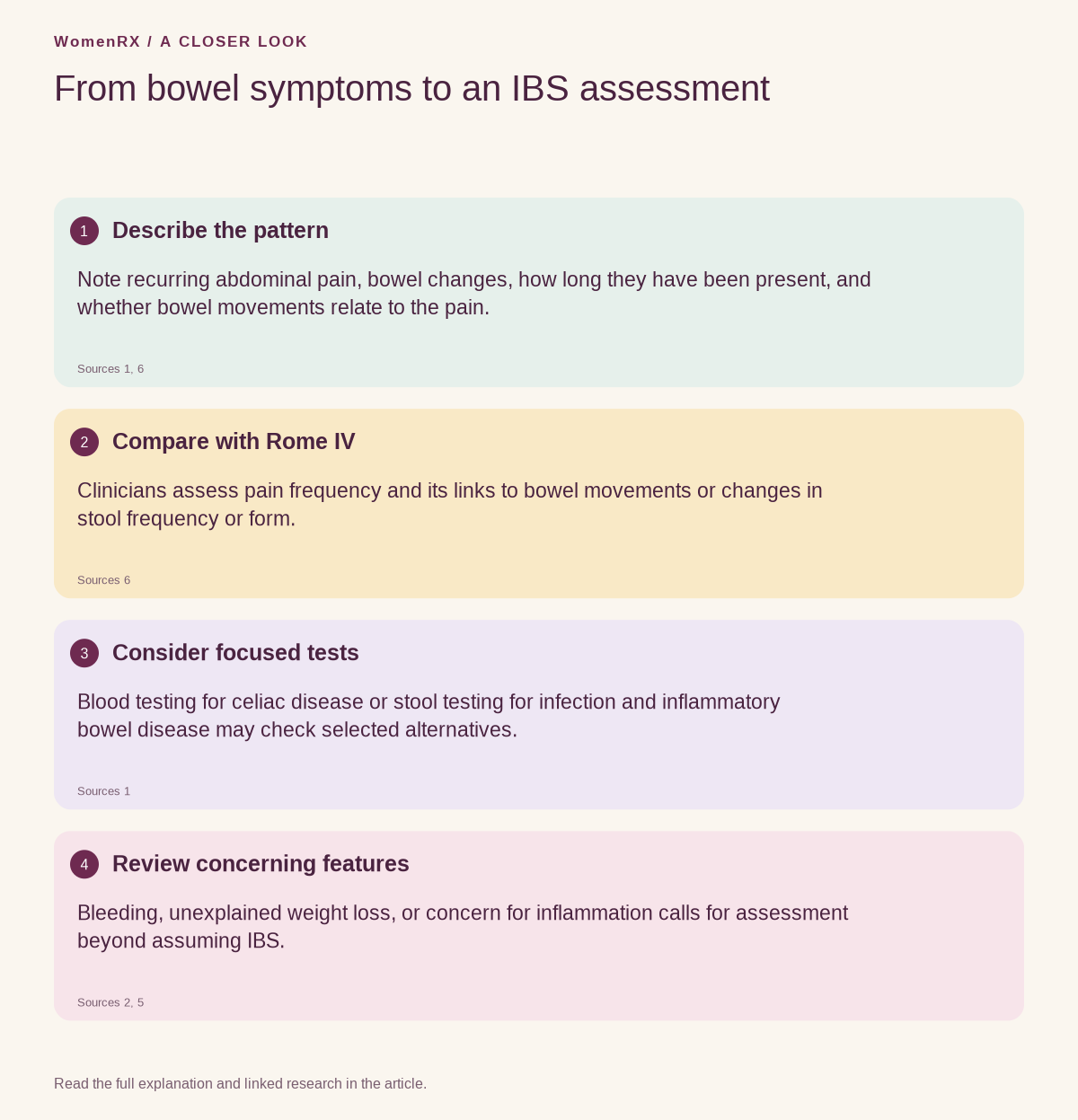
From bowel symptoms to an IBS assessment
Describe the pattern: Note recurring abdominal pain, bowel changes, how long they have been present, and whether bowel movements relate to the pain.16
Compare with Rome IV: Clinicians assess pain frequency and its links to bowel movements or changes in stool frequency or form.6
Consider focused tests: Blood testing for celiac disease or stool testing for infection and inflammatory bowel disease may check selected alternatives.1
Review concerning features: Bleeding, unexplained weight loss, or concern for inflammation calls for assessment beyond assuming IBS.25
Read the figure as text
A focused assessment starts with the symptom pattern, then considers whether selective testing or closer review is needed.- Describe the pattern: Note recurring abdominal pain, bowel changes, how long they have been present, and whether bowel movements relate to the pain.16
- Compare with Rome IV: Clinicians assess pain frequency and its links to bowel movements or changes in stool frequency or form.6
- Consider focused tests: Blood testing for celiac disease or stool testing for infection and inflammatory bowel disease may check selected alternatives.1
- Review concerning features: Bleeding, unexplained weight loss, or concern for inflammation calls for assessment beyond assuming IBS.25
More questions, answered
Does a normal test result rule out IBS?
No. IBS is diagnosed from the symptom pattern and clinical assessment; tests are used to look for selected alternative explanations, not to produce a positive IBS result. 1 6
Does everyone with suspected IBS need a colonoscopy?
No. Further procedures are not usually needed when the assessment is clear, though a clinician may consider more testing when the diagnosis is uncertain or another concern needs investigation. 1
Sources you can check
- Getting diagnosed with IBS (irritable bowel syndrome) - NHSAccessed 2026-09-25Return to first citation
- Unintentional weight loss - NHSAccessed 2026-09-25Return to first citation
- Irritable Bowel Syndrome | IBS | MedlinePlusAccessed 2026-09-25Return to first citation
- What is IBS (irritable bowel syndrome) - NHSAccessed 2026-09-25Return to first citation
- A real-world assessment of healthcare resource utilization following IBS-Smart ® and Trio-Smart ® testing in patients with suspected irritable bowel syndrome.Weinstock L, Salt WB, Cherry L, Tyson C, Magar R. · Frontiers in gastroenterology (Lausanne, Switzerland) · 2026Return to first citation
- Adherence of Swedish primary health care practitioners to diagnostic guidelines for IBS.Rauma J, Jansson S, Cao Y, van Nieuwenhoven MA. · Scandinavian journal of primary health care · 2026Return to first citation