IBS Claims: What the Evidence Actually Supports
IBS is diagnosed from a pattern of symptoms, but that diagnosis doesn’t identify one universal food trigger or treatment.
IBS can involve recurring abdominal pain with constipation, diarrhea, or both. There’s no single test that confirms it; clinicians assess the symptom pattern and may test for other conditions. A diagnosis doesn’t identify your triggers. A low-FODMAP diet can help some people, but it isn’t a universal fix. Symptoms may worsen around a period for some women; evidence about menopause and IBS is less clear. 2 6 9 13
Start with what IBS means
IBS is a condition involving recurring abdominal pain and changes in bowel habits. Symptoms can include bloating, constipation, diarrhea, or shifts between the two. They may come and go, and can affect everyday life. IBS can be uncomfortable, but it does not harm the intestines. 2 3
That combination matters: IBS describes a recognizable symptom pattern, not proof that one food, stressor, or other factor is responsible. Gut sensitivity, movement through the digestive system, and other factors have been linked to IBS, but its exact cause is unknown. 3
Claim: “There’s a single test for IBS”
Not quite. There is no specific test that confirms IBS. Instead, clinicians assess whether symptoms fit the pattern and use tests when needed to check for other conditions. 2 9
One commonly used set of criteria describes recurrent abdominal pain over the previous three months, associated with at least two of these: a relationship to bowel movements, a change in how often you have bowel movements, or a change in stool appearance. Symptoms must have started at least six months before diagnosis under those criteria. These are clinical criteria, not a home self-test. 8
Depending on your symptoms and history, evaluation may include blood or stool tests. Other investigations may be considered when the cause remains uncertain. That doesn’t mean everyone with suspected IBS needs every test. The point is to consider other explanations when appropriate, rather than assume every bowel symptom is IBS. 2 9
Rectal bleeding or substantial unexplained weight loss calls for prompt medical assessment rather than being casually attributed to IBS. 4
Claim: “A diagnosis tells me what triggers my symptoms”
It doesn’t. IBS symptoms can flare after particular foods or drinks, but they can also worsen without an obvious trigger. Alcohol, caffeine, some spicy or fatty foods, and stress or anxiety are among the possible triggers listed in clinical guidance. That list is not a universal rule for every person with IBS. 4
A practical distinction: one food seeming to precede symptoms is a clue about your experience, not proof that the food is harmful for everyone or that it caused IBS. Avoiding more and more foods can become burdensome; guidance recommends dietitian or specialist advice if controlling symptoms means avoiding many foods. 1
Claim: “One diet works for everyone”
No. Guidance says there is no single diet that works for everyone with IBS. It recommends a balanced approach and attention to personal symptoms, rather than treating one dietary rule as universal. 1
Low-FODMAP is one named dietary approach, but it isn’t a universal fix. Randomized trials and network meta-analyses support its use for overall IBS symptoms and abdominal pain. The approach has three phases: restriction, reintroduction, and personalization. Dietitian guidance can help preserve nutritional adequacy and avoid prolonged restriction. 6
In a randomized study of adults with IBS who completed an initial six-week intervention, both a low-FODMAP diet and a microbiome-guided personalized diet were associated with improved symptom-severity scores at six weeks. At 12 months, the personalized-diet group had a higher symptom-improvement responder rate than the low-FODMAP group. This was an open-label study, and its long-term findings were described by the researchers as hypothesis-generating. Because both groups received dietary interventions, it doesn’t establish how much improvement either diet caused compared with making no dietary change. It also doesn’t show that microbiome testing is necessary or that either diet will work for you. The reported results don’t tell us whether women responded differently. 7
In a separate, early-terminated trial of children with IBS or functional abdominal pain, the proportion whose abdominal pain improved was not significantly different between a low-FODMAP diet and a regular diet at four weeks. Missing outcome data limit its interpretation, and that pediatric result cannot settle what works for adults. 5
The useful takeaway is not that a restrictive diet is always wrong or always right. It’s that a diet’s fit depends on the person, and broad restrictions deserve care. If symptom control is leading you to cut out many foods, ask about support from a dietitian rather than continually narrowing your diet on your own. 1
Claim: “A treatment that helps someone else should help me”
Not necessarily. IBS symptoms differ, and the symptom you most want to improve matters. For example, a review of IBS with constipation explains why bowel-movement frequency alone is an incomplete measure: abdominal pain, bloating, and straining may also be troublesome. It describes medication, dietary, and gut-brain behavioral approaches, rather than one treatment that addresses every symptom equally. 8
Practical guidance likewise separates options by symptom. It discusses asking a pharmacist about options for diarrhea or for bloating and cramps. Peppermint oil is among the options it mentions for bloating or cramps. For diarrhea, it mentions asking about loperamide; for constipation, it suggests soluble fiber such as oats and asking about laxatives. These are possible starting points, not evidence that each will relieve your particular combination of symptoms. 1
Claim: “My cycle tells me what’s causing my IBS”
Not on its own. A systematic review found that women with IBS, as well as women without it, reported more bowel symptoms during menstruation than at other points in the cycle. A separate review describes studies in which women with IBS reported more pain, bloating, or bowel changes before or during a period, although individual studies did not all agree. The research has not pinned down one hormonal mechanism that explains those changes for everyone. 10 13
One study of 102 premenopausal women with IBS found constipation was more common in the luteal phase than during menstruation. It was a study of one group, not a rule for how your bowel habits should change each month. 11 If your symptoms reliably shift around your period, that timing is useful context when judging a suspected food trigger: a flare after a meal may also have happened during a phase when your bowel symptoms tend to worsen. 10 11
The evidence is thinner for later life stages. A review describes reports of increased gastrointestinal symptoms around perimenopause, but a systematic review found too little evidence to determine how menopause or hormone supplementation affects IBS symptoms specifically. A new or changing bowel pattern during the menopause transition therefore shouldn’t automatically be explained as IBS or as hormones. 12 13
Bowel symptoms can have another explanation, too. Endometriosis can involve abdominal pain, bloating, and altered stool patterns that resemble IBS symptoms. That overlap is a reason not to treat menstrual timing as an IBS diagnosis by itself. 6
A more useful way to judge an IBS claim
Ask what the claim is actually promising. Does it describe a possible trigger, a treatment that may help some people, or a test that checks for another condition? Those are different claims. IBS can be diagnosed from a symptom pattern, but the diagnosis does not identify the cause, guarantee a treatment response, or make every new bowel symptom part of IBS. 2 9
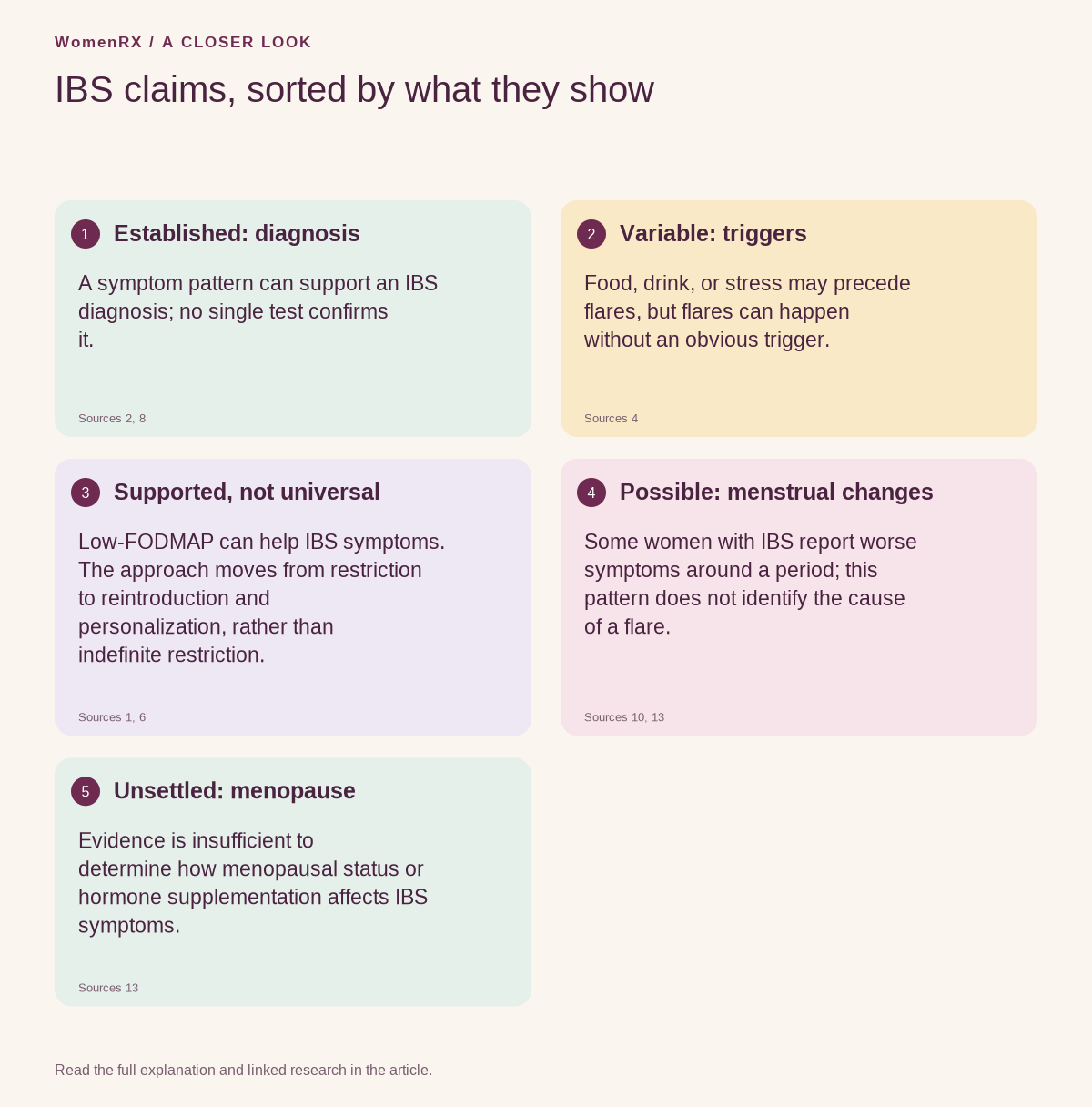
IBS claims, sorted by what they show
Established: diagnosis: A symptom pattern can support an IBS diagnosis; no single test confirms it.28
Variable: triggers: Food, drink, or stress may precede flares, but flares can happen without an obvious trigger.4
Supported, not universal: Low-FODMAP can help IBS symptoms. The approach moves from restriction to reintroduction and personalization, rather than indefinite restriction.16
Possible: menstrual changes: Some women with IBS report worse symptoms around a period; this pattern does not identify the cause of a flare.1013
Unsettled: menopause: Evidence is insufficient to determine how menopausal status or hormone supplementation affects IBS symptoms.13
Read the figure as text
A quick way to separate established diagnostic points from individual possibilities and questions research has not settled.- Established: diagnosis: A symptom pattern can support an IBS diagnosis; no single test confirms it.28
- Variable: triggers: Food, drink, or stress may precede flares, but flares can happen without an obvious trigger.4
- Supported, not universal: Low-FODMAP can help IBS symptoms. The approach moves from restriction to reintroduction and personalization, rather than indefinite restriction.16
- Possible: menstrual changes: Some women with IBS report worse symptoms around a period; this pattern does not identify the cause of a flare.1013
- Unsettled: menopause: Evidence is insufficient to determine how menopausal status or hormone supplementation affects IBS symptoms.13
More questions, answered
Does having IBS mean tests can never find another condition?
No. IBS has no specific confirming test, and clinicians may order tests to check for other conditions. A previous IBS diagnosis doesn’t mean new or concerning symptoms should automatically be attributed to IBS. 2 9
Does a food-trigger diary prove that a food causes IBS?
No. It can help you notice whether a food seems to precede your symptoms, but IBS flare-ups can also happen without an obvious trigger. A suspected trigger is personal information, not proof of a universal cause. 1 4
Sources you can check
- Diet, lifestyle and medicines for IBS (irritable bowel syndrome) - NHSAccessed 2026-09-25Return to first citation
- Irritable Bowel Syndrome | IBS | MedlinePlusAccessed 2026-09-25Return to first citation
- What is IBS (irritable bowel syndrome) - NHSAccessed 2026-09-25Return to first citation
- Symptoms of IBS (irritable bowel syndrome) - NHSAccessed 2026-09-25Return to first citation
- Efficacy of a low-FODMAP diet in children with irritable bowel syndrome and functional abdominal pain-not otherwise specified: a randomized controlled trial with early termination.Stróżyk A, Horvath A, Kozłowska-Jalowska A, Muir J, Szajewska H. · Frontiers in pediatrics · 2026Return to first citation
- Low-FODMAP Diet for Gastrointestinal Symptoms in Endometriosis: A Systematic Review.Watrowski R, Kostov S, Schäfer SD, Juhasz-Böss I, Palumbo M, Sparić R, Mereu L, Vitale SG, Alkatout I. · Nutrients · 2026Return to first citation
- Long-term microbiome and clinical effects of a microbiome-guided personalized diet versus low-FODMAP diet in irritable bowel syndrome: A 12-month follow-up randomized controlled trial.Tunali V, Arslan NÇ, Derviş Haki̇m G, Gündoğdu A, Ermi̇ş BH, Hora M, Nalbantoğlu ÖU. · Gut microbes · 2026Return to first citation
- Irritable Bowel Syndrome with Constipation: Diagnosis and Multisymptom Management Beyond Abdominal Pain and Bowel Movement Frequency: A Review.Shah ED, Sharma A, Curren N, Laitman AP, Staller K. · Advances in therapy · 2026Return to first citation
- Getting diagnosed with IBS (irritable bowel syndrome) - NHSAccessed 2026-09-25Return to first citation
- Symptomatology of irritable bowel syndrome and inflammatory bowel disease during the menstrual cycle.Bharadwaj S, Barber MD, Graff LA, Shen B. · Gastroenterology report · 2015Return to first citation
- Irritable Bowel Syndrome and the Menstrual Cycle.Pati GK, Kar C, Narayan J, Uthansingh K, Behera M, Sahu MK, Mishra D, Singh A. · Cureus · 2021Return to first citation
- Do fluctuations in ovarian hormones affect gastrointestinal symptoms in women with irritable bowel syndrome?Heitkemper MM, Chang L. · Gender medicine · 2009Return to first citation
- Meta-analysis: do irritable bowel syndrome symptoms vary between men and women?Adeyemo MA, Spiegel BM, Chang L. · Alimentary pharmacology & therapeutics · 2010Return to first citation