Can Diet Help With Autoimmune Conditions? What Evidence Supports
Diet may ease some symptoms or support overall health, but evidence for changing autoimmune disease activity depends on the condition and the outcome measured.
There isn’t one anti-inflammatory diet proven to treat autoimmune conditions as a group. In rheumatoid arthritis, Mediterranean-style eating is a possible supportive approach, but clinical benefits remain uncertain. 1 2 In inflammatory bowel disease, some trials found quality-of-life improvements without establishing reduced inflammation. 3 For autoimmune thyroid disease, evidence does not support diet as an independent treatment; any complementary role remains uncertain. 5 Celiac disease has a specific dietary trigger: gluten. 4
Start with the condition and the outcome
“Anti-inflammatory diet” can describe very different things, from eating more vegetables and fish to cutting out several food groups. The first question is what you hope will change: symptoms, quality of life, a lab result, or the disease itself. Evidence for one outcome doesn’t automatically prove an effect on another.
That distinction can help keep a diet experiment focused. Easing a symptom may matter, but it is not the same as showing that a diet controls inflammation or changes the course of a condition.
What has been studied for each condition?
Rheumatoid arthritis: a possible adjunct, not established treatment
Mediterranean-style eating emphasizes foods such as vegetables, whole grains, fish, and olive oil. Reviews describe it as a promising supportive pattern for rheumatoid arthritis (RA), but findings from clinical studies have been mixed, and the clinical importance of any benefit remains uncertain. A broader review of nutrition approaches in RA also describes inconsistent or weak evidence in some areas. 1 2
That makes this a different claim from saying the diet treats RA. The reviews describe dietary changes as an addition to conventional care, not a reason to replace it. 1 2
Inflammatory bowel disease: quality of life isn’t the same as inflammation
A review of 15 clinical trials in adults with inflammatory bowel disease (IBD) found quality-of-life improvements in some studies of low-FODMAP eating, IgG-guided diets, a dietary modification program, and high-fiber eating. In the trials reviewed, the anti-inflammatory diet, Autoimmune Protocol Diet, and Mediterranean diet did not significantly improve quality of life. These findings don’t rank the diets or establish that any quality-of-life change reduced intestinal inflammation. The trials used different approaches and measures. 3
For a restrictive plan, it helps to be clear about the target before you start. If you’re aiming for symptom relief, decide what change you’ll track and when you’ll reassess whether the tradeoff is worthwhile. Dietary changes can also be difficult to maintain and may add stress or feelings of deprivation. 3
Autoimmune thyroid disease: diet is not an independent treatment
For Hashimoto’s thyroiditis and Graves’ disease, research has explored diet, nutrients, and gut microbes. But a review describes the evidence as limited and heterogeneous, with much of it observational rather than based on dietary intervention trials. It concludes that current findings don’t support diet as an independent treatment for autoimmune thyroid disease. 5
Celiac disease: a specific gluten trigger
Celiac disease is triggered by gluten. That condition-specific trigger does not mean that avoiding gluten treats other autoimmune conditions. 4
A study of cocoa in mice with celiac-like disease does not establish cocoa as a treatment for people or as a replacement for a gluten-free diet. 6
Questions to ask before cutting foods
A useful conversation is specific to your diagnosis and the change you’re considering. You might ask:
- What outcome are we trying to change? Symptoms, quality of life, or a measure of disease activity?
- What evidence applies to my condition? A result in RA doesn’t establish a benefit for IBD or thyroid disease.
- What foods would I remove, and what would replace them? Consider whether the plan is manageable and whether it leaves you with enough variety.
- How will I know if it’s helping? Choose a symptom or other outcome to track, and agree when to review the result.
- Can I meet my nutrition needs? Ask about this before restricting foods, especially if your condition already limits what you can eat. If you’re pregnant or breastfeeding, include those needs in the discussion.
A dietitian familiar with your condition can help assess a restrictive plan; the IBD review specifically notes the role of dietitians in helping manage diet changes. 3 The reviews describe diet as supportive rather than a replacement for conventional RA treatment, so don’t stop prescribed treatment because you’re changing what you eat. 1 2
What the evidence says about women
The studies summarized here don’t establish that an anti-inflammatory diet works differently by sex or life stage, or which approach is best during pregnancy or breastfeeding. In one cross-sectional study of people with RA, palmitoleic acid levels were higher in women, but the study did not find an association between palmitoleic acid and disease activity. That blood measurement doesn’t show that changing foods improves RA. 7
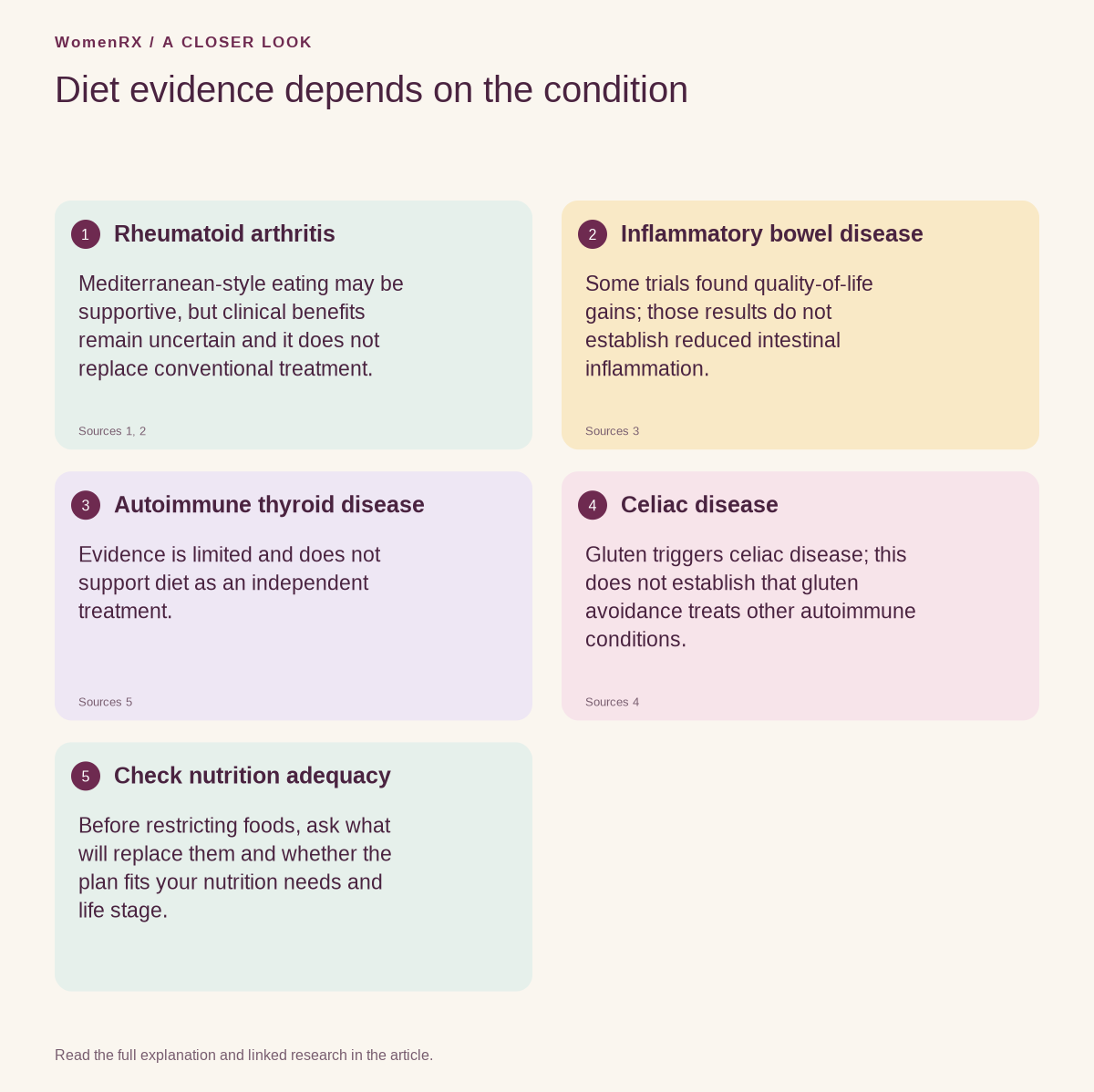
Diet evidence depends on the condition
Rheumatoid arthritis: Mediterranean-style eating may be supportive, but clinical benefits remain uncertain and it does not replace conventional treatment.12
Inflammatory bowel disease: Some trials found quality-of-life gains; those results do not establish reduced intestinal inflammation.3
Autoimmune thyroid disease: Evidence is limited and does not support diet as an independent treatment.5
Celiac disease: Gluten triggers celiac disease; this does not establish that gluten avoidance treats other autoimmune conditions.4
Check nutrition adequacy: Before restricting foods, ask what will replace them and whether the plan fits your nutrition needs and life stage.
Read the figure as text
Compare what outcomes have been reported by condition, and consider nutrition adequacy before removing foods.- Rheumatoid arthritis: Mediterranean-style eating may be supportive, but clinical benefits remain uncertain and it does not replace conventional treatment.12
- Inflammatory bowel disease: Some trials found quality-of-life gains; those results do not establish reduced intestinal inflammation.3
- Autoimmune thyroid disease: Evidence is limited and does not support diet as an independent treatment.5
- Celiac disease: Gluten triggers celiac disease; this does not establish that gluten avoidance treats other autoimmune conditions.4
- Check nutrition adequacy: Before restricting foods, ask what will replace them and whether the plan fits your nutrition needs and life stage.
More questions, answered
Does a symptom improvement mean the disease is under better control?
Not necessarily. In the IBD trials reviewed, quality of life was an outcome, and a reported improvement in quality of life does not by itself establish reduced intestinal inflammation. 3
Does a gluten-free diet help autoimmune conditions other than celiac disease?
Gluten triggers celiac disease, but that doesn’t establish gluten avoidance as treatment for other autoimmune conditions. For autoimmune thyroid disease, current findings don’t support diet as an independent treatment. 4 5
Sources you can check
- Impact of Nutritional Diet Therapy on Rheumatoid Arthritis Disease Activity.Deseatnicova E, Covaliov E, Deseatnicova O, Siminiuc R, Rezus E, Groppa L. · Nutrients · 2026Return to first citation
- A Brief Review of the Mediterranean Diet's Role in Mediating Inflammation and in Management of Rheumatoid Arthritis.Chen JL, Tran HN, Liu L. · The Permanente journal · 2025Return to first citation
- The impact of dietary interventions on quality of life in adults with inflammatory bowel disease: a narrative review.McGuire R, Knol LL, Douglas J. · Journal of nutritional science · 2026Return to first citation
- Celiac Disease and Cardiovascular Disease: Epidemiology, Mechanisms, and Clinical Challenges.Silverman J, Somogyi D, Charlat M, Wruble A, Frishman W. · Cardiology in review · 2026Return to first citation
- The role of gut microbiota in autoimmune thyroid diseases: nutritional determinants and diet-based modulation.Lewandowski H, Maslyk M, Kaminska H, Szarpak L. · Frontiers in endocrinology · 2026Return to first citation
- Cocoa Attenuates Gluten-induced Pathogenesis in a Preclinical Model of Celiac Disease.Girbal-González M, Rodríguez-Lagunas MJ, Rodríguez-Banqueri A, Eckhard U, Gomis-Rüth FX, Franch-Masferrer À, Pérez-Cano FJ. · Molecular nutrition & food research · 2026Return to first citation
- Elevated plasma monounsaturated fatty acids and their associations with disease activity, adiposity and sex in patients with rheumatoid arthritis: a cross-sectional study.Narayana Swamy S, Belury MA, Cole RM, Heitman K, Pan S, Yang Z, Karabukayeva A, Mao-Draayer Y, Hanaoka BY. · RMD open · 2026Return to first citation