Why Some Autoimmune Diseases Are More Common in Women
Women develop many autoimmune diseases more often than men, but the reasons appear to differ by disease.
Many autoimmune diseases are more common in women, but there isn’t one explanation that fits them all. Researchers are investigating how immune responses, inherited susceptibility, sex hormones, and environmental factors interact in particular tissues. Myasthenia gravis shows why the disease and its subtype matter: an early-onset subtype is more often seen in females, while other forms have different immune features. 1 2 4
A pattern, not a single cause
In an autoimmune disease, the immune system mistakenly attacks the body’s healthy tissues. There are many different autoimmune diseases, and women develop many types more often than men. That’s a broad population pattern, not a rule for every condition or an explanation by itself. 1
Researchers are studying several possible contributors. Genes may make someone more susceptible, while environmental exposures may help trigger disease in a person with that susceptibility. A review of sex differences in immunity also describes genetics, sex hormones, and environmental factors as interacting influences, with effects that depend on the tissue and disease involved. It does not establish how much each factor contributes to the difference between women and men in a particular disease. 1 2
The useful takeaway: “more common in women” describes who is affected more often. It doesn’t mean every woman has a high risk, or that one biological difference explains every autoimmune disease.
Immune strength can have a tradeoff
A more active immune response can help the body respond to infections. The same broad tendency may also make autoimmune complications more likely, according to a review of sex differences in immunity. But this doesn’t mean women’s immune systems simply work “better” or “worse.” Immune activity varies across tissues, and the consequences depend on what’s happening in a particular disease. 2
Myasthenia gravis makes that distinction concrete. A review describes early-onset disease with acetylcholine-receptor antibodies as frequently associated with females and with changes in the thymus, an organ involved in immune function. A subtype involving MuSK antibodies has different antibody and immune features. Those differences don’t prove why one group develops disease more often, but they show why a finding about one subtype cannot automatically explain another. 4
Where genes, hormones, and environment fit
Inherited risk can help explain why autoimmune diseases sometimes run in families, but family history doesn’t make disease inevitable. MedlinePlus describes viruses, certain chemicals, and other environmental factors as possible triggers in people who already have relevant genetic susceptibility. That explains why risk may differ between individuals; on its own, it does not explain why rates differ between women and men. 1
Sex hormones are another area of research, but they aren’t a universal answer. A reported difference between females and males doesn’t, by itself, show whether hormones caused it, which hormone mattered, or when an effect might occur. A review identifies hormones alongside genetics and environment as influences on sex differences in immunity, without establishing their relative roles across autoimmune diseases. 2
Researchers can also look for biological differences within a disease. In a study of childhood-onset lupus, researchers found sex-associated patterns in blood-cell DNA methylation, including immune-related patterns in male patients. Methylation affects how genes are regulated. This is a clue about disease biology, not evidence that those patterns cause the difference in how often females and males develop lupus. 3
Age matters, but it isn’t a hormone timeline
The myasthenia gravis review distinguishes an early-onset subtype frequently associated with females from later-onset disease with a different immune context. It also notes that healthcare access, diagnosis, referral, and disease awareness can influence which cases are counted. Age at onset and how a study identifies cases therefore matter when interpreting a reported sex difference. 4
That is not the same as knowing how autoimmune risk changes through puberty, pregnancy, postpartum, perimenopause, or postmenopause. Nor are sex, gender, and measured hormone levels interchangeable: a study that groups people as female and male has not necessarily measured their hormones or the effects of healthcare and social circumstances. To understand a claim, look for the specific disease and subtype, what researchers measured, and whether differences in case identification could affect the comparison. 2 4
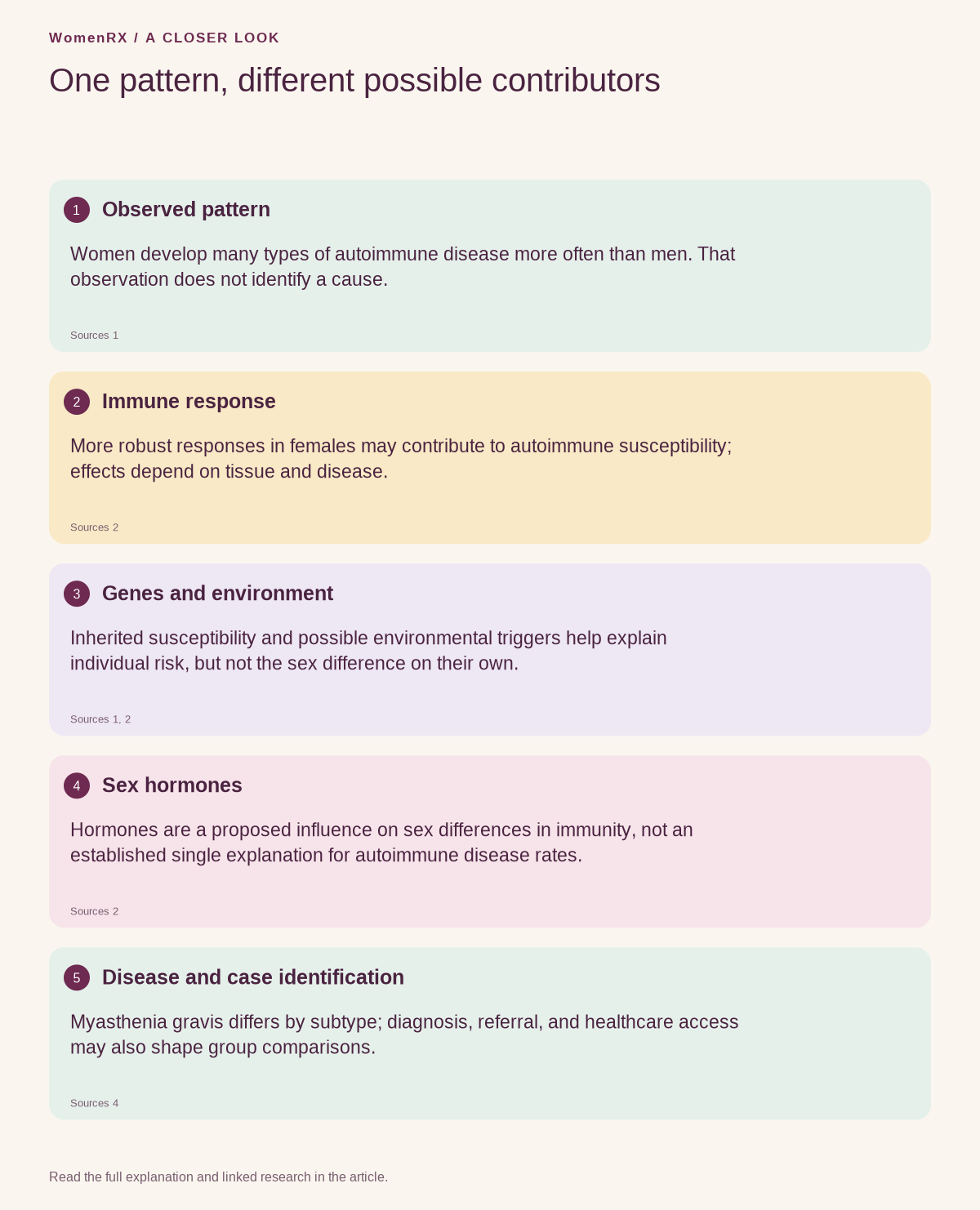
One pattern, different possible contributors
Observed pattern: Women develop many types of autoimmune disease more often than men. That observation does not identify a cause.1
Immune response: More robust responses in females may contribute to autoimmune susceptibility; effects depend on tissue and disease.2
Genes and environment: Inherited susceptibility and possible environmental triggers help explain individual risk, but not the sex difference on their own.12
Sex hormones: Hormones are a proposed influence on sex differences in immunity, not an established single explanation for autoimmune disease rates.2
Disease and case identification: Myasthenia gravis differs by subtype; diagnosis, referral, and healthcare access may also shape group comparisons.4
Read the figure as text
This map separates an observed population pattern from proposed influences and shows why disease subtype and case identification matter.- Observed pattern: Women develop many types of autoimmune disease more often than men. That observation does not identify a cause.1
- Immune response: More robust responses in females may contribute to autoimmune susceptibility; effects depend on tissue and disease.2
- Genes and environment: Inherited susceptibility and possible environmental triggers help explain individual risk, but not the sex difference on their own.12
- Sex hormones: Hormones are a proposed influence on sex differences in immunity, not an established single explanation for autoimmune disease rates.2
- Disease and case identification: Myasthenia gravis differs by subtype; diagnosis, referral, and healthcare access may also shape group comparisons.4
More questions, answered
Does a stronger immune response mean women have better immunity?
Not in a simple, across-the-board sense. A review describes stronger immune responses in females as one possible reason for greater autoimmune susceptibility, while emphasizing that immune differences depend on the tissue and disease. 2
Does family history mean I’ll develop an autoimmune disease?
No. A family history can point to inherited susceptibility, but it doesn’t determine what will happen. Environmental factors may also contribute to whether disease develops. 1
Sources you can check
- Autoimmune Diseases | Autoimmune Disease Symptoms | MedlinePlusAccessed 2026-09-25Return to first citation
- Sex differences in tissue-specific immunity and immunology.Sharma S, Gibbons A, Saphire EO. · Science (New York, N.Y.) · 2025Return to first citation
- DNA Methylation Profiling Reveals Distinct Epigenetic Clusters and Suggests Epigenetic Patterns Associated With Sex and Disease Activity in Childhood-Onset Lupus.Casares-Marfil D, Kavrul Kayaalp G, Guliyeva V, Akgün Ö, Türkmen Ş, Kılıç Könte E, Şener S, Şahin S, Kasapçopur Ö, Sözeri B, Sözer Tokdemir S, Özen S, Aktay Ayaz N, Sawalha AH. · Arthritis & rheumatology (Hoboken, N.J.) · 2026Return to first citation
- The immune microenvironment and population heterogeneity in myasthenia gravis: implications for precision therapeutics.Xue X, Liu C, Qiu C, Liu S, Liu F, Li Y. · Frontiers in immunology · 2026Return to first citation