What Causes Lichen Sclerosus? What We Know
Lichen sclerosus can affect girls and women at different life stages, but its exact cause is still unknown.
Lichen sclerosus is a chronic inflammatory skin condition, not a sign of poor hygiene. Researchers suspect that immune activity and inherited susceptibility may contribute, but neither has been established as the single cause. Hormonal explanations remain uncertain, too. It can appear in childhood or later in life, and a clinician usually assesses it by examining the affected skin; a biopsy may be useful when the diagnosis needs clarification. 1 2 3
The short answer: there isn’t one known cause
Lichen sclerosus is a chronic inflammatory skin condition that commonly affects the vulva and nearby skin. Its exact cause hasn’t been established. The leading ideas involve the immune system and genetic susceptibility, possibly alongside local factors that make skin more vulnerable. These are proposed contributors, not a proven explanation for why a particular person develops it. 2 3 6
It isn’t caused by poor personal hygiene. Vulvar lichen sclerosus is classified as a noninfectious skin condition, so it isn’t a sexually transmitted infection. 1 3
What immune and genetic theories mean
An immune contribution is plausible because researchers have found signs consistent with immune activity in affected skin, and lichen sclerosus is associated with autoimmune conditions in some adult populations. But an association doesn’t show that an autoimmune condition causes lichen sclerosus, or that every person with lichen sclerosus has an autoimmune disease. Research in children also describes immune mechanisms as an area of growing interest, not a settled explanation. 2 4 7
Genetic susceptibility is another possibility. It may help explain why the condition occurs in some people and not others, but current reviews don’t identify a single inherited cause that can explain an individual diagnosis. 3 6
Hormones have also been proposed as a factor because cases are more common around prepuberty and after menopause. That pattern alone doesn’t prove that low estrogen causes the condition; reviews describe the hormonal theory as uncertain. Lichen sclerosus can also occur during reproductive years. 3 5
Irritation may affect the skin without explaining the disease
Repeated rubbing or injury may trigger visible changes in susceptible skin or make an existing flare worse. That is different from saying friction is the underlying cause. Avoid treating irritation as proof that you did something wrong: the reason the condition starts is still unknown. 1 5
Some older theories suggested an infectious cause. Current reviews describe the condition as noninfectious, and research hasn’t established infection as the explanation. 3 5
It can appear at more than one life stage
Lichen sclerosus can affect people of all ages. It is often recognized in girls before puberty and in peri- or postmenopausal women, but those are patterns in how often it appears, not age limits. Someone in her reproductive years can develop it, too. 1 3 5
On the vulva, it may cause itching, soreness, burning, or pale or white patches. Skin can also look fragile or bruised, and changes may extend to the area around the anus. Symptoms and appearance vary, and other conditions can cause similar complaints, so a description alone can’t confirm the diagnosis. 3 4 5
Why examination matters
A clinician often makes the diagnosis by looking at the skin and considering its pattern and symptoms. A biopsy isn’t needed in every case, but a clinician may consider one when the appearance doesn’t make the diagnosis clear or when tissue needs closer assessment. 2 3
That examination matters because ongoing lichen sclerosus can scar the skin and change vulvar anatomy. In adults, it is also associated with an increased risk of vulvar cancer; the level of risk in children is not established. This doesn’t mean that a persistent patch is cancer. It means lasting or changing vulvar skin deserves an accurate assessment rather than an assumption about hygiene, hormones, or infection. 1 4 5
If you notice ongoing itching, soreness, or pale patches, especially if the skin is changing, arrange an examination with a clinician familiar with vulvar skin conditions. For a child with persistent genital itching or pain, a pediatric clinician can assess the symptoms. The useful question isn’t just “What caused this?” It’s also “Does the appearance fit lichen sclerosus, and is any testing needed to confirm it?”
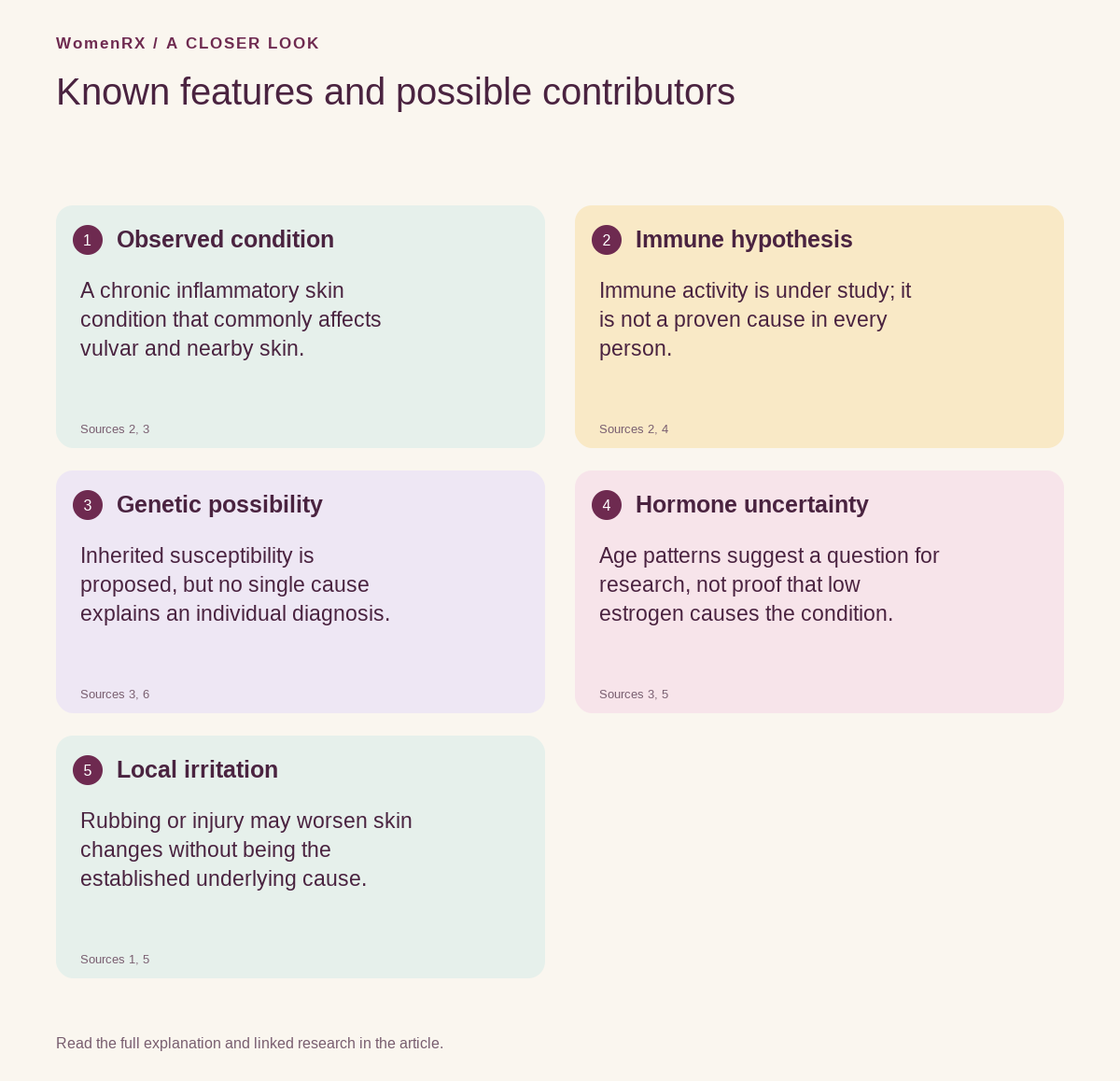
Known features and possible contributors
Observed condition: A chronic inflammatory skin condition that commonly affects vulvar and nearby skin.23
Immune hypothesis: Immune activity is under study; it is not a proven cause in every person.24
Genetic possibility: Inherited susceptibility is proposed, but no single cause explains an individual diagnosis.36
Hormone uncertainty: Age patterns suggest a question for research, not proof that low estrogen causes the condition.35
Local irritation: Rubbing or injury may worsen skin changes without being the established underlying cause.15
Read the figure as text
This comparison separates observed clinical features from theories about what may contribute to lichen sclerosus.- Observed condition: A chronic inflammatory skin condition that commonly affects vulvar and nearby skin.23
- Immune hypothesis: Immune activity is under study; it is not a proven cause in every person.24
- Genetic possibility: Inherited susceptibility is proposed, but no single cause explains an individual diagnosis.36
- Hormone uncertainty: Age patterns suggest a question for research, not proof that low estrogen causes the condition.35
- Local irritation: Rubbing or injury may worsen skin changes without being the established underlying cause.15
More questions, answered
Does lichen sclerosus mean I have an autoimmune disease?
No. Immune activity is one proposed part of lichen sclerosus, and some studies report associations with autoimmune conditions. That does not mean everyone with lichen sclerosus has an autoimmune disease or that one has caused it. 2 7
Is lichen sclerosus caused by low estrogen?
That hasn’t been established. The condition is more common around prepuberty and after menopause, but this pattern does not prove that low estrogen causes it; cases also occur during reproductive years. 3 5
Sources you can check
- Lichen sclerosus - NHSAccessed 2026-09-25Return to first citation
- EMAS clinical guide: vulvar lichen sclerosus in peri and postmenopausal women.Pérez-López FR, Ceausu I, Depypere H, Erel CT, Lambrinoudaki I, Rees M, Schenck-Gustafsson K, Tremollieres F, van der Schouw YT, Simoncini T, EMAS, Spanish Menopause society. · Maturitas · 2013Return to first citation
- Etiology, Clinical Features, and Diagnosis of Vulvar Lichen Sclerosus: A Scoping Review.Singh N, Ghatage P. · Obstetrics and gynecology international · 2020Return to first citation
- The Importance of Immunological Disorders in the Pathogenesis of Lichen Sclerosus in Pediatric Patients: A Systematic Review.Torres A, Zaborek-Łyczba M, Łyczba J, Mertowska P, Mertowski S, Grywalska E. · International journal of molecular sciences · 2022Return to first citation
- Pediatric Vulvar Lichen Sclerosus-A Review of the Literature.Orszulak D, Dulska A, Niziński K, Skowronek K, Bodziony J, Stojko R, Drosdzol-Cop A. · International journal of environmental research and public health · 2021Return to first citation
- Advances in the pathogenesis of vulvar lichen sclerosus.Xie X, Wu K. · Molecular biology reports · 2024Return to first citation
- Clinical evaluation of vulvar lichen sclerosus: case series.Kazandi M, Sahin C, Terek MC, Cirpan T, Oztekin K. · European journal of gynaecological oncology · 2010Return to first citation