Can Clitoral Changes Be Reversed? Start With the Cause
Some causes have treatments that ease symptoms or address scarring, but improvement in comfort or function doesn’t necessarily mean anatomy will return to how it was.
Sometimes symptoms or function can improve, but whether a visible or felt change can be reversed depends on its cause. Menopause-related tissue changes, an inflammatory skin condition such as lichen sclerosus, and scarring after childbirth call for different evaluations and discussions. Treatment for menopausal vulvovaginal symptoms isn’t proof that clitoral size or sensation will be restored.
A change in appearance isn’t a diagnosis
“Clitoral atrophy” can sound like one specific condition, but a change in size, visibility, or sensation doesn’t identify its cause. The clitoris and surrounding vulvar tissue may be affected by scarring from lichen sclerosus, and a surgical report also describes clitoral phimosis in connection with chronic inflammatory skin disease, postmenopausal vulvar atrophy, and obstetric trauma. Those possibilities need different conversations about treatment. 1 6
It also helps to separate three outcomes: less discomfort, better function, and a change in anatomy. Improvement in one doesn’t establish improvement in the others.
When menopause may be part of the picture
After menopause, lower hormone levels can contribute to genitourinary syndrome of menopause (GSM), which involves changes in vulvovaginal tissue. GSM is one possible context for a genital change, not an explanation to assume without an assessment. A clinical review emphasizes that GSM can overlap with inflammatory, infectious, and neoplastic vulvar conditions; the pattern and appearance of the affected area matter when distinguishing them. 3
When the assessment points to menopause-related vulvovaginal symptoms, hormone treatment may be one topic to discuss. The North American Menopause Society’s 2022 position statement describes low-dose vaginal estrogen, vaginal dehydroepiandrosterone (DHEA), and oral ospemifene as options for bothersome GSM symptoms not relieved by over-the-counter therapies, for women without an indication for systemic hormone therapy. A meta-analysis of randomized trials in postmenopausal women found that vaginal DHEA improved vaginal dryness and pain with sex compared with placebo. These findings concern vulvovaginal symptoms, not demonstrated restoration of clitoral anatomy or sensation. 5 4
If treatment is being considered solely for moderate-to-severe vulvar and vaginal atrophy symptoms due to menopause, the U.S. Climara estradiol patch label says to consider topical vaginal products first. The right option depends on the diagnosis and the person’s circumstances; a hormone treatment shouldn’t be started just because the clitoris looks or feels different. 2
Skin disease and scar tissue need a different discussion
Lichen sclerosus can affect people of any age, though it is more common in women over 50. It can cause itchy patches on the genitals; over time, affected skin may scar and tighten, and the vulva can shrink, sometimes affecting the clitoris and inner labia. Prescription steroid ointment usually helps relieve lichen sclerosus symptoms, but that doesn’t establish that existing scar-related anatomical changes will reverse. 1
If scarring affects the clitoral area, a specialist may discuss whether treatment for the underlying condition is enough or whether a procedure should be considered. A surgical report describes treatment for clitoral phimosis when scarring is irreversible, with the aim of regaining function. A report of a surgical technique is not evidence that surgery reliably restores anatomy or sensation for everyone. 6
What an assessment can sort out
A useful evaluation starts with what changed and what else is happening, then a focused examination. A 2026 clinical review recommends attention to the appearance and distribution of skin changes and related mucocutaneous findings; it notes that biopsy may be appropriate in some cases. Referral to a vulvar specialist or dermatologist may be considered when the diagnosis is uncertain, treatment isn’t working, or scarring or functional problems are present. 3
For example, itchy white patches and tightening skin point to a different discussion than a change noticed alongside other menopausal genital tissue symptoms, or a change after childbirth. These are clues to describe, not a way to diagnose yourself. At an appointment, you might ask: “What cause best fits what you see?” “Is the issue tissue change, scarring, or both?” and “What outcome is this treatment expected to improve: symptoms, function, or anatomy?” Those questions keep expectations clear and make it easier to weigh next steps.
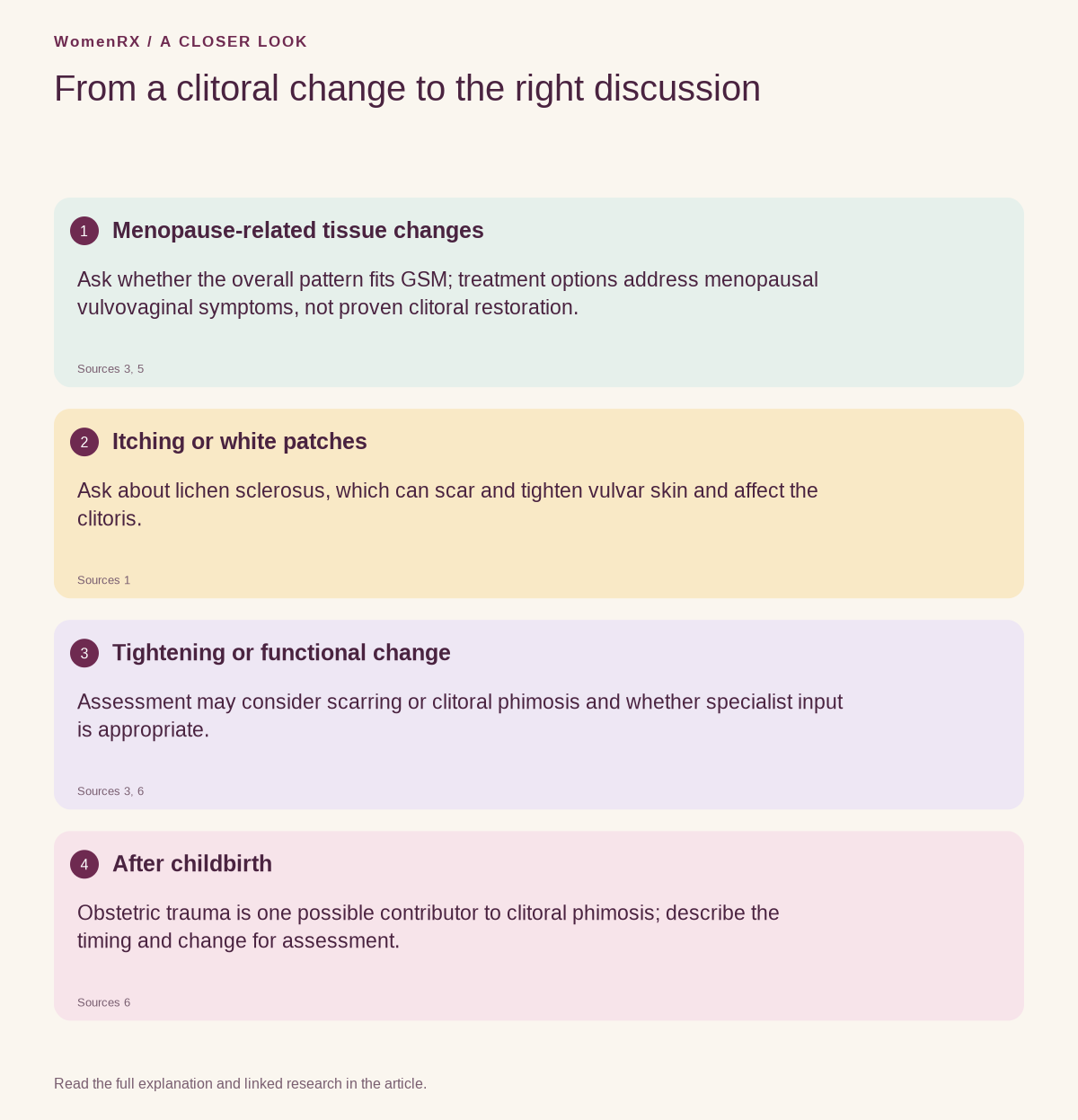
From a clitoral change to the right discussion
Menopause-related tissue changes: Ask whether the overall pattern fits GSM; treatment options address menopausal vulvovaginal symptoms, not proven clitoral restoration.35
Itching or white patches: Ask about lichen sclerosus, which can scar and tighten vulvar skin and affect the clitoris.1
Tightening or functional change: Assessment may consider scarring or clitoral phimosis and whether specialist input is appropriate.36
After childbirth: Obstetric trauma is one possible contributor to clitoral phimosis; describe the timing and change for assessment.6
Read the figure as text
A visible or felt change can have different causes. Assessment helps connect the pattern to a treatment conversation without assuming that symptom relief means anatomy has been restored.- Menopause-related tissue changes: Ask whether the overall pattern fits GSM; treatment options address menopausal vulvovaginal symptoms, not proven clitoral restoration.35
- Itching or white patches: Ask about lichen sclerosus, which can scar and tighten vulvar skin and affect the clitoris.1
- Tightening or functional change: Assessment may consider scarring or clitoral phimosis and whether specialist input is appropriate.36
- After childbirth: Obstetric trauma is one possible contributor to clitoral phimosis; describe the timing and change for assessment.6
More questions, answered
Does vaginal estrogen restore clitoral size?
The guidance here supports vaginal estrogen as an option for certain bothersome menopausal GSM symptoms. It doesn’t establish that it restores clitoral size or sensation. 5
Can lichen sclerosus cause the vulva or clitoris to look different?
Yes. Lichen sclerosus can cause scarring and tightening, and the vulva may shrink with the clitoris and inner labia affected. Treatment can relieve symptoms, but scarring may remain. 1
Sources you can check
- Lichen sclerosus - NHSAccessed 2026-09-25Return to first citation
- CLIMARA (ESTRADIOL) PATCH [BAYER HEALTHCARE PHARMACEUTICALS INC.] | US prescribing information and patient instructionsAccessed 2026-09-25Return to first citation
- A Practical Management Approach to Vulvar Dermatoses and Genitourinary Syndrome of Menopause.Negris O, Ghafari-Saravi A, Mauskar MM. · Obstetrics and gynecology · 2026Return to first citation
- Intravaginal dehydroepiandrosterone for the treatment of vulvovaginal atrophy: a systematic review and meta-analysis.Lemos MJ, Queiroz LF, Diniz AF, Longo da Silva CM, Dos Santos PL, de Oliveira Gomide P, Ferraz JM, De Marco Novellino AM. · Menopause (New York, N.Y.) · 2026Return to first citation
- The 2022 hormone therapy position statement of The North American Menopause Society.“The 2022 Hormone Therapy Position Statement of The North American Menopause Society” Advisory Panel. · Menopause (New York, N.Y.) · 2022Return to first citation
- Surgical treatment of clitoral phimosis.Aboud C, Cristinelli S, Roccaro G, Meningaud JP, Hersant B. · Journal of gynecology obstetrics and human reproduction · 2021Return to first citation