Clitoral or Vulvar Changes: Why Treatment Starts With the Cause
Dryness, skin inflammation, and scarring can call for different care, even when the change seems to be in the same place.
“Clitoral atrophy” describes a concern, not a diagnosis that points to one treatment. A clinician can look at the skin and surrounding tissue, ask about symptoms and reproductive stage, and check for conditions that can resemble menopause-related changes. Menopause-associated dryness may lead to a discussion of vaginal treatments; an identified inflammatory skin condition calls for care directed at that condition instead.213
What needs to be identified first
You may be noticing a change in how the area around your clitoris looks or feels, or you may be dealing with itching, dryness, pain, or a change in sexual comfort. Those details matter more to treatment than the label “atrophy.” Menopause-related tissue changes can cause dryness and painful sex, but inflammatory and other vulvar conditions can produce overlapping symptoms.2
An examination helps distinguish a more diffuse change in vulvar and vaginal tissue from a particular patch, lesion, or area of scarring. The clinician may ask when the change began and look at where and how the skin has changed. A biopsy may be needed for some findings. If the diagnosis remains uncertain, symptoms persist despite treatment, or there’s scarring or an effect on function, a vulvar specialist or dermatologist may be helpful.2
If dryness is part of menopause-related tissue change
After menopause, lower estrogen can be associated with thinner vulvovaginal tissue and symptoms such as dryness, urinary discomfort, and pain with sex. Clinicians call this collection of symptoms genitourinary syndrome of menopause, or GSM. It’s a possible explanation for diffuse tissue changes, not a reason to assume every change near the clitoris is hormonal.2
The treatment goal here is relief of the symptoms bothering you. Over-the-counter options may be enough for some people. If GSM symptoms remain bothersome and there’s no separate reason to use whole-body hormone therapy, the 2022 North American Menopause Society position statement recommends discussing low-dose vaginal estrogen or other prescription options, including vaginal DHEA or oral ospemifene.1 Estradiol vaginal cream is one product indicated for moderate to severe symptoms of vulvar and vaginal atrophy due to menopause.6
That doesn’t make estrogen the right choice for every person or every vulvar change. Hormone-treatment decisions depend on the symptom being treated, the route of treatment, medical history, and individual risks. Whole-body hormone therapy is a different decision from treating local symptoms.1 Treatment may ease menopause-related symptoms, but it shouldn’t be presented as a promise to restore a particular clitoral appearance or sensation.
If the skin itself is inflamed or changing
Itching and discomfort aren’t automatically signs of dryness. Lichen sclerosus, lichen simplex chronicus, and erosive lichen planus are examples of distinct vulvar skin conditions; they can affect different areas and quality of life in different ways.4 The treatment goal shifts from addressing menopause-related dryness to controlling the identified skin disease and protecting comfort and function.
Topical corticosteroids are among treatments used for inflammatory vulvar skin disease, but the diagnosis matters before choosing a medicine. This research does not establish one steroid, strength, or schedule for every condition.3 If someone has both GSM and a skin condition, treating dryness alone may leave the skin problem unaddressed. Persistent symptoms or scarring deserve another look rather than an assumption that the first treatment simply needs more time.2
Some causes require an entirely different discussion. Vulvar Crohn’s disease, for example, is rare and diagnostically challenging. A small case series describes immune-targeted biologic treatments selected in light of disease extent, other conditions, prior treatment, and immunosuppression risks. That specialist-level example is not a treatment suggestion for an unexplained vulvar change; it shows why identifying the cause can change the treatment category.5
What a useful follow-up checks
The question isn’t only whether the area looks different. It’s whether the symptom you wanted to improve, such as itching, dryness, pain, or sexual discomfort, is actually improving and whether the skin is changing further. If the diagnosis is unclear, treatment isn’t helping, or scarring affects function, reassessment or specialist evaluation can help keep a skin condition from being mistaken for GSM.2
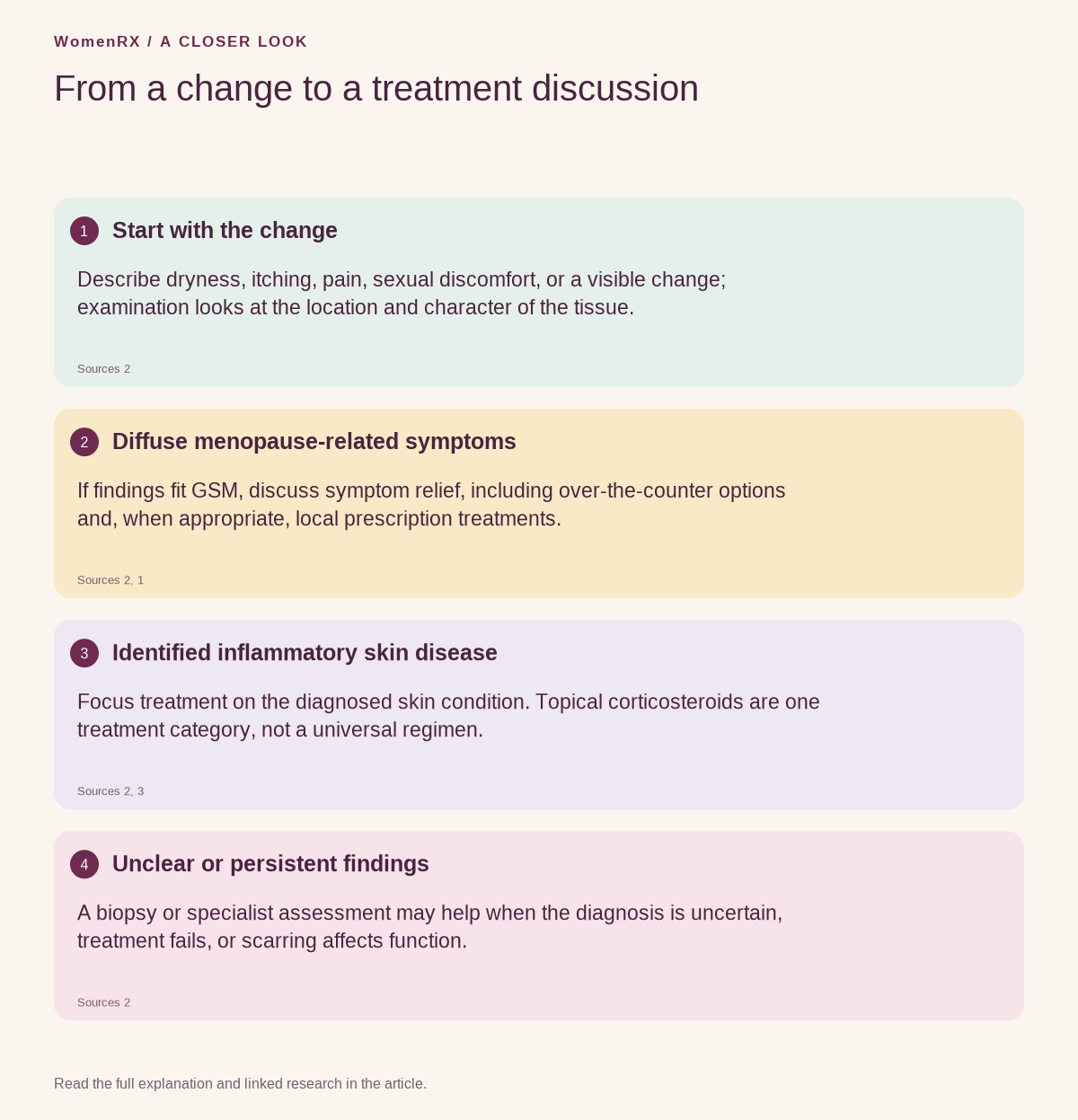
From a change to a treatment discussion
Start with the change: Describe dryness, itching, pain, sexual discomfort, or a visible change; examination looks at the location and character of the tissue.2
Diffuse menopause-related symptoms: If findings fit GSM, discuss symptom relief, including over-the-counter options and, when appropriate, local prescription treatments.21
Identified inflammatory skin disease: Focus treatment on the diagnosed skin condition. Topical corticosteroids are one treatment category, not a universal regimen.23
Unclear or persistent findings: A biopsy or specialist assessment may help when the diagnosis is uncertain, treatment fails, or scarring affects function.2
Read the figure as text
The same symptom can lead to different options once the tissue and likely cause are assessed.- Start with the change: Describe dryness, itching, pain, sexual discomfort, or a visible change; examination looks at the location and character of the tissue.2
- Diffuse menopause-related symptoms: If findings fit GSM, discuss symptom relief, including over-the-counter options and, when appropriate, local prescription treatments.21
- Identified inflammatory skin disease: Focus treatment on the diagnosed skin condition. Topical corticosteroids are one treatment category, not a universal regimen.23
- Unclear or persistent findings: A biopsy or specialist assessment may help when the diagnosis is uncertain, treatment fails, or scarring affects function.2
More questions, answered
Does a change near the clitoris mean I need estrogen?
No. Estrogen may be discussed when symptoms fit menopause-related GSM, but a localized skin change or scarring needs assessment for other causes. The treatment choice follows the diagnosis and the symptom you want to improve.21
Why might someone mention a steroid instead of estrogen?
Topical corticosteroids are among treatments used for inflammatory vulvar skin conditions, while vaginal estrogen is an option for menopause-related vulvar and vaginal symptoms. They address different suspected causes; neither should be chosen from the word “atrophy” alone.312
Sources you can check
- The 2022 hormone therapy position statement of The North American Menopause Society.“The 2022 Hormone Therapy Position Statement of The North American Menopause Society” Advisory Panel. · Menopause (New York, N.Y.) · 2022Return to first citation
- A Practical Management Approach to Vulvar Dermatoses and Genitourinary Syndrome of Menopause.Negris O, Ghafari-Saravi A, Mauskar MM. · Obstetrics and gynecology · 2026Return to first citation
- The impact of anxiety on vulvar dermatological diseases: a systematic review.Sharifi S, Katamanin O, Moraga R, Flood KS, Ezenwa E. · International journal of women's dermatology · 2026Return to first citation
- Clinical spectrum and quality of life burden of vulvar lichenoid dermatoses: a cross-sectional study of 1177 patients.Liu T, Zhang Y, Sun K, Shao Y, Yang K, Yang M, Chang J. · Clinical and experimental dermatology · 2026Return to first citation
- Vulvar Crohn's-Case Series and Review of Treatment With Ustekinumab.Conlin EM, Elas DE, Bartolo-Costello AA, Stockdale CK. · Journal of lower genital tract disease · 2026Return to first citation
- ESTRACE (ESTRADIOL) CREAM [ALLERGAN, INC.] | US prescribing information and patient instructionsAccessed 2026-09-25Return to first citation