Vulvar Lichen Sclerosus: What Diagnosis and Care Involve
It can affect children and adults, and knowing what to describe and ask can help you leave with a clearer care plan.
Vulvar lichen sclerosus can cause itchy patches and discomfort. Describe the changes to a clinician rather than trying to diagnose them from appearance alone. A biopsy removes tissue for examination under a microscope; if one is proposed, ask what it would clarify. 1 2 Treatment commonly uses a prescription steroid ointment such as clobetasol propionate. Ask for clear application instructions and a follow-up plan. 1 3
Changes worth describing
Lichen sclerosus affects people of all ages, including children, though it’s more common in women over 50. It often affects genital skin. Patches may be itchy and white; skin of any color can be affected. Pain with urination or sex can also be a reason to seek care, particularly if you’ve already been diagnosed and symptoms continue. 1
When you make an appointment, describe where the skin has changed, what it looks or feels like, and whether symptoms are affecting urination or sex. If you’re asking on behalf of a child, say when the change began and what discomfort you’ve noticed. These details give the clinician a useful picture without asking you to diagnose the condition yourself.
Ask how the diagnosis is being assessed
An examination can provide information about vulvar skin changes. In one small review of girls with vulvar lichen sclerosus, 11 were diagnosed visually and four by biopsy. That pediatric experience doesn’t establish when an adult needs a biopsy. A biopsy removes tissue for examination under a microscope. In a retrospective study of women with lichen sclerosus associated with variable degrees of squamous cell hyperplasia, the authors recommended biopsy when patients did not have symptomatic relief, to exclude atypical components. That recommendation concerns the study’s particular group, not everyone with a persistent symptom or a visible change. 5 2 4
Ask what the clinician sees and what supports their assessment. If a biopsy is proposed, ask what question it is meant to answer and how the result could affect your care. You might also ask: “If we start treatment, what changes should lead us to revisit the plan?”
Get precise instructions for the ointment
A strong prescription steroid ointment is usual treatment, and clobetasol propionate is a standard option. It can take regular use over a few months to bring symptoms under control. In a small randomized trial of premenopausal women with previously untreated, biopsy-confirmed lichen sclerosus, clobetasol performed better than topical progesterone for the clinician-rated severity score after 12 weeks. That study supports clobetasol as a treatment option; it doesn’t set a personal schedule for you. 1 3
Before you leave, ask the prescriber or pharmacist to explain exactly where to apply the ointment, how often to use it, and for how long before the plan is reviewed. Ask what to do if you’re unsure you’ve applied it correctly or symptoms change. Follow the directions for your prescription rather than guessing at the amount or frequency.
Treatment can ease symptoms, but scarring and tightness can still occur over time. These changes can affect the vulva and may cause discomfort with urination, bowel movements, or sex. 1
Ask what follow-up fits your situation
Ask your clinician whether and when they recommend checking in, and what to do if itching, pain, or visible changes persist or worsen. If treatment isn’t helping, or sex or urination remains painful, let them know rather than assuming the diagnosis or plan is settled. 1
Lichen sclerosus is associated with a low risk of vulvar cancer. The NHS advises regular self-checks and seeking care if you’re worried. Ask what changes your clinician wants you to watch for; a concerning change is a reason to get it checked, not a reason to assume it is cancer. 1
Skin symptoms and sexual wellbeing don’t always improve in lockstep. In a small study of women treated for lichen sclerosus, sexual distress remained significant after 12 weeks even when the skin disease was adequately treated. If discomfort or changes in sex persist, say so; it’s a relevant part of care, not a side issue. 6
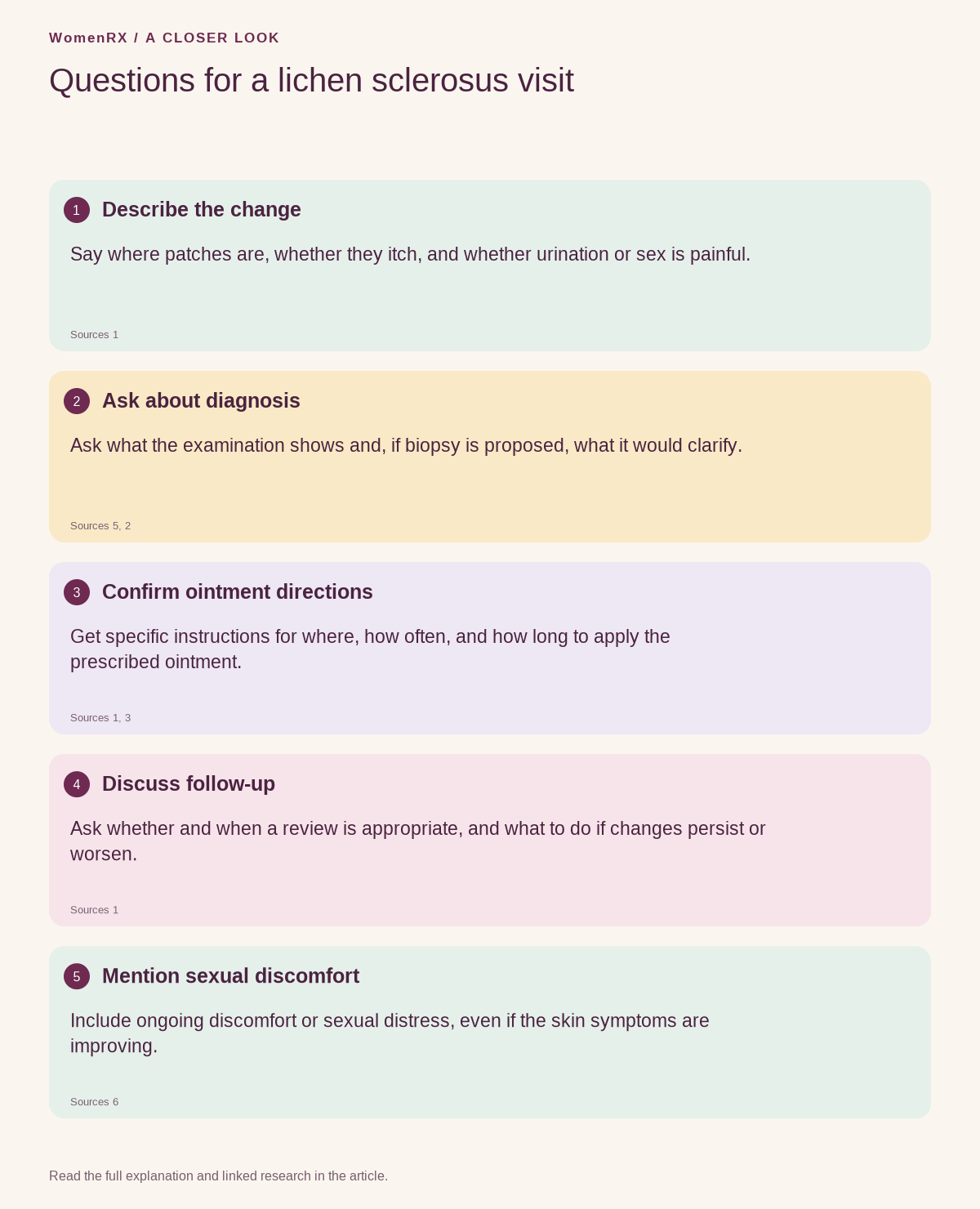
Questions for a lichen sclerosus visit
Describe the change: Say where patches are, whether they itch, and whether urination or sex is painful.1
Ask about diagnosis: Ask what the examination shows and, if biopsy is proposed, what it would clarify.52
Confirm ointment directions: Get specific instructions for where, how often, and how long to apply the prescribed ointment.13
Discuss follow-up: Ask whether and when a review is appropriate, and what to do if changes persist or worsen.1
Mention sexual discomfort: Include ongoing discomfort or sexual distress, even if the skin symptoms are improving.6
Read the figure as text
Use these prompts to describe symptoms, understand the assessment, and leave with clear treatment directions and a plan for what to do next.- Describe the change: Say where patches are, whether they itch, and whether urination or sex is painful.1
- Ask about diagnosis: Ask what the examination shows and, if biopsy is proposed, what it would clarify.52
- Confirm ointment directions: Get specific instructions for where, how often, and how long to apply the prescribed ointment.13
- Discuss follow-up: Ask whether and when a review is appropriate, and what to do if changes persist or worsen.1
- Mention sexual discomfort: Include ongoing discomfort or sexual distress, even if the skin symptoms are improving.6
More questions, answered
Does vulvar lichen sclerosus only happen after menopause?
No. It can affect children and adults, although it’s more common in women over 50. 1
Does treatment mean I no longer need to pay attention to changes?
Treatment can help symptoms, but skin may scar or tighten, and lichen sclerosus is linked to a low risk of vulvar cancer. The NHS advises regular self-checks and seeking care if you’re worried. Ask your clinician whether and when they recommend a review for you. 1
Sources you can check
- Lichen sclerosus - NHSAccessed 2026-09-25Return to first citation
- Biopsy: MedlinePlusAccessed 2026-09-25Return to first citation
- Efficacy of topical progesterone versus topical clobetasol propionate in patients with vulvar Lichen sclerosus - A double-blind randomized phase II pilot study.Günthert AR, Limacher A, Beltraminelli H, Krause E, Mueller MD, Trelle S, Bobos P, Jüni P. · European journal of obstetrics, gynecology, and reproductive biology · 2022Return to first citation
- Testosterone versus clobetasol for maintenance of vulvar lichen sclerosus associated with variable degrees of squamous cell hyperplasia.Ayhan A, Guven ES, Guven S, Sakinci M, Dogan NU, Kucukali T. · Acta obstetricia et gynecologica Scandinavica · 2007Return to first citation
- Clobetasol propionate in the treatment of premenarchal vulvar lichen sclerosus.Smith YR, Quint EH. · Obstetrics and gynecology · 2001Return to first citation
- The treatment of vulvar lichen sclerosus and female sexual dysfunction.Burrows LJ, Creasey A, Goldstein AT. · The journal of sexual medicine · 2011Return to first citation