Primary Ovarian Insufficiency: What Evaluation and Care Involve
Irregular or missed periods before 40 deserve evaluation, but symptoms alone can’t confirm POI; a focused assessment can clarify the diagnosis and help shape care around your health and pregnancy goals.
Primary ovarian insufficiency (POI) means the ovaries aren’t functioning normally before age 40. Irregular or missed periods can be an early sign, but diagnosis relies on evaluation and an elevated FSH level; the updated international guideline says one FSH result above 25 IU is enough when the picture is clear. If it’s uncertain, repeat FSH testing and/or AMH may help. POI can affect bone and cardiovascular health, and fertility needs its own discussion. 1 2
What a change in your periods can, and can’t, tell you
POI is a loss of normal ovarian function before age 40. Irregular or missed periods are common first signs; some people also have symptoms associated with lower estrogen, or seek care because they’re having difficulty getting pregnant. But a period change or a symptom by itself doesn’t establish POI. The evaluation matters. 1
POI also isn’t exactly the same as menopause. Ovarian function can be intermittent: periods may occasionally return, and pregnancy can still happen. That possibility doesn’t mean ovarian function has returned to normal or that pregnancy is predictable. 1
What the evaluation may involve
Expect to discuss your menstrual pattern, symptoms, health history, and whether POI runs in your family. A pregnancy test may be part of the evaluation. A clinician may also use blood testing and, in some cases, pelvic ultrasound to look at the ovaries. Ultrasound can contribute information, but it isn’t the same as the blood-test finding used in the updated diagnostic guidance. 1 2
The updated international POI guideline says a single FSH result above 25 IU is sufficient to diagnose POI when the clinical picture is clear. If there’s uncertainty, repeat FSH testing and/or an anti-Müllerian hormone (AMH) test may help clarify it. 2
A practical question to take to the visit is: “What finding supports POI in my case, and is anything still uncertain?” You can also ask what the ultrasound or each blood test is meant to clarify. Those questions can help distinguish the diagnostic evidence from tests that add context. 1 2
Separate symptom care from long-term health
Treatment discussions aren’t only about periods or hot flashes. POI can affect quality of life and is associated with concerns about bone, cardiovascular, cognitive, and sexual health. The guideline supports considering these areas as part of care, while also acknowledging that evidence is limited for many management options. 2
Hormone therapy is considered to help manage effects of POI, not to restore normal ovarian function. That distinction matters when discussing symptoms associated with lower estrogen and bone health: low estrogen in POI raises osteoporosis risk, while hormone therapy can mitigate some effects of the condition. Ask what a proposed treatment is intended to address, what uncertainties apply to you, and how your needs will be revisited over time. Menopause treatment findings in older populations shouldn’t automatically be treated as POI-specific guidance. 1 2
For bone health, ask how your individual risk should be assessed and what steps are appropriate for you. MedlinePlus identifies osteoporosis as a concern when estrogen is low and lists physical activity and a healthy body weight among measures that may help lower bone and heart-disease risk. It also mentions calcium and vitamin D; whether supplements make sense for you is a question to individualize rather than a reason to start a regimen on your own. 1
Give fertility its own conversation
Hormone therapy and fertility care answer different questions. The POI guideline addresses fertility as a separate part of management, and MedlinePlus notes that IVF may be considered for someone with POI who wants to become pregnant. Neither source suggests that hormone therapy restores normal ovarian function. Because occasional ovarian activity and pregnancy can still occur, discuss your pregnancy goals directly rather than treating a return of bleeding as a reliable sign of fertility. 1 2
If pregnancy is a goal, ask what options fit your situation and what can, and can’t, be predicted about your chances. If pregnancy isn’t a goal, you can still ask how POI affects your health and what care is intended to address those effects. The two conversations belong together, but one doesn’t replace the other. 1 2
A focused set of questions for your visit
- What findings support or argue against POI in my case?
- Is the FSH result clear, or would repeat testing or AMH help?
- What aspects of bone and cardiovascular health should we assess?
- If hormone therapy is being considered, what is its purpose for me, and what evidence limits apply?
- How should my care change if I want to become pregnant, or if I don’t?
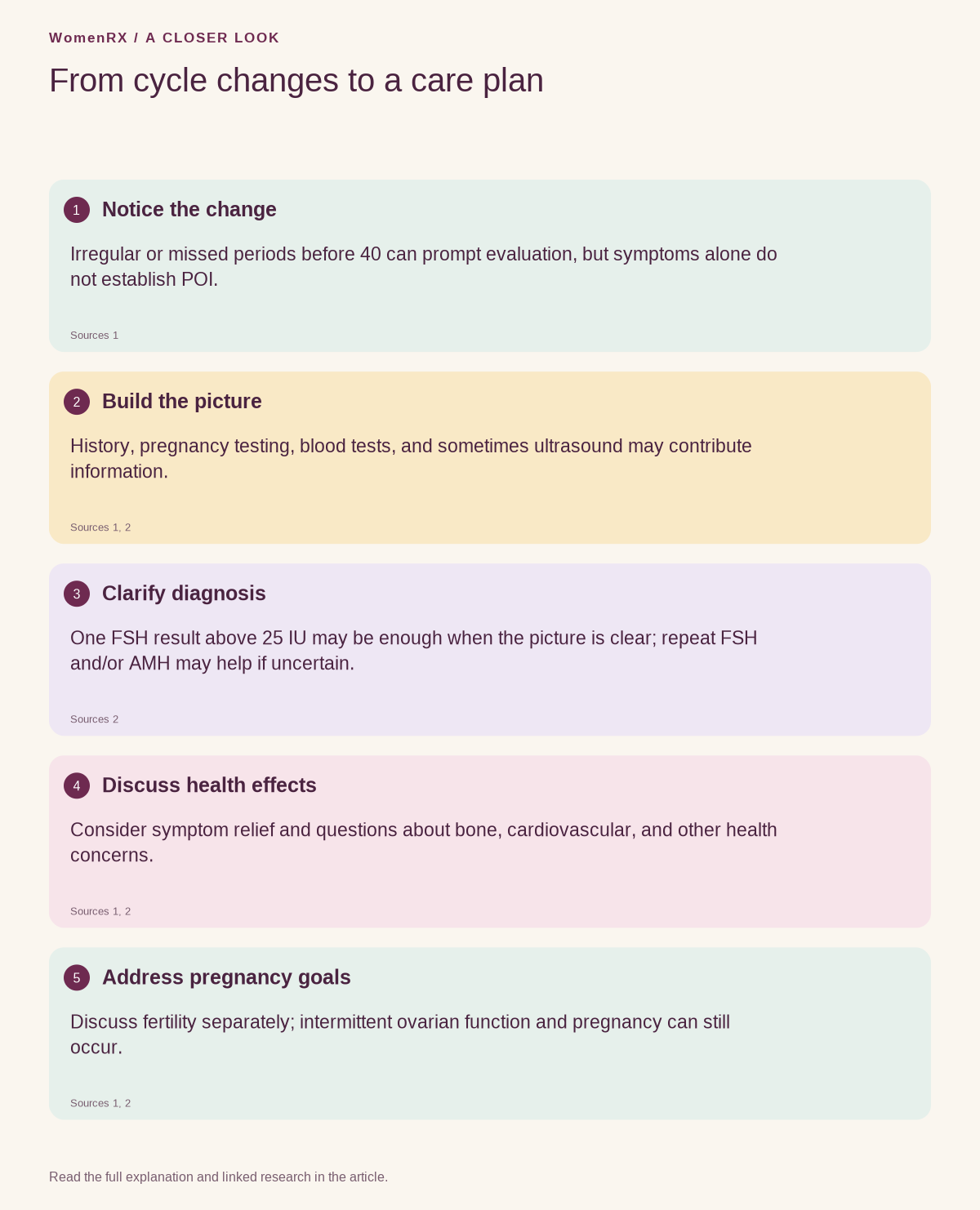
From cycle changes to a care plan
Notice the change: Irregular or missed periods before 40 can prompt evaluation, but symptoms alone do not establish POI.1
Build the picture: History, pregnancy testing, blood tests, and sometimes ultrasound may contribute information.12
Clarify diagnosis: One FSH result above 25 IU may be enough when the picture is clear; repeat FSH and/or AMH may help if uncertain.2
Discuss health effects: Consider symptom relief and questions about bone, cardiovascular, and other health concerns.12
Address pregnancy goals: Discuss fertility separately; intermittent ovarian function and pregnancy can still occur.12
Read the figure as text
This flow separates signs that prompt evaluation from diagnostic testing and the distinct conversations about health and fertility.- Notice the change: Irregular or missed periods before 40 can prompt evaluation, but symptoms alone do not establish POI.1
- Build the picture: History, pregnancy testing, blood tests, and sometimes ultrasound may contribute information.12
- Clarify diagnosis: One FSH result above 25 IU may be enough when the picture is clear; repeat FSH and/or AMH may help if uncertain.2
- Discuss health effects: Consider symptom relief and questions about bone, cardiovascular, and other health concerns.12
- Address pregnancy goals: Discuss fertility separately; intermittent ovarian function and pregnancy can still occur.12
More questions, answered
Does a period returning mean POI has gone away?
Not necessarily. POI can involve intermittent ovarian function, so occasional periods or pregnancy can occur without showing that ovarian function has returned to normal. 1
Can hormone therapy restore fertility?
The available guidance describes hormone therapy as a way to mitigate some effects of POI, not as a proven way to restore normal ovarian function. Fertility goals should be discussed separately. 1 2
Sources you can check
- Primary Ovarian Insufficiency | POI | MedlinePlusAccessed 2026-09-25Return to first citation
- Evidence-based guideline: premature ovarian insufficiency†‡.ESHRE, ASRM, CREWHIRL and IMS Guideline Group on POI, Panay N, Anderson RA, Bennie A, Cedars M, Davies M, Ee C, Gravholt CH, Kalantaridou S, Kallen A, Kim KQ, Misrahi M, Mousa A, N... · Climacteric : the journal of the International Menopause Society · 2024Return to first citation