Clitoral Atrophy: What Does the Term Mean, and When to Seek Care?
“Clitoral atrophy” isn’t, by itself, a confirmed diagnosis; an assessment can clarify whether there’s a skin condition, scarring, or another change.
“Clitoral atrophy” isn’t, by itself, a confirmed diagnosis. The phrase doesn’t tell you which tissue has changed or why. It may prompt questions about distinct findings, such as thinning vulvar skin or scarring that affects the clitoral hood. Conditions including lichen sclerosus can cause those changes, but age or hormonal stage alone can’t establish the cause. 3
What the phrase can, and can’t, tell you
The words alone don’t specify whether there is thinning of the skin, scarring, or a change in the clitoral hood. Those are different findings, and they don’t point to one cause.
For example, vulvar lichen sclerosus is an inflammatory skin condition that can cause thinning, pale or irritated skin, fissures, and scarring. Over time, scarring may fuse the clitoral hood or change the labia. Some people have itching, burning, soreness, or pain with sex; others have few symptoms. Lichen sclerosus can occur from childhood through postmenopause, so age alone doesn’t confirm or rule it out. 3
Labial fusion is another distinct change: tissue along the labia minora adheres in the midline. It may occur in postmenopausal people, but that finding is not the same as a diagnosis of clitoral atrophy. 5
A visible change isn’t a diagnosis
A clinician considers what the skin looks and feels like, where the change is, and whether there are symptoms. Lichen sclerosus is usually diagnosed from the clinical assessment; a biopsy may be considered when the diagnosis is unclear, a change raises concern, or treatment hasn’t worked. 3
Symptoms such as itching or soreness aren’t specific to lichen sclerosus. In a small study of girls with the condition, the authors noted that vulvar symptoms and age of onset are nonspecific and require differentiation from other skin conditions. That study involved children, so it does not establish how common those alternatives are in adults. 1
When to arrange an assessment
Book an appointment if you notice a persistent change in the clitoral hood or labia, or ongoing itching, burning, soreness, skin splitting, or pain with sex. A clinician can assess the area and decide whether the finding fits a skin condition or another explanation. Earlier assessment can matter: in a retrospective series of 15 children with genital lichen sclerosus, some already had scarring or other lasting anatomic changes when diagnosed. That small pediatric series cannot estimate risk for adults, but it illustrates why persistent changes deserve attention. 2
A new or changing dark or irregularly pigmented spot on the vulva should also be examined. A case report describes melanoma in situ in a changing pigmented lesion on the clitoral hood and labia; one case cannot tell us how likely melanoma is, but it shows why a changing lesion shouldn’t be assumed to be atrophy or dismissed based on appearance alone. 4
What to say at the appointment
You don’t need to know the right diagnosis before booking. Describe what changed, where you see it, whether it is progressing, and any symptoms such as itching, soreness, skin splitting, or pain. If you were told you have “clitoral atrophy,” ask what specific finding that phrase refers to and what cause is being considered. That turns a broad label into a question the examination can answer.
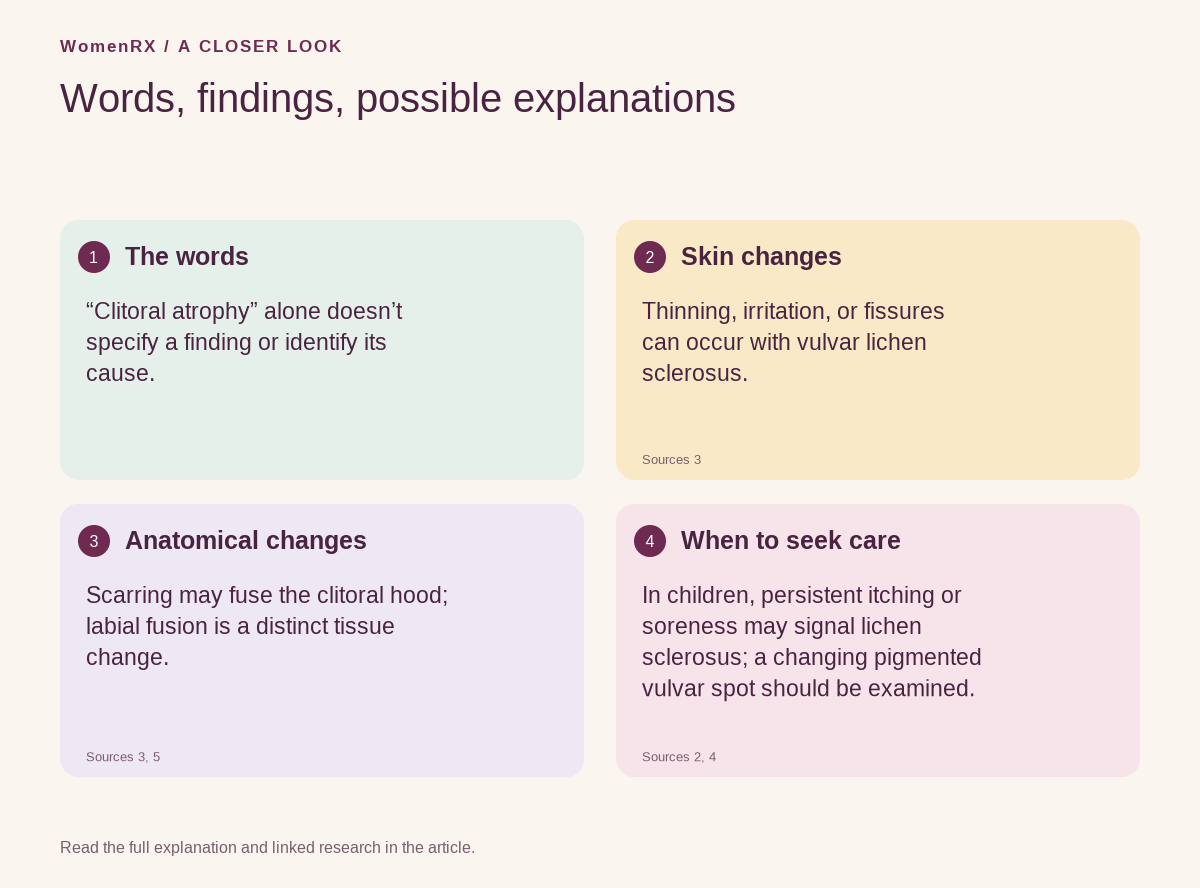
Words, findings, possible explanations
The words: “Clitoral atrophy” alone doesn’t specify a finding or identify its cause.
Skin changes: Thinning, irritation, or fissures can occur with vulvar lichen sclerosus.3
Anatomical changes: Scarring may fuse the clitoral hood; labial fusion is a distinct tissue change.35
When to seek care: In children, persistent itching or soreness may signal lichen sclerosus; a changing pigmented vulvar spot should be examined.24
Read the figure as text
The phrase alone doesn’t identify what has changed. This evidence map separates possible findings from conditions an assessment may consider.- The words: “Clitoral atrophy” alone doesn’t specify a finding or identify its cause.
- Skin changes: Thinning, irritation, or fissures can occur with vulvar lichen sclerosus.3
- Anatomical changes: Scarring may fuse the clitoral hood; labial fusion is a distinct tissue change.35
- When to seek care: In children, persistent itching or soreness may signal lichen sclerosus; a changing pigmented vulvar spot should be examined.24
More questions, answered
Does menopause cause clitoral atrophy?
Menopause or age alone can’t establish the cause of a clitoral or vulvar change. Some vulvar conditions occur in postmenopause, and low-estrogen tissue changes can be relevant to labial fusion, but that doesn’t mean every change around the clitoris is hormonal. 3 5
Does a clitoral hood that is hard to retract mean atrophy?
Not by itself. Fusion or scarring of the clitoral hood can occur with vulvar lichen sclerosus, but the finding needs an examination to identify its cause. 3
Sources you can check
- The Need of Differential Diagnosis Between Vulvar Lichen Sclerosus and Autoimmune Dermatoses in Adolescent Girls.Dulska A, Bodziony J, Janik M, Drosdzol-Cop A. · Dermatology and therapy · 2024Return to first citation
- Genital lichen sclerosus in childhood and adolescence-a retrospective case series of 15 patients: early diagnosis is crucial to avoid long-term sequelae.Nerantzoulis I, Grigoriadis T, Michala L. · European journal of pediatrics · 2017Return to first citation
- Vulvar Lichen Sclerosus.Bonham A. · Obstetrics and gynecology · 2026Return to first citation
- Early diagnosis of genital mucosal melanoma: how good are our dermoscopic criteria?Rogers T, Pulitzer M, Marino ML, Marghoob AA, Zivanovic O, Marchetti MA. · Dermatology practical & conceptual · 2016Return to first citation
- Labial AdhesionsSabir S, Anand S, Mendez MD. · 2025Return to first citation