Possible Signs of Perimenopause and When to Seek Care
Changes in your periods, especially alongside new hot flashes or night sweats, can point toward perimenopause, but some bleeding patterns need a separate check.
Periods that arrive more or less often, become heavier or lighter, or skip months can be signs of perimenopause, especially if hot flashes or night sweats are new too. No single symptom confirms it, and pregnancy is still possible. Note the pattern rather than one unusual day, and arrange a check for bleeding that disrupts your life, occurs between periods or after sex, or returns after 12 months without a period. 721
Start with what has changed for you
One late period may catch your attention. What tells you more is whether your usual pattern is changing: periods might come closer together, spread farther apart, or become heavier or lighter as you approach menopause. Hot flashes, night sweats, sleep disruption, and changes in mood or concentration may happen alongside those cycle changes. Some people have few symptoms; others find them hard to live with. 7
Perimenopause is a transition, not a diagnosis made from one symptom. Hormones vary during this time rather than simply dropping in a straight line, which helps explain why changes may feel uneven. A hot flash can feel like sudden heat in the face, neck, or chest, sometimes with sweating or a noticeable heartbeat. Night sweats can also interrupt sleep, and poor sleep may leave you feeling less focused or more irritable the next day. 47
Low mood deserves attention in its own right, not just a label of “hormones.” A review of prospective studies found a higher risk of depressive symptoms or diagnosis during perimenopause than before it, but that finding cannot tell you what is causing your mood change. 3
What else could change the picture?
A missed period is not proof that you cannot get pregnant. Pregnancy remains possible during perimenopause, so bring up that possibility if it applies to you rather than assuming the transition explains a missed period. 7
Your medical history matters too. Hormonal contraception can make bleeding irregular, stop it, or produce scheduled bleeding that does not show what your natural cycle is doing. Menopause can happen earlier after surgery to remove the ovaries or because of medical treatment. If you have had a hysterectomy, you cannot use the timing of periods to judge the transition; symptoms such as hot flashes become more relevant. 756
Heavier bleeding may happen as menopause approaches, but it is not automatically because of perimenopause. Fibroids, adenomyosis, endometriosis, some medicines, and other conditions can also contribute to heavy periods. That is why the amount and timing of bleeding matter as much as whether your cycle has become irregular. 2
A short record that is worth bringing in
You do not need a perfect diary. A calendar note can show what has changed from your usual pattern and make a conversation about symptoms more specific. For example, you could record:
- Bleeding: The first day of each period, whether bleeding was lighter or heavier than usual, how long it lasted, and any spotting between periods or after sex.
- How heavy it felt: Whether you bled through clothes or bedding, needed to change a pad or tampon every one to two hours, or missed activities because of bleeding. These are useful descriptions of heavy periods, not a score you have to calculate. 2
- Other changes: When hot flashes or night sweats happened, whether sleep was interrupted, and any mood or concentration changes that affected your day. 7
- Context: Whether pregnancy could be possible, and any hormonal contraception, hormone treatment, or relevant reproductive surgery. These details change how a clinician interprets periods and symptoms. 75
FSH and estradiol are hormone names you may hear, but a routine blood test is not required to recognize perimenopause. A clinician may consider FSH testing in some people aged 40 to 45 with symptoms and cycle changes; hormonal contraception can also make testing or cycle-based interpretation difficult. The useful first step is to describe what is happening, not to try to prove the transition with a single hormone result. 65
When bleeding needs its own check
Arrange a clinical check if heavy periods are affecting daily life, you have severe period pain, or you bleed between periods or after sex. Frequent product changes, bleeding through clothing or bedding, and feeling tired or short of breath are details worth mentioning. Heavy bleeding can have several causes, and an assessment may include checking for iron deficiency anemia. 2
There is a different rule once you have gone 12 months without a period and are not using hormonal contraception: any new vaginal bleeding needs checking, even a single episode of spotting or pink or brown discharge. Most postmenopausal bleeding is not serious, but it can sometimes signal cancer, so it should not be filed away as another irregular period. 61
If your symptoms are disrupting sleep, work, relationships, or how you feel day to day, you can ask about them before your periods stop. You do not need to wait for a full year without bleeding to discuss what has changed. 7
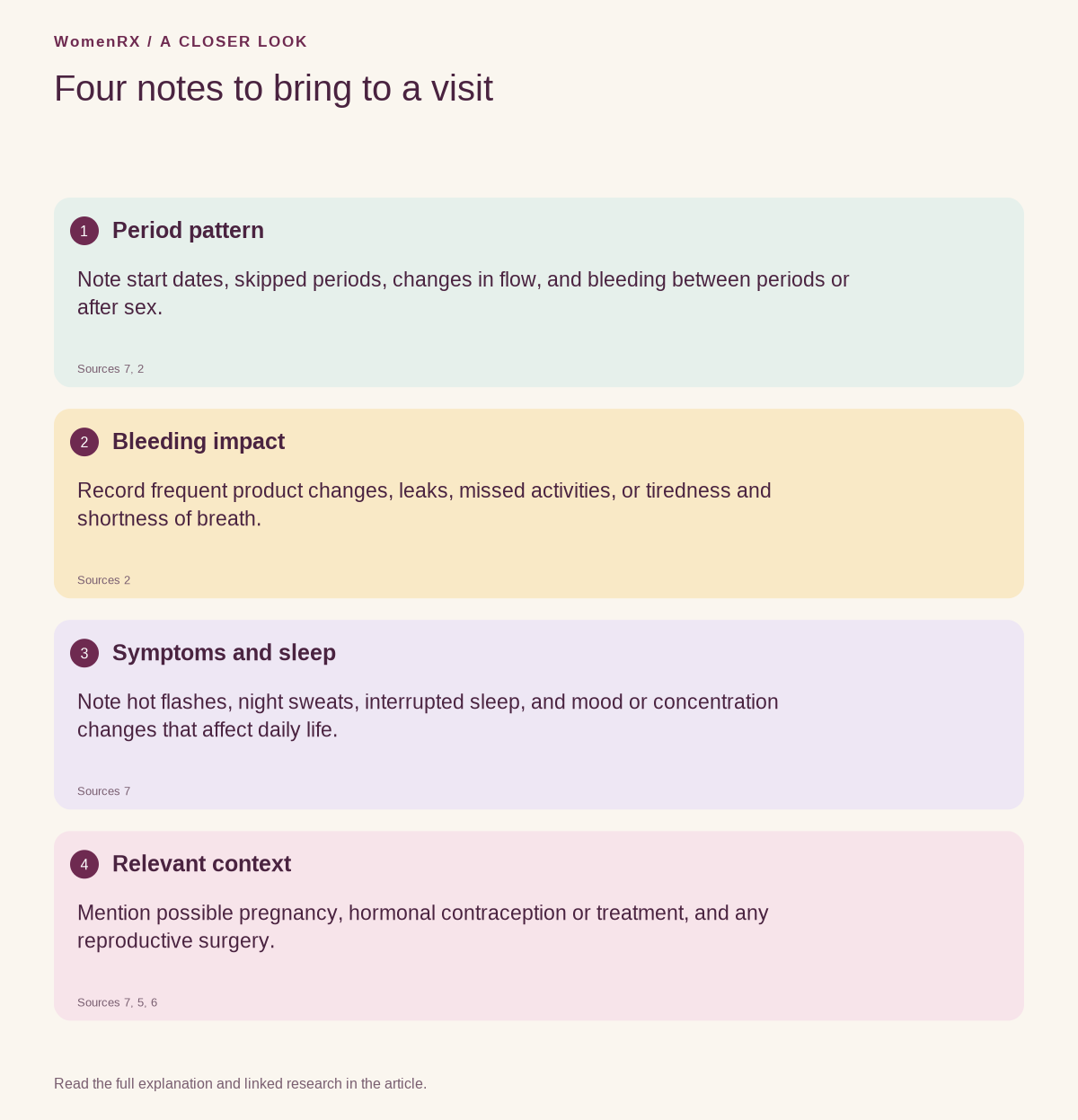
Four notes to bring to a visit
Period pattern: Note start dates, skipped periods, changes in flow, and bleeding between periods or after sex.72
Bleeding impact: Record frequent product changes, leaks, missed activities, or tiredness and shortness of breath.2
Symptoms and sleep: Note hot flashes, night sweats, interrupted sleep, and mood or concentration changes that affect daily life.7
Relevant context: Mention possible pregnancy, hormonal contraception or treatment, and any reproductive surgery.756
Read the figure as text
A brief record gives your clinician the pattern, its impact, and the context needed to interpret it. It is not a diagnostic score.- Period pattern: Note start dates, skipped periods, changes in flow, and bleeding between periods or after sex.72
- Bleeding impact: Record frequent product changes, leaks, missed activities, or tiredness and shortness of breath.2
- Symptoms and sleep: Note hot flashes, night sweats, interrupted sleep, and mood or concentration changes that affect daily life.7
- Relevant context: Mention possible pregnancy, hormonal contraception or treatment, and any reproductive surgery.756
Sources you can check
- Postmenopausal bleeding - NHSAccessed 2026-09-25Return to first citation
- Heavy periods - NHSAccessed 2026-09-25Return to first citation
- The risk of depression in the menopausal stages: A systematic review and meta-analysis.Badawy Y, Spector A, Li Z, Desai R. · Journal of affective disorders · 2024Return to first citation
- Metabolic Changes of Perimenopause and Nutritional Advice.Bonnes SLR, Nordhues H, Sood R, Kulick D, Muratore A, Bischof E. · Current nutrition reports · 2026Return to first citation
- Recommendations | Menopause: identification and management | Guidance | NICEAccessed 2026-09-25Return to first citation
- What are menopause and perimenopause? - NHSAccessed 2026-09-25Return to first citation
- Symptoms of menopause and perimenopause - NHSAccessed 2026-09-25Return to first citation